
-Dec-03-2025-09-33-55-4739-AM.png "LANDING PAGE (6)-Dec-03-2025-09-33-55-4739-AM")
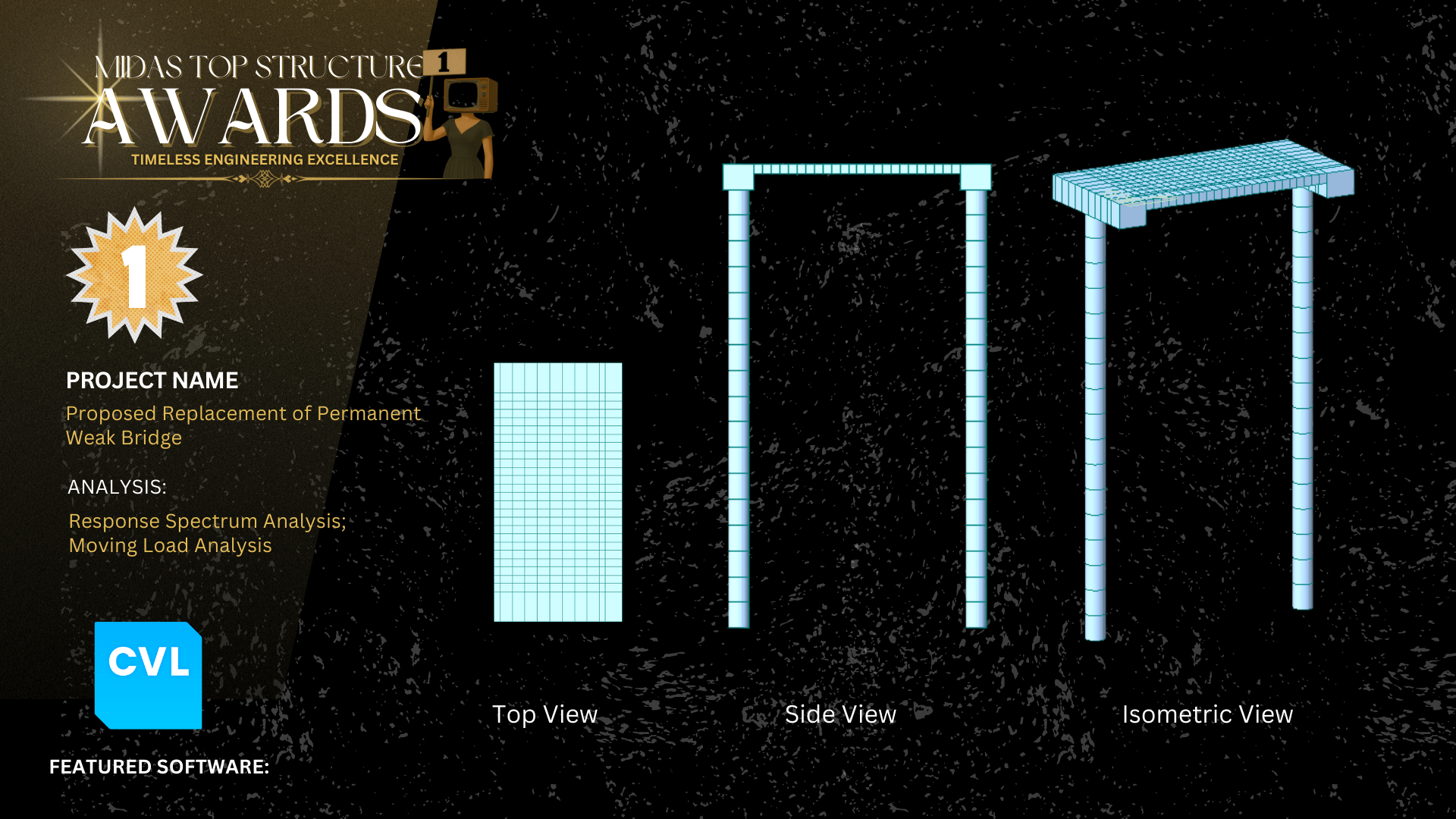
The existing bridge is a four-lane, ~10 m span along a busy national road, so full closure is not feasible. Replacement will be done in two phases, maintaining traffic by building one carriageway at a time with a two-lane setup per phase. A flat-slab superstructure was selected to maximize vertical clearance and is monolithically connected to the coping beam for effective moment transfer and optimized slab thickness. Both abutments are supported on bored piles extending up to 25.5 m below ground.
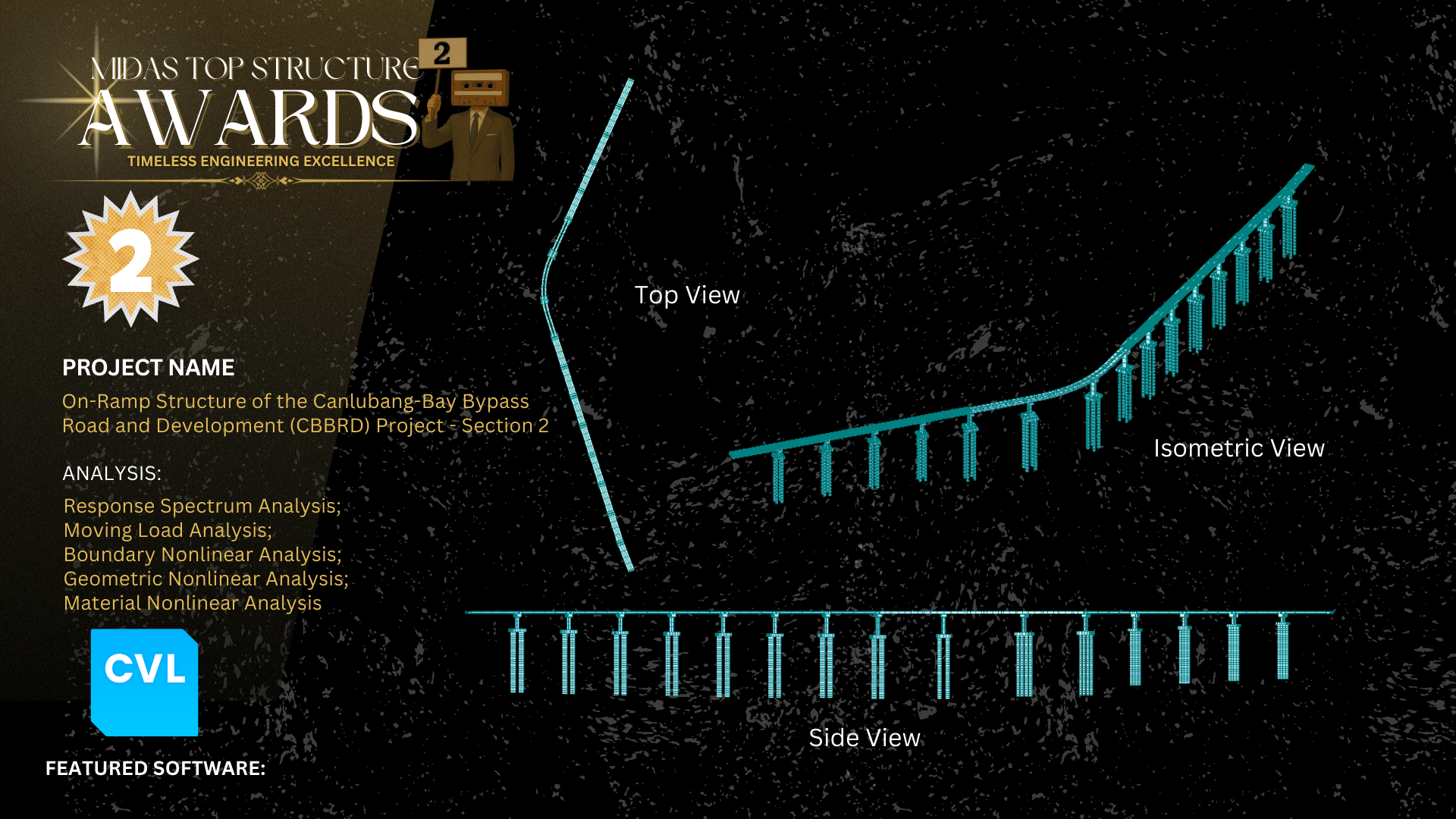
The Canlubang–Bay Bypass Road and Development (CBBRD) Project is an 18 km toll expressway along Laguna Lake, linking Calamba’s Canlubang Industrial Estate to Bay, Laguna. It is divided into three sections: two onshore embankments and an offshore segment with a viaduct and cable-stayed bridge.
This submission covers Section 2’s on-ramp connecting the viaduct approach to the main alignment, using AASHTO prestressed concrete girders and a curved steel box girder to suit the ramp’s curvature and grade changes. MIDAS Civil was used for 3D analysis and design, including load combinations and curved-girder behavior, to deliver a safe, durable, and buildable ramp.

This is a pedestrian bridge that would pass over the new Motorway (expressway) expansion that would connect residential areas and the local Hospital.

The high skew integral bridge is a single span measuring 23.5m in length and 50m in width. It is positioned above the current roadway and can accommodate medium to heavy load vehicles. The analyses utilised include Static and Response Spectrum Analysis, Moving Load Analysis, Settlement Analysis, and Construction Stage Analysis.

The model consists of a combination of 1-D and 2-D elements with multiple nodal boundaries to determine the most critical live load pattern as well as the most critical location in the box girder when a standard HL-93 load is placed upon the deck using Influence surface together with transverse lane optimization. Transverse analysis was performed to design the right amount of transverse prestressing to support the 4-meter cantilevered slab.
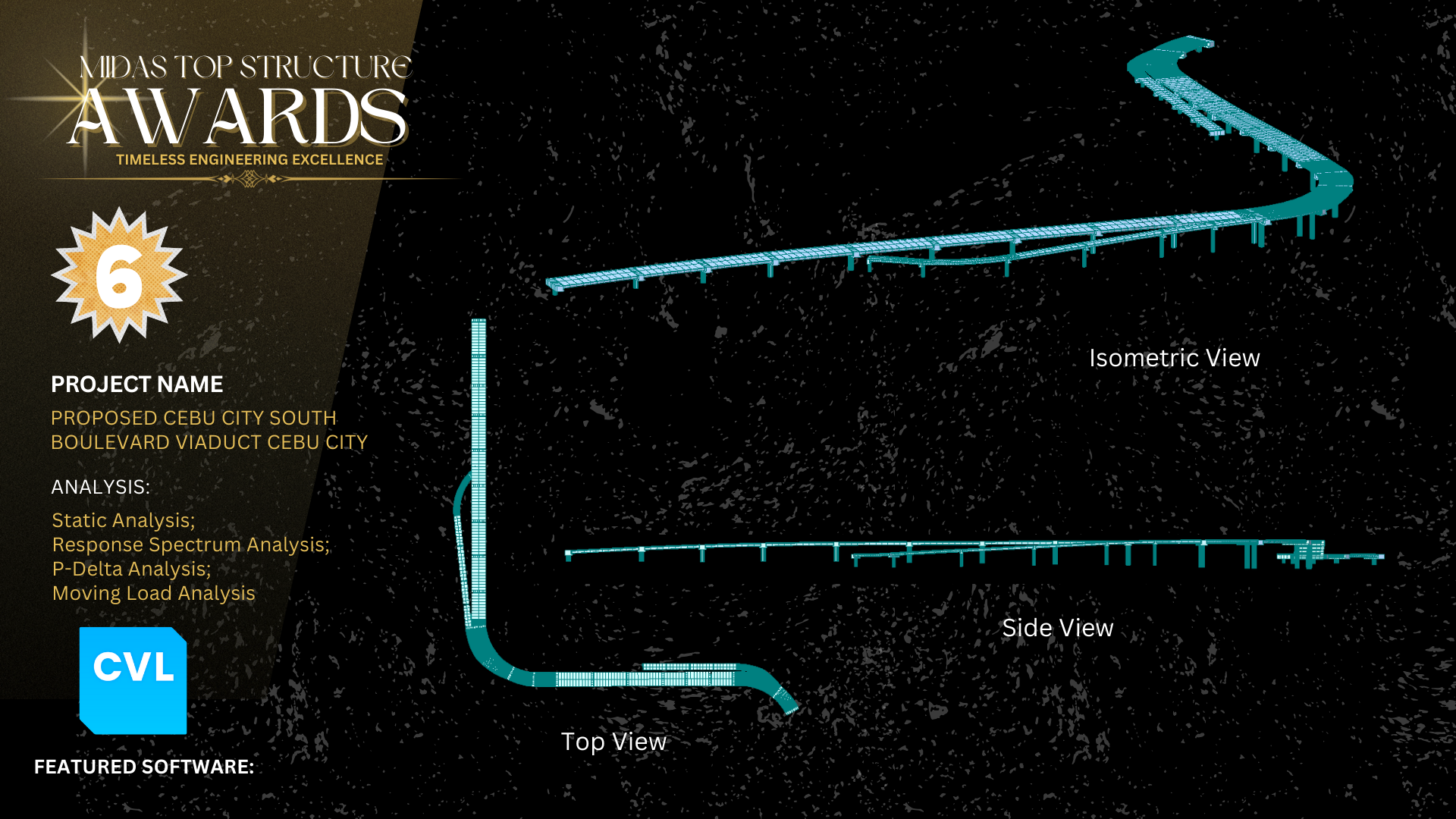
This 1.24 km viaduct connects major Philippine roads and uses prestressed concrete box girders: 5-cell PSCBG for the main viaduct and 2-cell PSCBG for the ramps. Curved segments and long pier spacing (40 m, 50 m, and 60 m) made box girders the preferred system due to their higher torsional stiffness and span efficiency versus I-girders.
In the model, straight segments used 5 m element sizes and curved sections used 0.5 m for better accuracy. Prestressing tendons were explicitly modeled, and elastomeric bearing pads were simulated using elastic links between girder bottoms and coping beams, which are supported by pier columns. Overall, the model demonstrates the software’s standard section library, bridge geometry modeling, and tendon modeling capabilities.
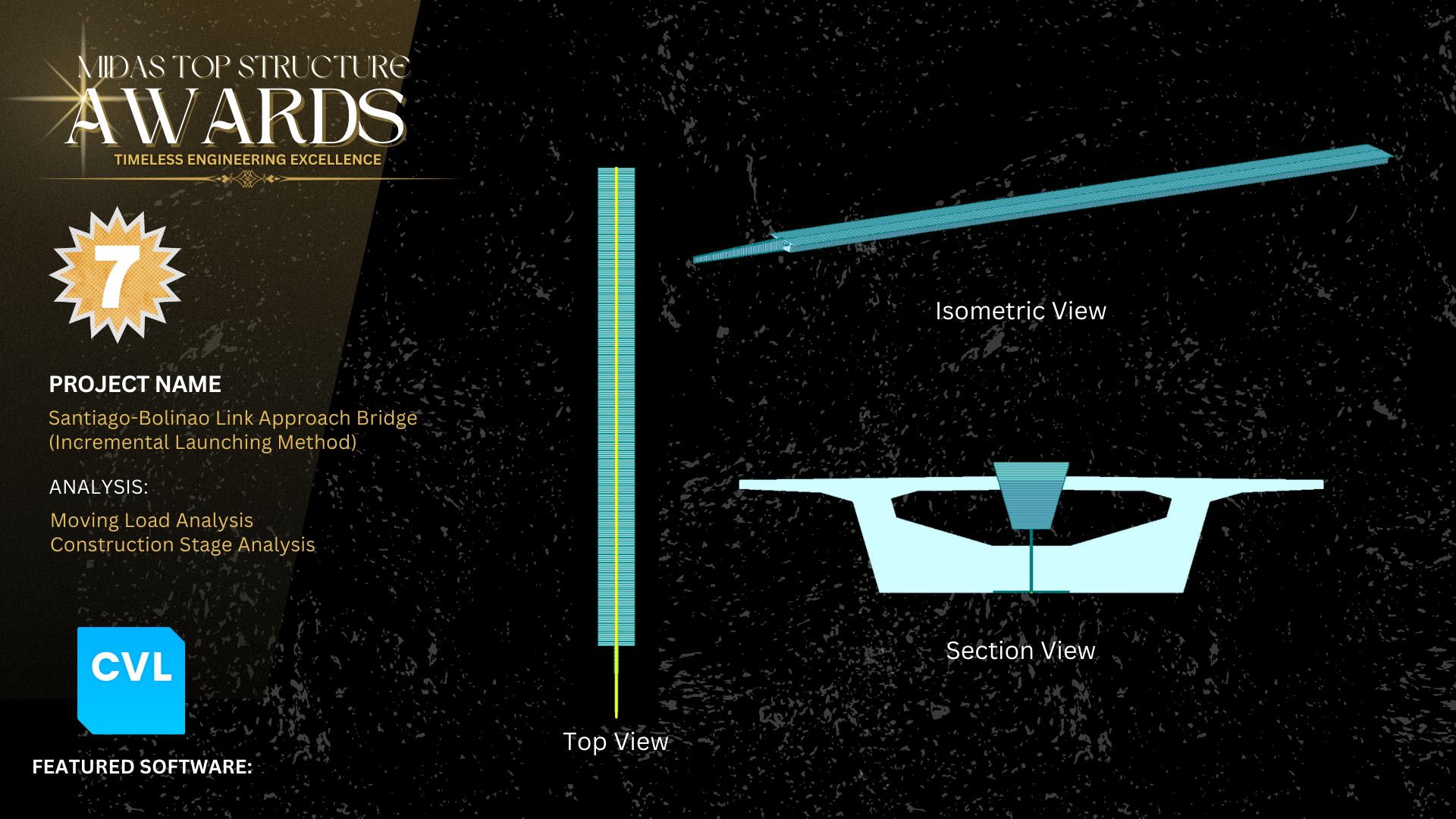
The model covers the analysis and design of a 200 m, four-span approach bridge linking Santiago Island to Bolinao Island. The 15.40 m-wide deck carries two traffic lanes and two bicycle lanes. Using MIDAS Civil wizards, the bridge was modeled for incremental launching with precast segments from a casting yard, including segment geometry, launching nose, tendons, and time-dependent concrete behavior, with construction stages and temporary supports generated automatically. The model checks launching and final service responses under static loads, HL-93/Tandem traffic loads, and response spectrum seismic analysis to confirm compliance with DPWH DGCS requirements.
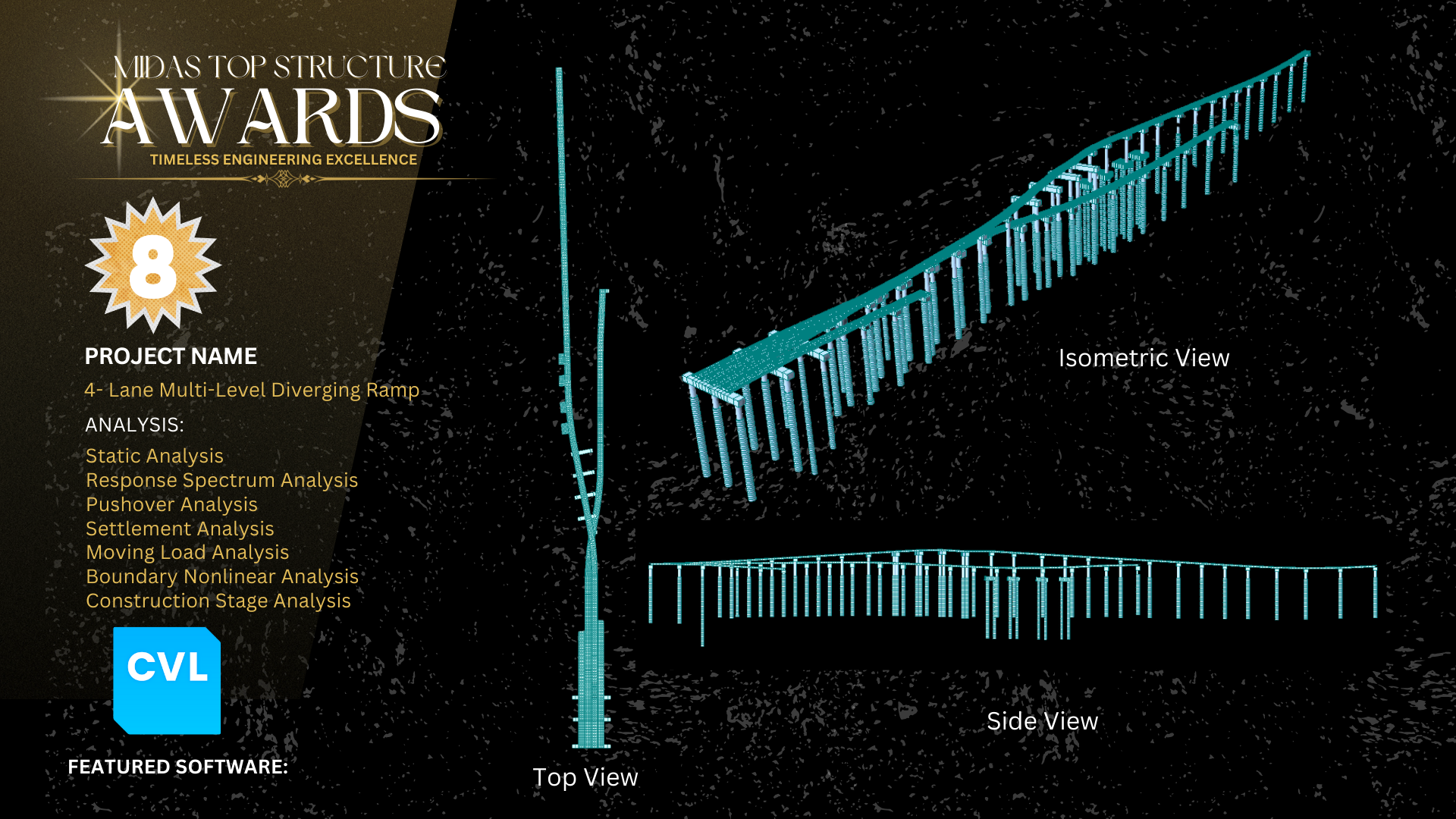
This 4-lane, multi-level ramp serves as a diversion route along major Metro Manila roads, designed under tight right-of-way constraints and varying ramp set-outs and elevations. The first three piers of the four ramps share a common substructure, requiring a converged substructure model alongside individual ramp models for design and analysis.
MIDAS Civil NX was used to generate and update the model, with MIDAS API applied to handle frequent revisions in road alignment and profile. River-site ground behavior was also considered through nonlinear soil springs (P–Y curves) and settlement checks. The model included key structural checks such as static, response spectrum, moving load, construction stage, and pushover analyses to assess seismic performance of both the tallest and shortest piers.