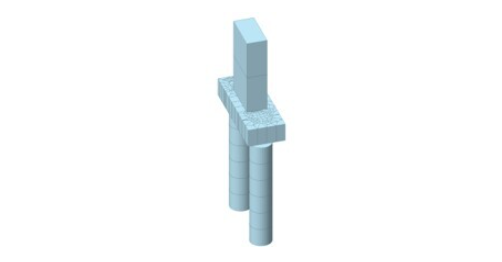
 Step 1
Model the pile in your bridge model
Global modeling allows modeling of the super/sub structure and foundation in the same model.
Civil NX builds LPile-style p-y springs directly from your borelogs - it's included in your Civil NX license.
Response spectrum analysis can't run with nonlinear springs. So you run it, read the displacements, update every spring by hand, and run it again - several rounds to converge one case, repeated for every load case.
Civil NX now runs that loop for you. You set a tolerance, click run, and it recalculates secant stiffness from the p-y curve until the change falls inside it.
In this hour we build p-y springs from borelogs, run the iterative response spectrum analysis live, and check the converged stiffness against a hand iteration, step for step.
Already in Civil NX. No add-on module, no separate license.
From the pile you're already modeling to a spring you can run any analysis on.
Step 1
Global modeling allows modeling of the super/sub structure and foundation in the same model.
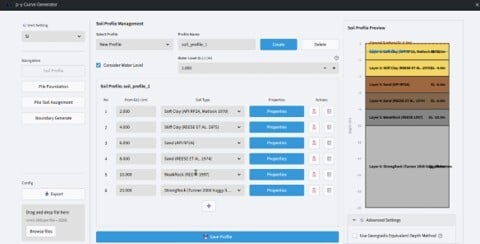 Step 2
Borelog data becomes a P-Y curve for every node → nonlinear p-y springs, generated automatically, without a separate LPile step.
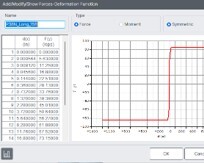 Step 3
Each curve becomes a force-deformation function you can use in any analysis.
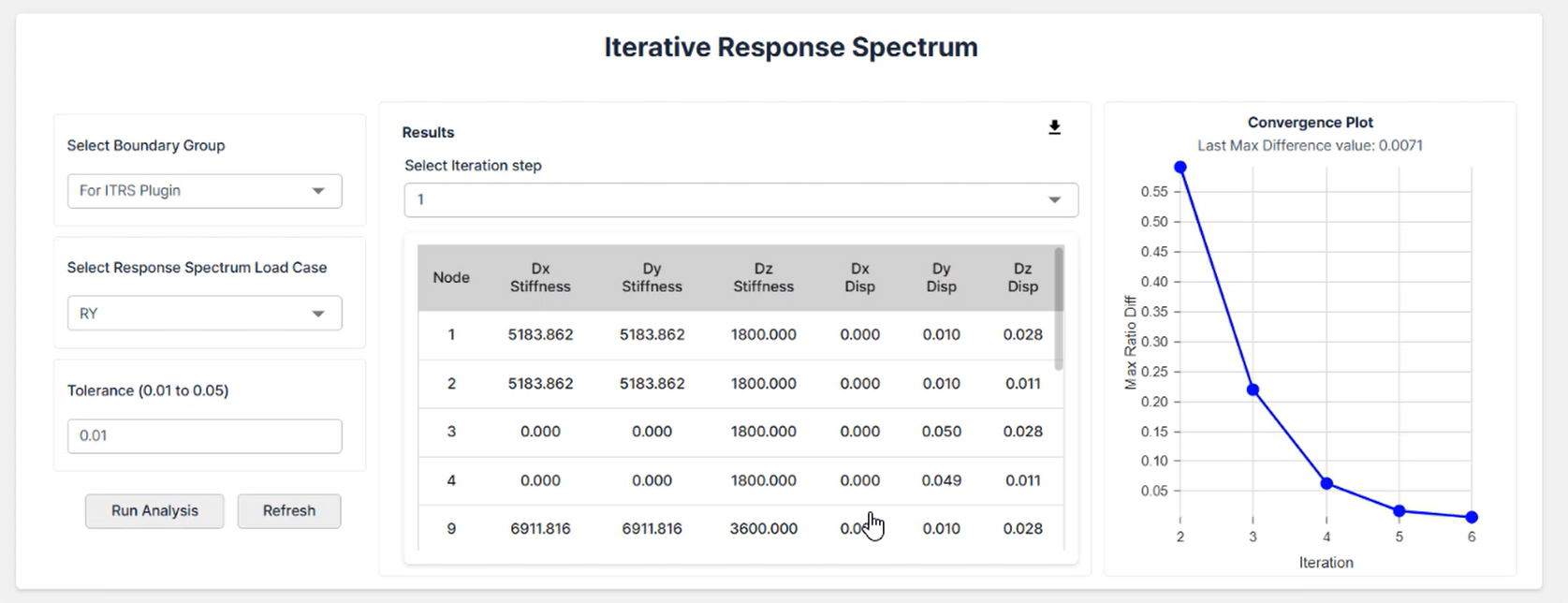
The same springs update their secant stiffness automatically, iteration by iteration, until they land inside your tolerance.
By the end of the hour you'll be able to set up and defend an automatically converged response spectrum analysis in your own model.
Civil NX processes point springs, extracts displacement results, and updates stiffness iteratively until convergence - then hands you the full history to compare.
Point springs are read and processed directly from the model, so nothing has to be exported, edited, and imported back.
Stiffness values update iteratively until they converge on your tolerance. You start the run once instead of restarting it five times.
Displacements come straight out of the analysis and drive the next stiffness value - no copying numbers between windows.
Track how each spring's stiffness moved across iterations. That trace is what you hand a reviewer asking how the value was reached.

Dev holds a Master's degree in Structural Engineering from SVNIT Surat and brings valuable experience from working on a wide range of bridge and building projects. His background includes both design and on-site execution, giving him a well-rounded perspective of structural systems. Dev is particularly enthusiastic about addressing complex engineering challenges and enhancing structural safety and efficiency.
50 minutes of presentation and live demo, then 10 minutes of open Q&A. Times are in EST.
Learn how Civil NX builds nonlinear p-y soil springs and runs iterative response spectrum analysis automatically.
