Multi-span bridges composed of simple-span precast girders with continuous deck and diaphragms at interior supports have been a popular solution since the 1960s. State DOTs have employed various details and design methodologies. Understanding the details and designs of the continuity connections is critical for successfully modeling this type of bridge.
According to the AASHTO WSDOT Questionnaire: Prestressed Girder Design Criteria (2013) and a survey conducted by the author, the details and designs of continuity connections can be grouped into two categories.
Category #1: Design a series of simple spans for all loads. The slab (with or without diaphragms at interior supports) is continuous over the interior supports but ignored in girder design.

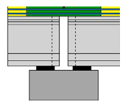
It is noted that Midas Civil always internally considers the partial fixities as pinned conditions. Since the deck acts more like a hinge, it does not carry a significant flexural stiffness. When Midas Civil Pre/Post-Tensioned Composite Girder Bridge Wizard is used to build a model, given continuous checkbox unchecked, Midas internally introduces hinges at all internal support locations, by means of beam end release, such that moments and shears get modeled for simple span for all dead loads and live loads.
Category #2: Design as simple for the non-composite dead load (girder & slab weight), continuous for the composite dead load (railings & FWS), and live load. And there are two sub-cases. Sub-case 1 replaces temporary supports with permanent supports over the pier. The disadvantage of this method is that it needs additional temporary supports or more cranes during construction, which could be difficult and costly when crossing rivers or traffic. Hence, it is usually implemented in post-tensioned continuity connections. Sub-case 2 connections are common in practice. Current AASHTO Specification falls into this type as it is an easy construction method. However, the continuity connections' behavior and load transfer mechanism make the bridges behave differently from analysis assuming idealized pin or roller supports. Some conventional modeling approaches treat double bearings as single bearings for simplicity, and the results tend to be conservative. System transformation is realized by setting the deactivation of temporary bearings and activation of permanent bearings.

Figure 2-1 Category #2 sub-case 1: single bearing

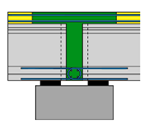
Figure 2-2 Category #2 sub-case 2: double bearings
Since slab concrete is usually poured before continuity connections, the weight of the wet concrete slab is the non-composite dead load. Midas Civil Pre/Post-Tensioned Composite Girder Bridge Wizard internally considers wet slab concrete as a non-composite dead load when a continuous checkbox is checked. Specifically, the Wizard assigns a dummy material with a weight density of zero to the concrete slab. Wet Concrete Load, a distributed load equivalent to the weight of the wet slab concrete, is applied to the model in the non-composite stage. Wet Concrete Load is deactivated when the simple spans are made continuous.

You can check more of these details in the download file.
Time-Dependent Effects and Restraint Moments
Conservative Design Approaches
Case Study: Eliminating Pier Deck Joints
/Yanling%20Leng%20346_240.png)
Yanling is an expert in bridge design/load rating, inspection, rehabilitation, and forensic analysis. She has comprehensive knowledge, skills, and experience in the bridge life cycle. Yanling’s work has been informed by her research into bridge safety and maintenance, focusing on the refined safety evaluation of bridge structures. She is a prolific author of peer-reviewed articles and has a passion for teaching and mentoring. She lectures Bridge Aesthetics at the Hebei Academy of Fine Arts, delivers STEM experiences to young children by leading a First Lego Explore League team, and presents STEM lecture series at an elementary school. Yanling is also named a MIDAS Top Expert Engineer. She has received multiple outstanding awards, including ENR’s National Top 20 Under 40 Award in 2023.