
1. Introduction
Long span cable bridges, including suspension and cable-stayed bridges, exhibit significant deflection in reinforcement girders. This article aims to explore design approaches and cases within design codes relevant to such structures.
2. Review of Design Codes
2.1 Vertical Displacement Regulation
The investigation into design codes reveals no specific regulation for allowable drooping in cable bridges over 200 meters. Examples include:
|
Classify |
Related content |
||
|
South Korea |
Design Standards for Road Bridges (2005) 3.2.3 |
Permissible value of active load deflection of bridges less than 200 m: suspension bridge L/350, long-distance bridge L/400 (L: light channel) |
|
|
Guidelines for the Design of Cable Steel Bridges (2006) 5.3 |
The allowable defelction of a bridge exceeding 200 m in distance shall be reviewed in consideration of the behavioral characteristics of the bridge. |
||
|
Design Criteria for Road Bridges (Limit State Design Method) - Cable Bridge |
For a cable bridge, it is difficult to uniformly define the allowable deflection due to the large difference in behavior depending on the span length and the structure type. The characteristics of the bridge, including reverse gradient to drainage, disturbance of seager, or damage to the pavement locally, should be sufficiently reviewed. |
||
|
Japan |
Honshu Shikoku Kyokubashi Kodan Corporation Design Code |
For bridges with spans exceeding 200 meters, deflection should be reviewed considering the bridge's structural form. |
|
|
U.S. |
AASHTO LRFD |
No specific acceptable deflection criteria for cable bridges |
|
|
Europe |
Eurocode |
Reviewing the allowable deflection of the bridge by fully considering the facility limit, damage to the pavement, and reverse gradient of drainage |
|
2.2 Horizontal Displacement Regulation
There is no specific regulation for horizontal displacement of cable bridges. The amplitude of reinforcement girders during windfall is determined using usability regulations.
|
Classify |
Related content |
|
|
Design Criteria for Road Bridges (Limit State Design Method) - Cable Bridge |
The maximum horizontal and vertical acceleration from the bridge reinforcement girder to the lane by the wind load shall not exceed 0.5 m/s2 for the single amplitude below the vehicle traffic limit wind speed. |
|
3. Case Study
3.1 Vertical Deflection
In the case of suspension bridges, it is in the range of 1/200 to 1/400, and in the case of cable-stayed bridges, it is in the range of 1/450 to 1/1,150.
|
Classify |
Main span Length (m) |
Vertical Deflection (m) |
ratio |
||
|
Suspension Bridge |
Yi Sun-sin Bridge |
1,545 |
3.88 |
1/399 |
|
|
Golden Gate |
1,280 |
3.29 |
1/389 |
||
|
Ulsan Bridge |
1,150 |
3.40 |
1/338 |
||
|
Minami Bisan Seto (南備讚瀨戶大橋) |
1,100 |
3.02 |
1/364 |
||
|
Forth Road |
1,005 |
4.11 |
1/245 |
||
|
Kita Bisan-Seto (北備讚瀨戶大橋) |
990 |
2.60 |
1/381 |
||
|
Shimotsui-Seto (下津井瀨戶大橋) |
940 |
2.43 |
1/387 |
||
|
Ohnaruto(大鳴門橋) |
876 |
2.90 |
1/302 |
||
|
Palyeong Bridge |
850 |
2.53 |
1/336 |
||
|
Innoshima(因島大橋) |
770 |
2.33 |
1/330 |
||
|
Kanmon Straight(關門橋) |
712 |
2.44 |
1/292 |
||
|
Ohshima(大島大橋) |
560 |
1.81 |
1/309 |
||
|
Gwangan Bridge |
500 |
2.25 |
1/222 |
||
|
Cable-stayed Bridge |
Meiko-Nishiobashi Bridge (名港西大橋) |
405 |
0.75 |
1/540 |
|
|
Iwakuro Island Bridge(岩黑島橋) |
420 |
0.93 |
1/452 |
||
|
Dongyi 1 Bridge (Jeogseong-Jeongog) |
400 |
0.48 |
1/838 |
||
|
Myodo Bridge (Yeosu Industrial Complex No. 1) |
430 |
0.38 |
1/1131 |
||
Vertical Deflection Standards in Suspension Bridges:
In practice, designs often exceed the standard allowable range of L/350 for vertical deflection in suspension bridges. This is evident in case studies of certain bridges such as Minami, Kita Bisan Seto, and Shimotsui Seto, which have a height of 13 meters due to being parallel to road rails. Similarly, the Golden Gate Bridge, with its truss-type reinforcement girder height of 7.6 meters, demonstrates minimal vertical deflection attributable to the girder's flexural rigidity. Consequently, in designing long suspension bridges, it seems more practical to allow a degree of sagging that adheres to the allowable stress and usability standards, rather than strictly following the L/350 vertical sagging regulation in road bridge design standards.
Standard for Vertical Deflection in Cable-Stayed Bridges:
Cable-stayed bridges typically adhere to the allowable deflection standard of L/400 as specified in road bridge design standards. These bridges, being less flexible compared to suspension bridges, do not exhibit significant vertical sagging.
3.2 Horiaontal Displacement
To design according to usability criteria of cable steel bridge design guidelines, the horizontal maximum acceleration shall not exceed 0.5 m/s2, so the horizontal displacement of the reinforcing girder may be obtained by reverse calculation.
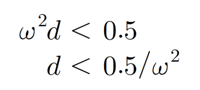 where d : maximum amplitude, ω : natural frequency
∙ The design results of Ulsan Bridge are as follows.
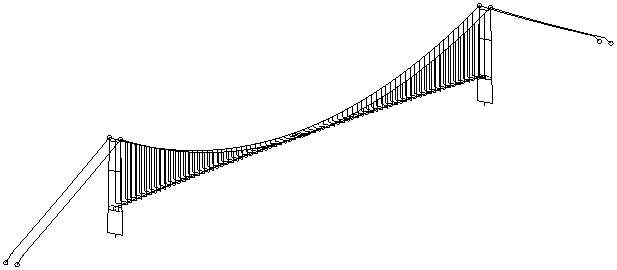 Structural Analysis Model
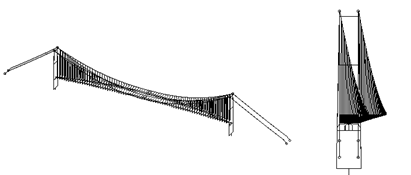 Mode Shape (1st Mode, Period : 18.18sec Frequency : 0.55Hz)
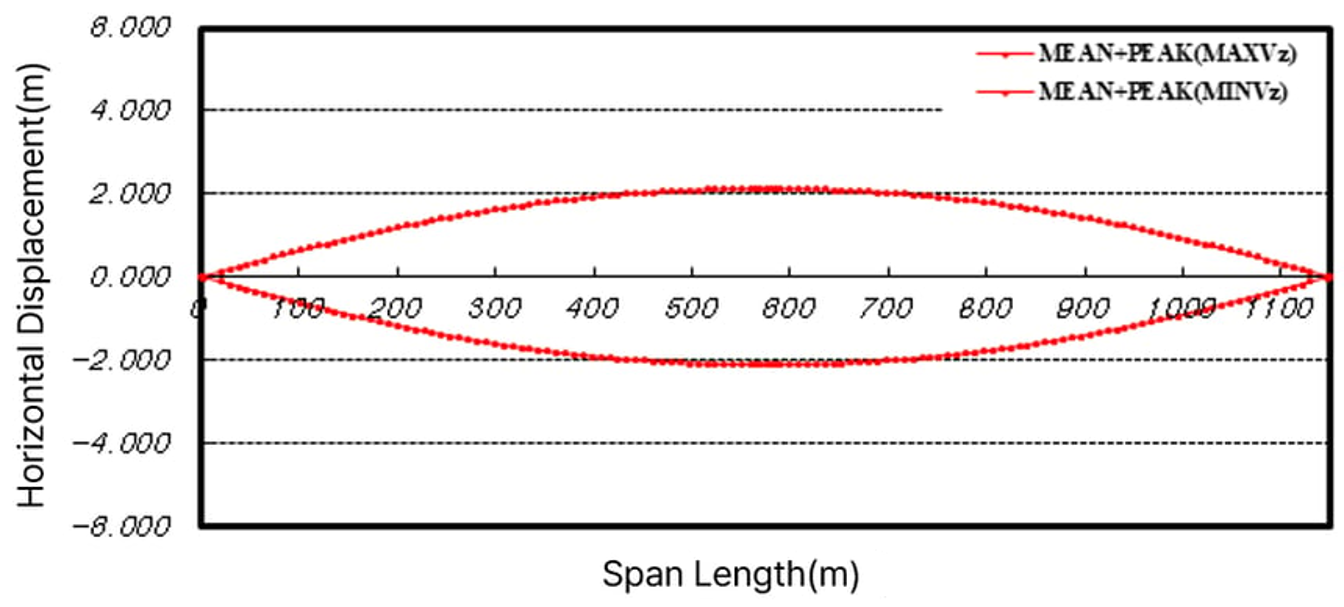 Horizontal Displacement (Wind Speed : 25m/s)
|
Period (sec) |
Frequency (Hz) |
ω (rad/sec) |
Allowable Amplitude (m) |
Design Amplitude (m) |
|
|
18.18 |
0.055 |
0.346 |
4.19 |
2.12 |
|
∙ Horizontal displacement occurring within the allowable tensile stress and bridge vibration within the allowable amplitude based on usability criteria are considered to be okay.
4. Conclusion
In road bridge design standards, there are deflection regulations for cable bridges with spans of 200 meters or less. However, for long-span cable bridges, variations in behavior due to span length and structural form make it difficult to establish a uniform definition for allowable deflection.
Notably, cable-stayed bridges, with their higher rigidity in reinforcing girders, typically meet the L/400 deflection standard. However, suspension bridges, characterized by their flexibility, often struggle to comply with the L/350 standard. This divergence highlights the need for a tailored approach in bridge design, especially for longer spans.
Therefore, designing long span cable bridges requires a nuanced understanding that goes beyond standard limitations. It demands adherence to both the allowable stress and usability standards, including factors like potential cracking. Crucially, a comprehensive evaluation of displacement is necessary, factoring in the constraints of drainage facilities, seagar, and deflection equipment.

I have spent 20 years working exclusively in bridge design at an engineering firm in South Korea. I primarily handled the design of cable bridges such as arch bridges and suspension bridges, and frequently used analysis programs like MIDAS Civil and RM Bridge.
I hope my content can provide at least some assistance to my seniors and juniors in the civil engineering field.
※ Click on any keyword under 'Topics' to explore related content.