
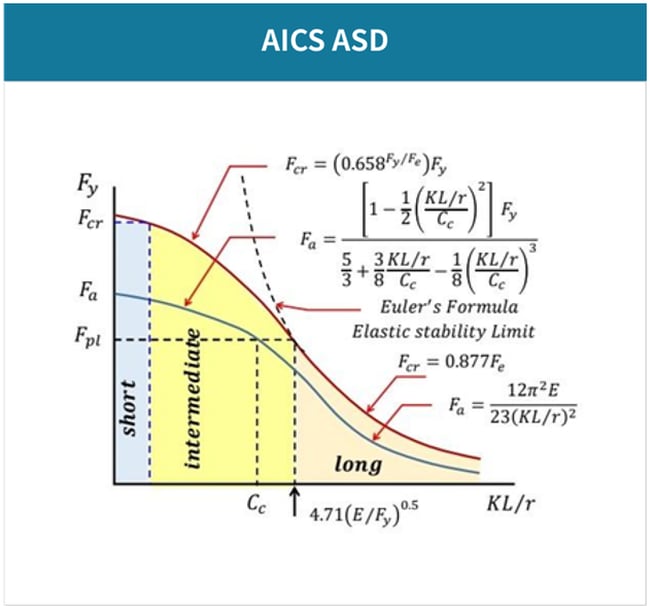
Long column that are longer than the size of the members in a member subjected to compressive force are mainly broken by buckling and this effect is called the slenderness effect.
This is referred to as the critical slenderness ratio (KL/r), which distinguishes between short columns and long columns. If the member is smaller than the critical slenderness ratio, compression failure occurs, and if it is larger than the critical slenderness ratio, it is destroyed by buckling.
Reflecting on this phenomenon, AISC has classified short columns and long columns based on the critical slenderness ratio and calculated the allowable compressive stress. When examining the provided formula for calculating allowable compressive stress, it is crucial to accurately consider the slenderness ratio coefficient and incorporate it into the design.
In this content, besides the method of categorizing into the existing six types, we aim to introduce the Alignment Chart method, which is commonly used.
Effective Length Factor
When analyzing frames or designing structural components, such as column members, subjected to compression in structural design, the member experiencing compression considers the Effective Length Factor (K-Factor) to calculate the Effective Length (Le). This calculation is essential in determining the buckling strength.
Euler Buckling Stress
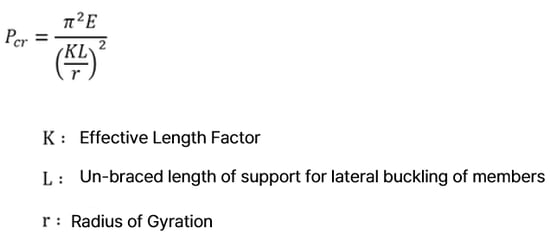
The load at which a column begins to buckle is referred to as the buckling load (critical load), and this is also known as the Euler buckling stress according to the following formula. Therefore, the accurate determination of the buckling stress requires the calculation of the slenderness ratio coefficient.
Effective Length, Le
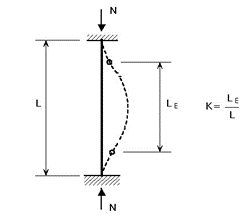
Effective Length (Le) is the length that represents the effective distance at which the structural system as a whole collapses due to yielding and buckling behavior. It is determined by virtually extending the individual members or the member axis at the point of collapse, where the bending moment becomes zero.
In other words, the effective length is the length at which a hinge point (moment = 0) occurs on the internal or virtual extension line of the member, and the length of this hinge point is considered the effective length.
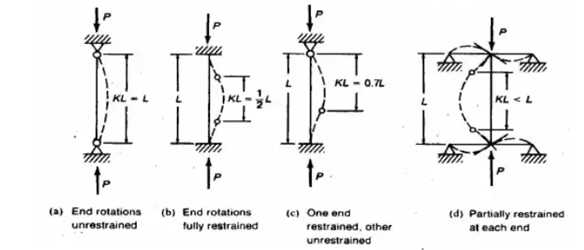
The ratio of the effective length to the actual length is known as the Effective Length Factor (K-Factor).
-
Methods for Calculating Effective Length Factor
There are various methods for determining the Effective Length Factor, which is the ratio of the effective length to the original length of the target member. Among the widely known methods for calculating effective length, the following types are commonly used:
(1) Alignment Chart Method (Yura, 1971 and Disque, 1973) : Considering Adjacent Member Stiffness
(2) Story-stiffness Method (Lui and Sun 1995. Effective Length of Uniform and Stepped Crane Columns, AISC) : Considering the Overall Stiffness and Behavior of Columns on Each Floor
(3) Elastic Buckling Analysis Method (White and Hajja, 1997) : Not constrained by Alignment Chart limitations, but may result in irrational effective length for small axial loads
(4) Inelastic Buckling Eigenvalue analysis (Fukumoto, 1997) : Analyzing inelastic buckling eigenvalues based on tangent modulus theory
General Application Method for Effective Length Factor
Conducting eigenvalue analysis for the entire frame to determine the slenderness ratio coefficient is impractical for practical purposes. Therefore, in general design applications, slenderness ratio coefficients based on the boundary conditions provided by SSRC (Structural Stability Research Council) are commonly applied.
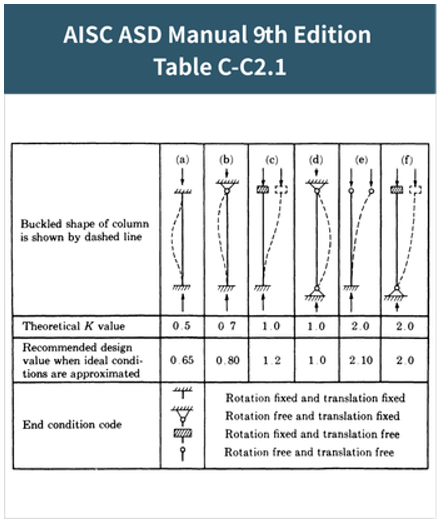
However, each component of a steel frame structure is significantly influenced by the behavior of adjacent members. Therefore, in the design process, it is crucial to consider the impact of one member's behavior on the neighboring members. This consideration is essential for an ideal design and enables an economical design.
Among the methods available, let's explore the most traditional Alignment Chart method specified in the AISC ASD (Allowable Stress Design) for steel structures.
Alignment Chart Method : Assumptions
This method is also an idealized approach, and it comes with the following assumptions:
(1) All members must exhibit behavior within the elastic range (purely elastic).
(2) All members should have the same cross-sectional area (constant cross-section).
(3) All connections (joints) are assumed to be rigid.
Alignment Chart Method : Using Calculation Formulas
The calculations are differentiated based on the presence or absence of bracing and are as follows:
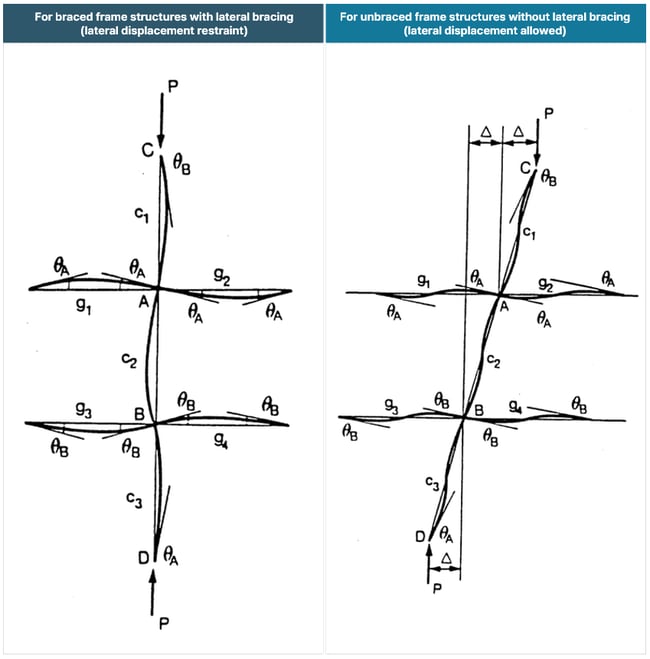
(1) For braced frame structures with lateral bracing (lateral displacement restraint):
.png?width=795&height=105&name=%EB%B8%8C%EB%A0%88%EC%9D%B4%EC%8B%B1%EC%9D%B4%20%EC%84%A4%EC%B9%98%EB%90%9C%20%EB%BC%88%EB%8C%80%EA%B5%AC%EC%A1%B0%20(%ED%9A%A1%EB%B3%80%EC%9C%84%EA%B5%AC%EC%86%8D).png)
(2) For unbraced frame structures without lateral bracing (lateral displacement allowed):
.png?width=795&height=96&name=%EB%B8%8C%EB%A0%88%EC%9D%B4%EC%8B%B1%EC%9D%B4%20%EC%97%86%EB%8A%94%20%EB%BC%88%EB%8C%80%EA%B5%AC%EC%A1%B0%20(%ED%9A%A1%EB%B3%80%EC%9C%84%20%EC%88%98%EB%B0%98).png)
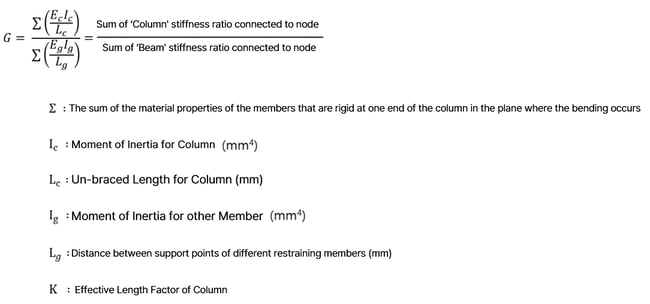
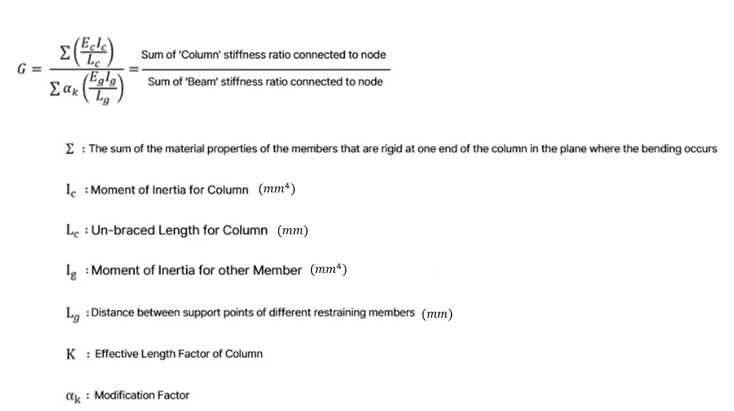
Here, the subscript denote each end of the column, and the definitions of the symbols used are as follows:
Alignment Chart Method : Using Chart
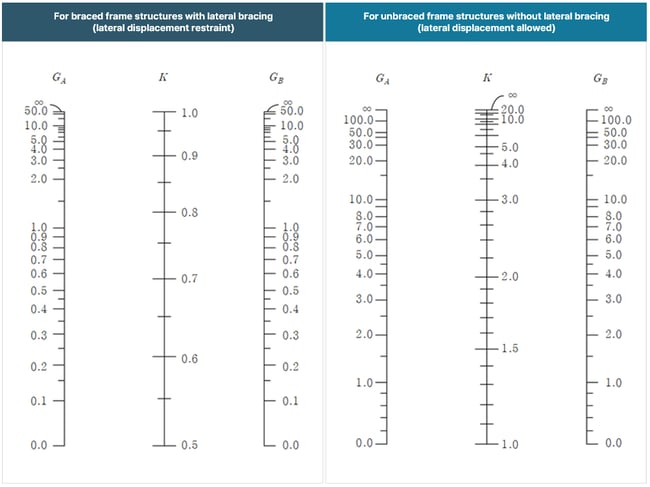
There is a way to use a chart to calculate the complex above expression more conveniently, and you can use this chart to calculate the effective buckling length coefficient.
Alignment Chart Method : Example
Check out the examples below to help you understand.

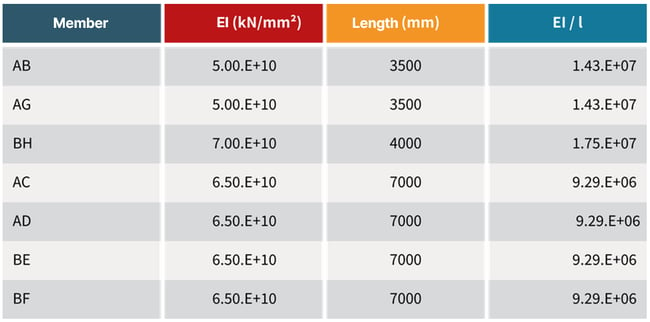
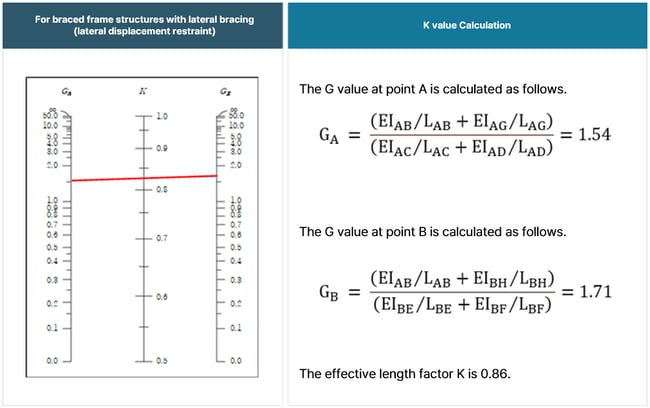
Under the given conditions, when calculating the slenderness ratio for the A-B member, the obtained value is 0.86. This value is less than the typical design application value of 1.0, suggesting that an economical design is possible.
In cases where the difference from the allowable stress is not significant, using the Alignment Chart to reduce the slenderness ratio in calculations can be an economical design approach rather than increasing the material strength.
Modified Alignment Chart
The mentioned conditions apply when both ends of the girder have the same boundary conditions.
If the boundary conditions at both ends of the girder are different, the SSRC (Structural Stability Research Council) guide suggests a modified length of the girder, as proposed by Duan and Chen. This modification allows for a straightforward application in design, and the details are provided as follows:
Conclusion
AISC's research indicates that 90% of structures with bracing and 40% of structures without bracing are designed as short columns. This suggests that a significant portion of civil engineering structures is designed with short columns for safety reasons.
However, even in short columns, the slenderness ratio is considered when determining the allowable compressive stress, and there are cases where long column design is necessary due to various special conditions.
As an example, consider a system support that corresponds to a long column due to its length compared to the section. In such cases, a thorough examination of buckling is essential.
The method explained in this content, using the Alignment Chart, provides an alternative design approach. Instead of increasing the material strength or enlarging the member's cross-section, this method can be considered when the safety factor (SF) or unit check (UC) falls slightly short during the design process.
However, there are some challenges in applying the methods suggested by national standards such as AISC in real-world designs, as outlined below.
(1) Lack of Actual Cases for Review
(2) Determination of Lateral Constraints - Difficulty in determining Lateral Constraints and Non-Lateral Constraints
Generally, using reduced slenderness ratios compared to the calculation methods for the six types can lead to increased allowable stress. However, applying this approach in practice may be considered too conservative, and the increased workload in design verification may be burdensome.
Furthermore, the determination of structures that satisfy ideal lateral restraint conditions may lack sufficient experience and cases for validation, potentially increasing the workload in the design process.
Despite these challenges, the aim of this content is to contribute, even if only slightly, to the development of civil engineering technology by contemplating the utility and application methods of various design approaches.
References
- AISC ASD Specification for Structural Steel Buildings (💡Link Click)
- Duan, L. and Chen, W.F. “Effective Length Factors of Compression Members” Structural Engineering Handbook Ed. Chen Wai-Fah Boca Raton: CRC Press LLC, 1999

I have experience in various design works in plant and civil engineering, but there is still much to learn. Let's all continue to study and grow.
Please also visit my blog (click)
👉Learn More About the Editor (click)
※ Click on the keywords below 'Topics' to view related content.