Would you like to sign out?

Select Country

  • Afghanistan English
  • Albania English
  • Algeria English
  • American Samoa English
  • Andorra English
  • Angola English
  • Anguilla English
  • Antarctica English
  • Antigua and Barbuda English
  • Argentina Español
  • Armenia English
  • Aruba English
  • Australia English
  • Austria English
  • Azerbaijan English
  • Bahamas English
  • Bahrain English
  • Bangladesh English
  • Barbados English
  • Belarus English
  • Belgium English
  • Belize English
  • Benin English
  • Bermuda English
  • Bhutan English
  • Bolivia Español
  • Bosnia and Herzegovina English
  • Botswana English
  • Bouvet Island English
  • Brazil Español
  • British Indian Ocean Territory English
  • British Virgin Islands English
  • Brunei English
  • Bulgaria English
  • Burkina Faso English
  • Burundi English
  • Cambodia English
  • Cameroon English
  • Canada English
  • Cape Verde English
  • Caribbean Netherlands English
  • Cayman Islands English
  • Central African Republic English
  • Chad English
  • Chile Español
  • Christmas Island English
  • Cocos (Keeling) Islands English
  • Colombia Español
  • Comoros English
  • Congo English
  • Cook Islands English
  • Costa Rica Español
  • Côte d’Ivoire English
  • Croatia English
  • Cuba Español
  • Curaçao English
  • Cyprus English
  • Czech Republic English
  • Democratic Republic of the Congo English
  • Denmark English
  • Djibouti English
  • Dominica English
  • Dominican Republic Español
  • Ecuador Español
  • Egypt English
  • El Salvador Español
  • Equatorial Guinea English
  • Eritrea English
  • Estonia English
  • Ethiopia English
  • Falkland Islands English
  • Faroe Islands English
  • Fiji English
  • Finland English
  • France English
  • French Guiana Español
  • French Polynesia English
  • French Southern Territories English
  • Gabon English
  • Gambia English
  • Georgia English
  • Germany English
  • Ghana English
  • Gibraltar English
  • Greece English
  • Greenland English
  • Grenada English
  • Guadeloupe Español
  • Guam English
  • Guatemala Español
  • Guernsey English
  • Guinea English
  • Guinea-Bissau English
  • Guyana English
  • Haiti Español
  • Heard Island and McDonald Islands English
  • Honduras Español
  • Hong Kong English
  • Hungary English
  • Iceland English
  • India English
  • Indonesia English
  • Iran English
  • Iraq English
  • Ireland English
  • Isle of Man English
  • Israel English
  • Italy English
  • Jamaica English
  • Japan 日本語
  • Jersey English
  • Jordan English
  • Kazakhstan English
  • Kenya English
  • Kiribati English
  • South Korea 한국어
  • Kuwait English
  • Kyrgyzstan English
  • Laos English
  • Latvia English
  • Lebanon English
  • Lesotho English
  • Liberia English
  • Libya English
  • Liechtenstein English
  • Lithuania English
  • Luxembourg English
  • Macau English
  • Madagascar English
  • Malawi English
  • Malaysia English
  • Maldives English
  • Mali English
  • Malta English
  • Marshall Islands English
  • Martinique Español
  • Mauritania English
  • Mauritius English
  • Mayotte English
  • Mexico Español
  • Micronesia English
  • Moldova English
  • Monaco English
  • Mongolia English
  • Montenegro English
  • Montserrat English
  • Morocco English
  • Mozambique English
  • Myanmar English
  • Namibia English
  • Nauru English
  • Nepal English
  • Netherlands English
  • New Caledonia English
  • New Zealand English
  • Nicaragua Español
  • Niger English
  • Nigeria English
  • Niue English
  • Norfolk Island English
  • Northern Mariana Islands English
  • Norway English
  • Oman English
  • Pakistan English
  • Palau English
  • Palestine English
  • Panama Español
  • Papua New Guinea English
  • Paraguay Español
  • Peru Español
  • Philippines English
  • Pitcairn Islands English
  • Poland English
  • Portugal Español
  • Puerto Rico Español
  • Qatar English
  • Réunion English
  • Romania English
  • Russia English
  • Rwanda English
  • Saint Barthélemy Español
  • Saint Helena English
  • Saint Kitts and Nevis English
  • Saint Lucia English
  • Saint Martin Español
  • Saint Pierre and Miquelon English
  • Saint Vincent and the Grenadines English
  • Samoa English
  • San Marino English
  • Sao Tome and Principe English
  • Saudi Arabia English
  • Senegal English
  • Serbia English
  • Seychelles English
  • Sierra Leone English
  • Singapore English
  • Sint Maarten English
  • Slovakia English
  • Slovenia English
  • Solomon Islands English
  • Somalia English
  • South Africa English
  • South Georgia English
  • South Sudan English
  • Spain Español
  • Sri Lanka English
  • Sudan English
  • Suriname English
  • Svalbard and Jan Mayen English
  • Eswatini English
  • Sweden English
  • Switzerland English
  • Syria English
  • Taiwan English
  • Tajikistan English
  • Tanzania English
  • Thailand English
  • Togo English
  • Tokelau English
  • Tonga English
  • Trinidad and Tobago English
  • Tunisia English
  • Turkey English
  • Turkmenistan English
  • Turks and Caicos Islands English
  • Tuvalu English
  • U.S. Virgin Islands English
  • Uganda English
  • Ukraine English
  • United Arab Emirates English
  • United Kingdom English
  • United States of America English
  • U.S. Minor Outlying Islands English
  • Uruguay Español
  • Uzbekistan English
  • Vanuatu English
  • Vatican City English
  • Venezuela Español
  • Vietnam English
  • Wallis and Futuna English
  • Western Sahara English
  • Yemen English
  • Zambia English
  • Zimbabwe English
  • Åland Islands English
  • East Timor English
  • Netherlands Antilles English
  • Serbia and Montenegro English
  • North Macedonia English
  • Timor-Leste English
Bridge

Exploring Dynamics in Structural Load Analysis

Table of Contents Click the table of contents for details.


The previous article discussed how to solve a dynamics problem by hand (OK by Excel). In this article, the basics of dynamics will be reviewed.
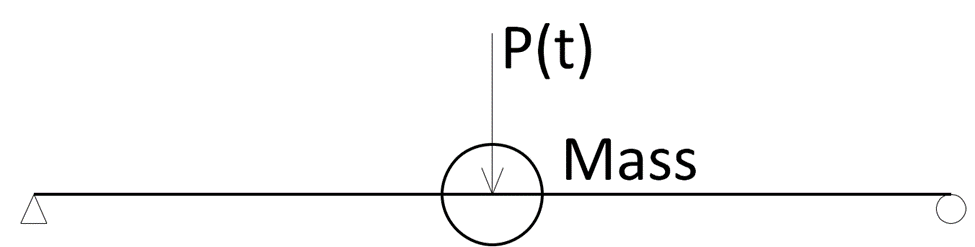
 

Fig1 Simple BeamFig1 Simple Beam


Say we are calculating the center deflection. The load is P(t). P(t) means the load is not constant and varies with time, something like Fig2.


Fig2 P(t)Fig2 P(t)


However, in the meantime, we assume P(t) is constant as P.


Returning to Fig1, the span length is L, and flexural stiffness is EI. If we can recall what we learned from Mechanics of Materials, deflection at the span center would be

 

deflection at the span center

Is this correct?


This is correct only if the load P slowly applies from zero to the total value P. In other words, if P varies linearly between P(t=0)=0 and P(t=∞)=P, as shown in Fig3, the deflection at the center should be Δ static = PL3/(48EI).


Fig3 P(t=0)=0, P(t=∞)=PFig3 P(t=0)=0, P(t=∞)=P


We all know that this is not feasible in real-world engineering. What happens if the load P does not apply very (whatever this means) slowly?


The easiest way may be to check the extreme case as shown in Fig4, say P(t=0)=P, so-called suddenly applied load or impact load, etc.
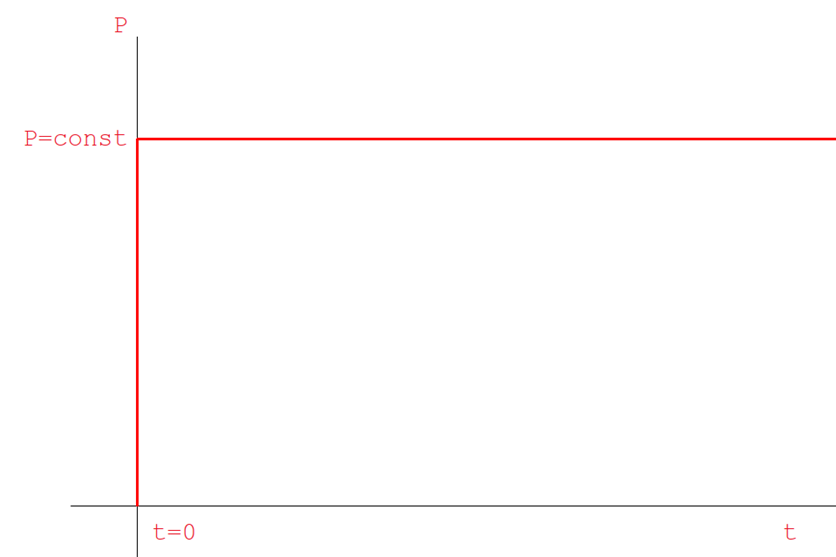
 

Fig4 P=const, Suddenly Applied Load or Impact LoadFig4 P=const, Suddenly Applied Load or Impact Load


If the load P applies suddenly, i.e., P(t=0)=P, the deflection would be twice of Δ static, and this can be proved easily from Timoshenko’s Mechanics of Materials, 2.8 Impact Loading.


It may be logical if we have the following questions. What happens if the load P reaches its maximum value somewhere between zero and infinity? Twice of static value is too much. What is the minimum loading time, say if we can allow 5% of additional response, etc.?


We can answer all these questions by dynamics. Before starting complex discussions, it may be helpful to review some genius work. A more general case can be found in Dr. Biggs, Introduction to Structural Dynamics, Fig 2.6D, as shown below.
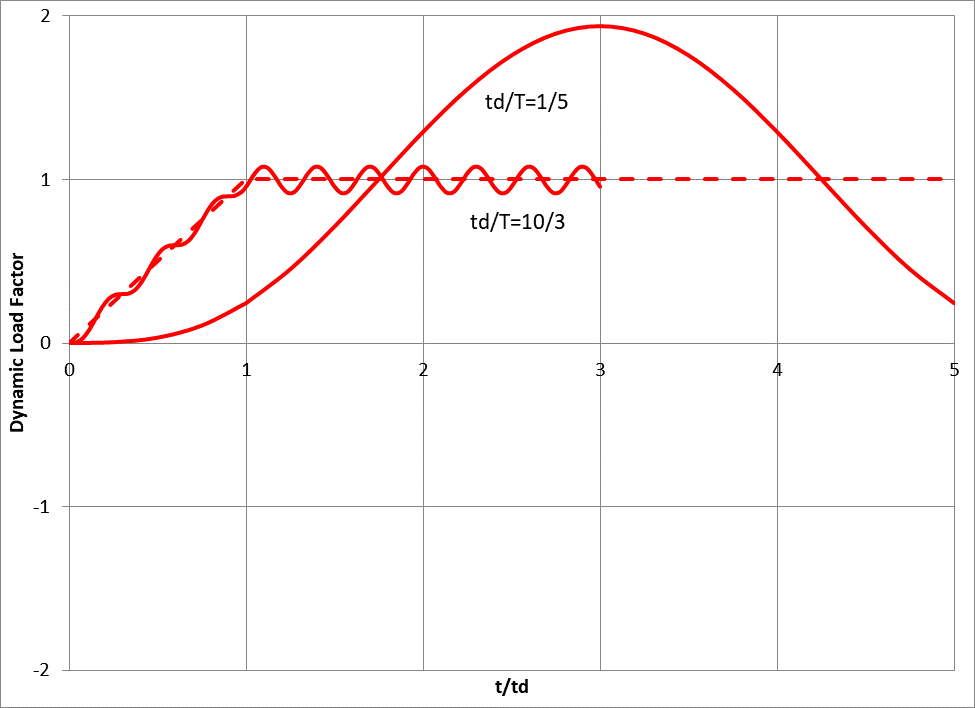
 

Fig5 Figure 2.6D from Dr. BiggsFig5 Figure 2.6D from Dr. Biggs


The dashed line shows the loading diagram. At t=0, P=0, and at some arbitrary selected time t=td (t/td=1), P=P max. Then if the loading time td is very short compared to the natural period of structure T, say td/T=0.2, the maximum response (deflection is one of them) is around twice that from static (again if the load P applies very slowly). This is as expected from Timoshenko’s simple case.


Also, we can see that if load P applies very slowly, i.e., if load P reaches its full value at td=(3.333)T, the response is approximately proportional to the loading. This graph looks very simple and very easy to use. However not that simple to generate (Thanks to Dr. Biggs!).


Let’s review the previous example again. Let K = 48EI/L3 = 2000 lb/ft, total beam weight is W = 64.4 lb (assumed to be lumped at the span center, which is not correct), then the natural period is
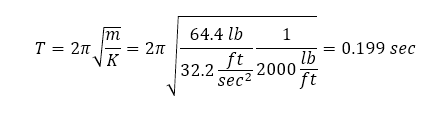
 

natural period

Assume the loading is as shown in Fig2.


We can see that the load P starts half of P max and reaches its maximum value at around 0.5T, which is much shorter than 3.33T, but somewhat larger than 0.2T. (It is easy to regenerate Fig5 with td/T=1/2; however not shown here). So we can guess that the maximum response may be close to twice the static value.

 

static value

Without further calculation, we can catch that the maximum deflection would be less than (2)(Δ static)=0.1 ft.


Now we can solve this problem by hand or by MIDAS. The results are shown in Fig6.
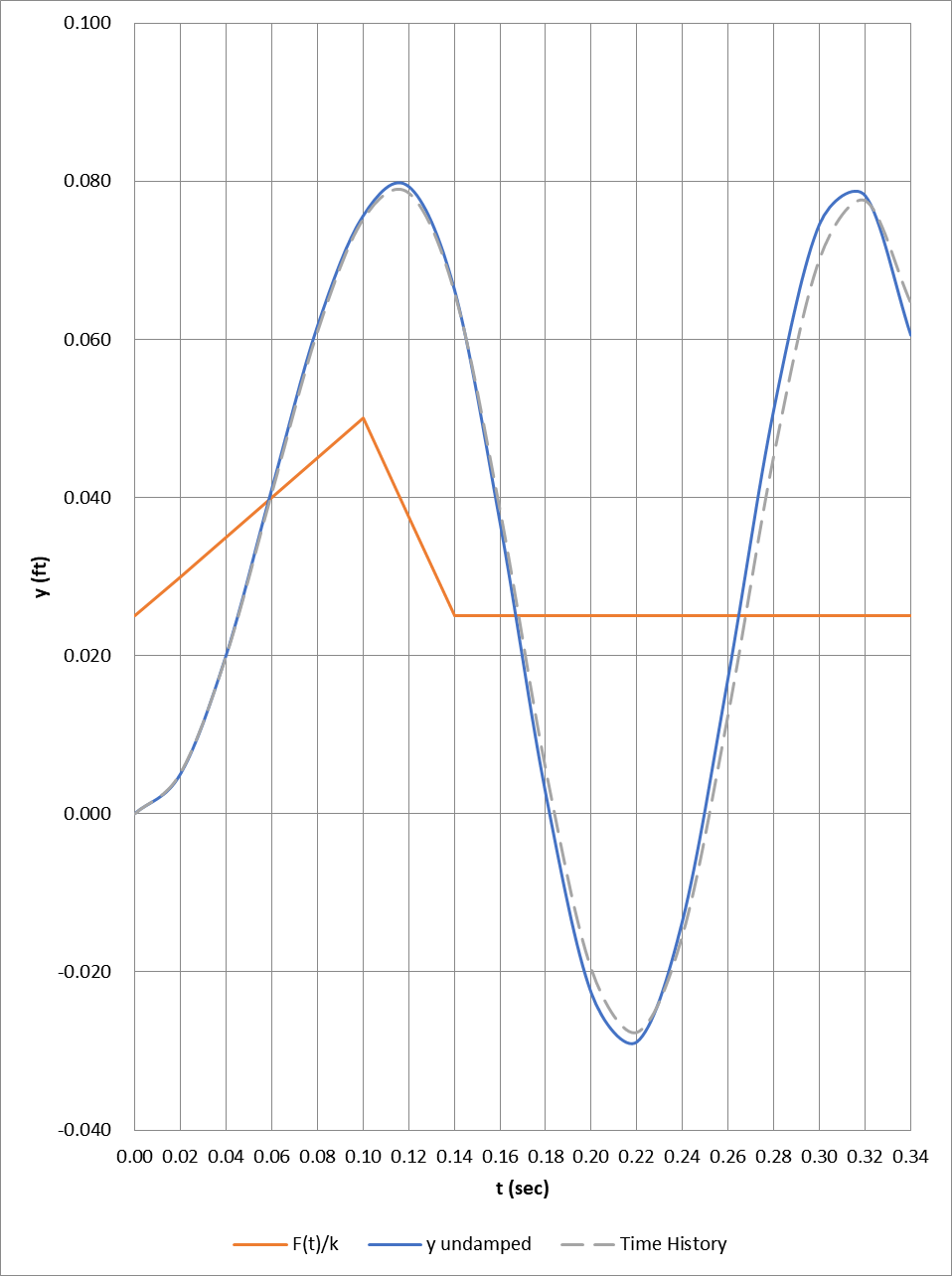
 

Fig6 Time history analysis resultFig6 Time history analysis result


In Fig6, the red line shows static results, the blue line shows results from by-hand (Excel), and the green dashed line shows rigorous time-history analysis results from MIDAS. The maximum deflection is around 0.080 ft and less than (2)(Δ static), but somewhat close to it, as expected.


For dynamics, the loading itself is very approximated (how can we exactly estimate wind or earthquake?), and rigorous calculation to increase some percent of accuracy hardly makes sense. Old design charts like Fig5 are very easy to use and can minimize human mistakes. I highly recommend it, at least for preliminary design or for checking.


#Dynamics Problem Solving
#Deflection Analysis
#Impact Loading

 

About the Editor
Seungwoo Lee, Ph.D., P.E., S.E.
Senior Supervising Engineer WSP USAs (Tampa, FL)

He is a Senior Supervising Engineer with a high level of expertise in the design and analysis of suspension bridges. He has a solid fundamental understanding of structures and can apply his knowledge exceptionally well to the design and analysis of highly complex structures. He is also a strong communicator, able to identify and distill the key information that is relevant to the task at hand and present it in a clear and quickly understandable manner.

Subscribe to Newsletter

Catch the weekly engineer news!

What you may
also like