
Introduction
The aim of this study is to comparatively examine the calibration procedure of site response analyses for complete and separate systems.
Site response analysis (SRA) is referred to as the first step/stage of dynamic structure-soil interaction (SSI) analysis (Wolf, 1985). SRA is performed to assess the response of local site conditions under seismic motions applied to the bedrock. In such an analysis, the propagation of stress waves from the bedrock to the ground surface in the absence of superstructure loads is investigated, and the response of the soil at any depth above the bedrock can be determined. The variation of seismic waves at any depth in terms of amplitude (stress, deformation, acceleration, etc.), duration, and frequency content can be evaluated using SRA.
1. Determining lateral soil dimensions
Firstly, the horizontal dimensions of the soil should be determined. For this purpose, 1-D and 3-D linear site response analyses were performed. In the analyses, the response spectra at the ground surface were taken into account and the results were compared. Thus, the change of the response from the base to the surface was evaluated and the horizontal soil dimensions were determined. In the 3-D model, the "free-field" elements available in the Midas GTS NX were used to prevent the reflection of the incident wave at the horizontal boundaries. In the 3-D model, "Compliant Base", which is also available in the Midas GTS NX, was used to prevent the reflection of incoming waves at the base of the ground. In the analyses. The damping is assumed to be 10% for linear analyses. Damping was applied to the system as viscous damping by determining the mass and stiffness proportional coefficients. The generated 3D models in Midas GTS NX is given in Figure 1. It should be noted that in the area where the building will be located, smaller element sizes are used while moving towards the boundaries larger dimensions are applied.
%20Full%20model%2c%20(right)%20Separate%20model.png?width=734&height=378&name=Figure%201.%20Plan%20view%20of%203D%20models%20(left)%20Full%20model%2c%20(right)%20Separate%20model.png)
2. Calibration of Soil Material Model
In this study, the Ramberg-Osgood (1943) material model, which represents the nonlinear material properties of the soil and is commonly used in the literature, has been employed. This model was initially developed for metals, such as aluminum, with no well-defined yield stress. Later, Faccioli et al. (1973) utilized this model to predict the shear modulus reduction curves of sands for modeling soil behavior. The model is available in the Midas GTS NX (2023) software package. To describe the soil behavior using this model, three parameters are required: Initial shear modulus (G0), reference strain (γr), and maximum damping value (hmax). Taking these parameters into account, the yield criterion of this model is expressed through the following equations.

Furthermore, the maximum damping value was obtained by comparing with the results of Darendeli (2001) and Vucetic and Dobry (1991) in Figure 2. In this study, the maximum damping value was determined as 20%. Additionally, an additional 1% damping, applied as Rayleigh damping, was incorporated into the numerical model to represent damping at small deformations.
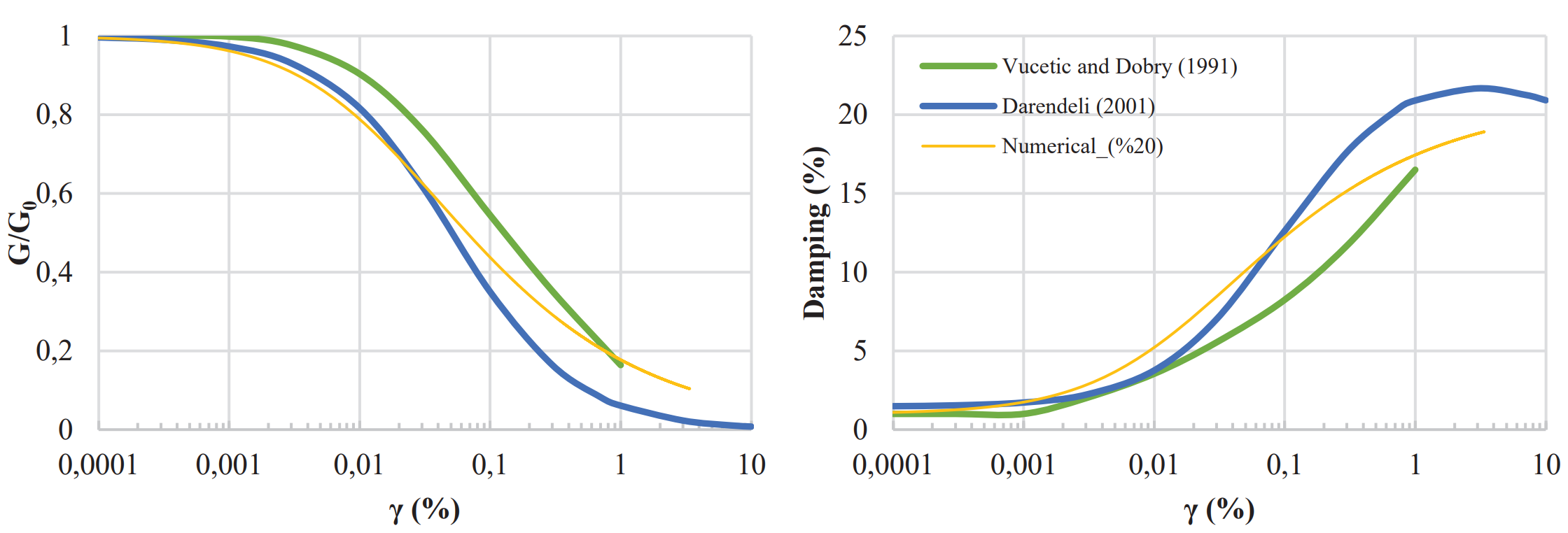 Fig. 2. Variation of shear modulus and damping with shear strain
3. Evaluation of Analysis Results
Fig. 2. compares 1D and 3D linear site response analysis results for complete and separate models using various lateral dimensions. The results are given for center and edge of the foundation. According to the results in Figure 3, as the dimension increased the variation in response spectrum decreased. This means that increasing the dimension after a certain point is meaningless when artificial boundaries are applied to the lateral and base of the soil domain. Here, 400x400m for complete and 200x200m for separate models are selected for calibration.
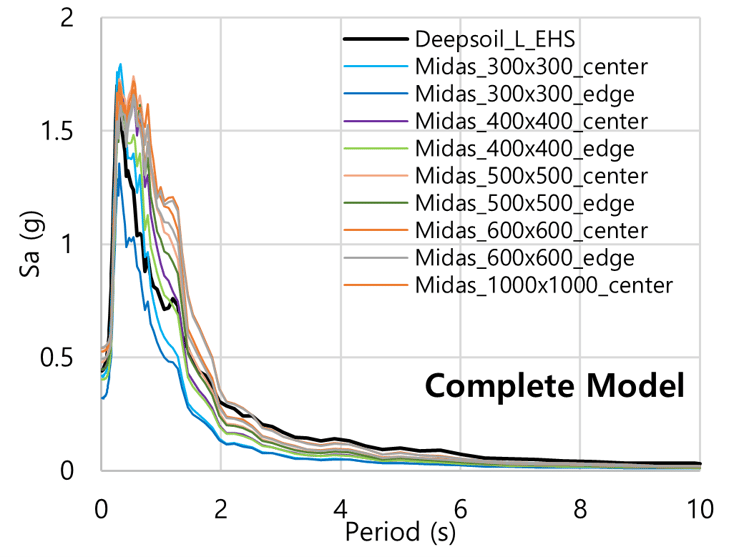 Fig. 3. Comparison of response spectrum at ground level for full model
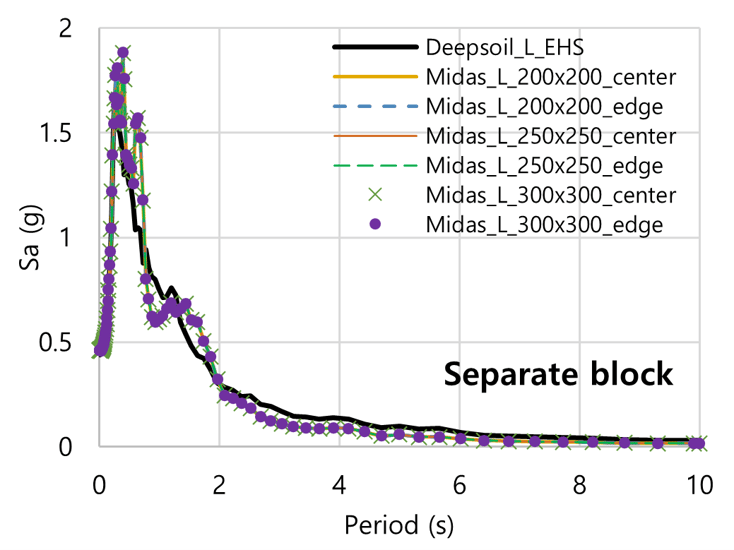 Fig. 3. Comparison of response spectrum at ground surface
After calibration of numerical models, nonlinear SRA are performed. Nonlinear SRA results are given in Fig. 4. The results of Vucetic and Dobry (1991) and Darendeli (2001) are also added to the figure. The results between 3D and 1D models seem fairly good. Additionally, the center and edge results seem close to each other, meaning that the behavior of soil in the studied area is similar to each other.
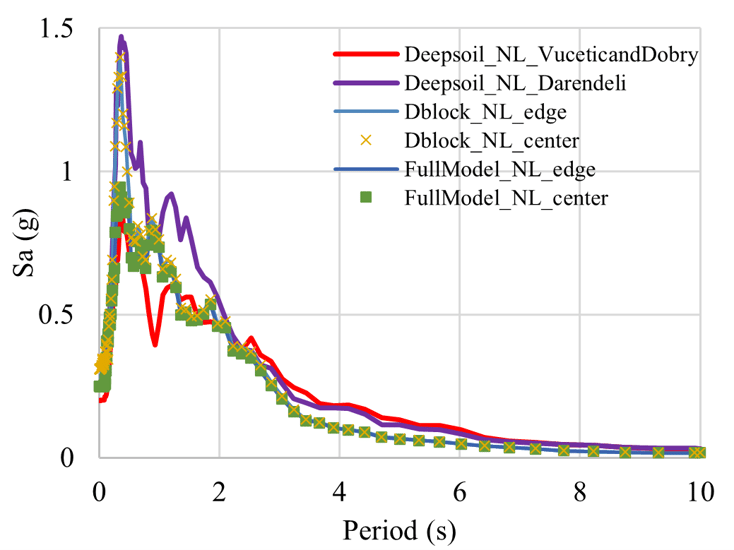 Fig. 4. Comparison of nonlinear response spectra at ground level
4. Concluding remarks
Large models, especially in finite element analysis, are an additional burden and can cause significant time loss. This study focuses on the verification of the 3D model for dynamic SSI analysis. A parametric study is carried out using different lateral dimensions for a sample project to calibrate the 3D model against 1D results in terms of response spectrum at ground level.
The model is also performed considering nonlinear soil behavior using Ramberg-Osgood model. The results indicate that increasing the lateral dimensions is meaningless when artificial boundaries are used as there is no significant change in response spectrum at the ground level after a specific point. A good match is obtained for linear and nonlinear results between 1D and 3D SRA. It can be said that such a calibration process is an effective solution method in the absence of experimental test results.
For a detailed information on site response analysis, I can send the full conference paper in pdf format.
References
Darendeli MB (2001) Development of A New Family of Normalized Modulus Reduction and Material Damping Curves.
Ph.D. Dissertation, The University of Texas at Austin.
Faccioli E, Santayo V, Leone JL (1973) Microzonation criteria and seismic response studies for the city of Managua. In:
The Earthquake Engineering Research Distribution Conferance. Managua, Nicargua.
Midas GTS NX (2023) Online Manual. MIDAS Information Technology Co.
Ramberg W, Osgood WR (1943) Description of stress strain curves by three parameters 902:28.
Vucetic M, Dobry R (1991) Effect of soil plasticity on cyclic response. Journal of Geotechnical Engineering117(1): 89-
107.
Wolf JP (1985) Dynamic soil-structure interaction. Prentice Hall.
/M.%20%C3%96mer%20Timura%C4%9Fao%C4%9Flu%20240_240.png)
Hello, I am M.Ömer Timurağaoğlu. I received my PhD from Department of Civil Engineering at Uludağ University, Türkiye. During my academic career, I mostly worked on reinforced concrete structures and structure-soil interaction. After finishing my PhD, I spent an intensive study period on pile foundations. Recently, I focused on the design of pile foundations under kinematic and inertial loads. I share the design experience and knowledge I have gained in the industrial field with everyone through academic publications. Sharing is good. Let's share together.
※ Click on the keywords below 'Topics' to view related content.