1. Introduction
Generally, one might think of iconic buildings on land such as the Eiffel Tower (300m, 1889), Empire State Building (381m, 1931), Sears Tower (443m, 1970), CN Tower (553m, 1973), and Burj Khalifa (807m, 2009) as the tallest structures on Earth. However, these are constructed onshore, and there are also colossal buildings offshore in the ocean, referred to as 'offshore structures.'
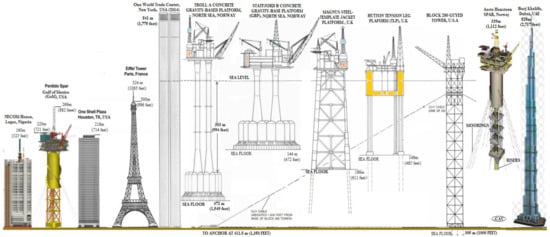 Fig. 1 Offshore oil platforms compared to tallest building structures
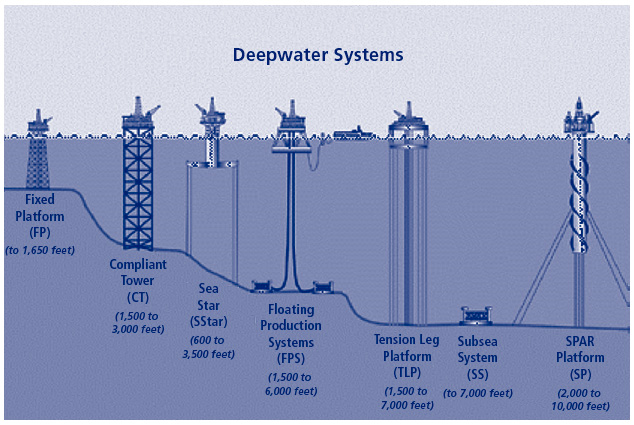 Fig. 2 Type of Offshore Structure (Refer to U.S. Minerals Management Service, Gulf of Mexico Region, Offshore Information, October 1999.)
Offshore structures face external forces such as wave loads (wave force), wind loads (wind force), current loads (current force), and seismic loads (earthquake force).
Wind loads, especially crucial in the stability analysis of offshore structures exposed to the atmospheric conditions above the sea surface, result in significant moments on the structure. For operational offshore structures, the design wind speed is generally high (above 70 knots), but due to the significantly lower air density compared to water (i.e., only about 1/850), the wind force is smaller than the wave load.
Current loads, caused by the resistance due to ocean currents, can be neglected in the design conditions for operational offshore structures, considering their relatively low speeds (usually around 2-3 knots), unless stress concentration near the free surface causes fatigue failure.
Seismic loads, originating from the acceleration of the seabed during an earthquake, act as inertial forces on fixed structures and as hydrodynamic pressure on floating structures. In general, in regions not prone to earthquakes or in areas with water depths exceeding 100m, seismic loads are smaller than wave loads.
Therefore, in the design conditions of typical offshore structures, wave loads are usually the most significant external force. Accurately estimating wave loads is a key factor for the successful design of offshore structures (Choi, 1981).
To estimate wave loads, it is essential to first measure and collect long-term wave data for the target offshore area. Methods for calculating wave loads based on this data include the 'design wave method,' where the wave height corresponding to a recurrence period of 50 or 100 years is selected, and the wave load is calculated at the phase where it reaches its maximum. Another method is the 'wave-energy spectral density method,' where the probabilistic distribution of wave loads is determined based on a specific sea state, and statistical methods are employed to establish design conditions. The former calculates wave loads for specific wave height and period, while the latter calculates wave loads for multiple periods.
2. Composition and types of waves
Wave is the orbital motion of water particles within a limited range, and it is not directly carried out by water particles, but the propagation of energy through water particles.
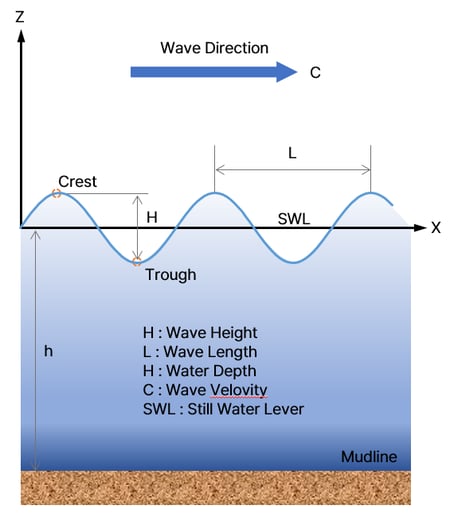 Fig. 3 Definition of Wave
2.1 Types of Waves
Deep Water Wave :
A deep water wave refers to waves that occur in deep-sea environments where the ratio of water depth to wavelength is 1/2 ≤ h/L. These waves propagate along the sea surface and are also known as surface waves. In deep water waves, water particles undergo circular motion with the wave crest as the diameter. As the water depth increases, the size of the circular motion diminishes rapidly, minimizing the influence of the seafloor.
Shallow Water Wave :
A shallow water wave is characterized by a ratio of water depth to wavelength in the range 1/20 ≤ h/L < 1/2 . In these waves, the motion of water particles is influenced by seafloor friction, resulting in elliptical orbits. The elliptical trajectories at the sea surface become flatter towards the seafloor.
Long Water Wave :
A long water wave, sometimes referred to as a subcritical wave, is a wave occurring in very shallow waters where h/L < 1/20 . These waves have a significantly low water depth compared to the wavelength, making them distinct.
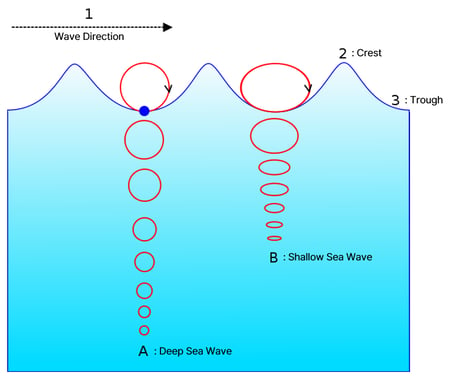 Fig. 4 Deep sea wave and shallow sea wave
Regular Wave :
A progressive wave is a wave that uniformly advances in any direction within a given space. In contrast, when progressive and reflected waves overlap, they create a standing wave, also known as a standing wave or stationary wave. In a standing wave, wave crests and troughs occur at the same fixed location, resulting in a waveform that does not propagate.
Irregular Wave and Regular Wave :
Actual ocean waves exhibit varying waveforms, with fluctuations in wave height, period, and direction. Waves that lack uniformity in these characteristics, constantly changing, are termed irregular waves. Understanding the characteristics of irregular waves is challenging, and theoretically handling them is complex. Consequently, waves with constant amplitude, period, and direction are treated as regular waves.
Small Amplitude Wave (Linear Wave Theory) and Finite Amplitude Wave (Nonlinear Wave Theory ):
When dealing with regular waves theoretically, waves with very small amplitudes or wave steepness (H/L) significantly smaller than the water depth are referred to as small amplitude waves. Conversely, waves with larger amplitudes fall into the category of finite amplitude waves. Treating waves as small amplitude simplifies the motion equations as they become linear. However, in the case of finite amplitude waves, nonlinear terms are introduced, making the analysis more complex.
The results obtained from MIDAS CIVIL and manual calculation for anchorage slip loss are shown in the figure below.

You can check more of these details in the download file.
2.2 Wave transformation
2.3 Wave statistics
References
Doogi Kim, Structural Dynamics, Gumi Library, 2005/2009.
Choi Hang-soon, Consideration on wave loads acting on marine structures, Journal of the Korean Society of Shipbuilding, 18(2), 49-55, June 1981.
Tedesco, J.W., McDougal, W.G., Ross, C.A. (1999). Structural Dynamics: Theory and Applications, Addison-Wesley, Menlo Park, CA.
SynClaire, http://synclaire.net.
Wikipedia encyclopedia site, http://en.wikipedia.org.
Amaechi, Chiemela Victor, Ahmed Reda, Harrison Obed Butler, Idris Ahmed Ja’e, and Chen An. 2022. "Review on Fixed and Floating Offshore Structures. Part I: Types of Platforms with Some Applications" Journal of Marine Science and Engineering10, no. 8: 1074. https://doi.org/10.3390/jmse10081074
Gobato, Ricardo & Gobato, Alekssander & Fedrigo, Desire. (2016). Harnessing the energy of ocean surface waves by Pelamis System.. Parana Journal of Science and Education. 2. 1-15.

I am a structural engineer who is interested in all structures from civil structures to offshore structures.
Based on various practical experiences, I would like to introduce engineering more easily.
And I want to be able to share my thoughts and enjoy the various attempts that can improve the efficiency of engineering work with you.
I hope every engineer who reads my contents will get even the slightest inspiration and motivation needed for the engineer's journey.
※ Click on the keywords below 'Topics' to view related content.