Would you like to sign out?

Select Country

  • Afghanistan English
  • Albania English
  • Algeria English
  • American Samoa English
  • Andorra English
  • Angola English
  • Anguilla English
  • Antarctica English
  • Antigua and Barbuda English
  • Argentina Español
  • Armenia English
  • Aruba English
  • Australia English
  • Austria English
  • Azerbaijan English
  • Bahamas English
  • Bahrain English
  • Bangladesh English
  • Barbados English
  • Belarus English
  • Belgium English
  • Belize English
  • Benin English
  • Bermuda English
  • Bhutan English
  • Bolivia Español
  • Bosnia and Herzegovina English
  • Botswana English
  • Bouvet Island English
  • Brazil Español
  • British Indian Ocean Territory English
  • British Virgin Islands English
  • Brunei English
  • Bulgaria English
  • Burkina Faso English
  • Burundi English
  • Cambodia English
  • Cameroon English
  • Canada English
  • Cape Verde English
  • Caribbean Netherlands English
  • Cayman Islands English
  • Central African Republic English
  • Chad English
  • Chile Español
  • Christmas Island English
  • Cocos (Keeling) Islands English
  • Colombia Español
  • Comoros English
  • Congo English
  • Cook Islands English
  • Costa Rica Español
  • Côte d’Ivoire English
  • Croatia English
  • Cuba Español
  • Curaçao English
  • Cyprus English
  • Czech Republic English
  • Democratic Republic of the Congo English
  • Denmark English
  • Djibouti English
  • Dominica English
  • Dominican Republic Español
  • Ecuador Español
  • Egypt English
  • El Salvador Español
  • Equatorial Guinea English
  • Eritrea English
  • Estonia English
  • Ethiopia English
  • Falkland Islands English
  • Faroe Islands English
  • Fiji English
  • Finland English
  • France English
  • French Guiana Español
  • French Polynesia English
  • French Southern Territories English
  • Gabon English
  • Gambia English
  • Georgia English
  • Germany English
  • Ghana English
  • Gibraltar English
  • Greece English
  • Greenland English
  • Grenada English
  • Guadeloupe Español
  • Guam English
  • Guatemala Español
  • Guernsey English
  • Guinea English
  • Guinea-Bissau English
  • Guyana English
  • Haiti Español
  • Heard Island and McDonald Islands English
  • Honduras Español
  • Hong Kong English
  • Hungary English
  • Iceland English
  • India English
  • Indonesia English
  • Iran English
  • Iraq English
  • Ireland English
  • Isle of Man English
  • Israel English
  • Italy English
  • Jamaica English
  • Japan 日本語
  • Jersey English
  • Jordan English
  • Kazakhstan English
  • Kenya English
  • Kiribati English
  • South Korea 한국어
  • Kuwait English
  • Kyrgyzstan English
  • Laos English
  • Latvia English
  • Lebanon English
  • Lesotho English
  • Liberia English
  • Libya English
  • Liechtenstein English
  • Lithuania English
  • Luxembourg English
  • Macau English
  • Madagascar English
  • Malawi English
  • Malaysia English
  • Maldives English
  • Mali English
  • Malta English
  • Marshall Islands English
  • Martinique Español
  • Mauritania English
  • Mauritius English
  • Mayotte English
  • Mexico Español
  • Micronesia English
  • Moldova English
  • Monaco English
  • Mongolia English
  • Montenegro English
  • Montserrat English
  • Morocco English
  • Mozambique English
  • Myanmar English
  • Namibia English
  • Nauru English
  • Nepal English
  • Netherlands English
  • New Caledonia English
  • New Zealand English
  • Nicaragua Español
  • Niger English
  • Nigeria English
  • Niue English
  • Norfolk Island English
  • Northern Mariana Islands English
  • Norway English
  • Oman English
  • Pakistan English
  • Palau English
  • Palestine English
  • Panama Español
  • Papua New Guinea English
  • Paraguay Español
  • Peru Español
  • Philippines English
  • Pitcairn Islands English
  • Poland English
  • Portugal Español
  • Puerto Rico Español
  • Qatar English
  • Réunion English
  • Romania English
  • Russia English
  • Rwanda English
  • Saint Barthélemy Español
  • Saint Helena English
  • Saint Kitts and Nevis English
  • Saint Lucia English
  • Saint Martin Español
  • Saint Pierre and Miquelon English
  • Saint Vincent and the Grenadines English
  • Samoa English
  • San Marino English
  • Sao Tome and Principe English
  • Saudi Arabia English
  • Senegal English
  • Serbia English
  • Seychelles English
  • Sierra Leone English
  • Singapore English
  • Sint Maarten English
  • Slovakia English
  • Slovenia English
  • Solomon Islands English
  • Somalia English
  • South Africa English
  • South Georgia English
  • South Sudan English
  • Spain Español
  • Sri Lanka English
  • Sudan English
  • Suriname English
  • Svalbard and Jan Mayen English
  • Eswatini English
  • Sweden English
  • Switzerland English
  • Syria English
  • Taiwan English
  • Tajikistan English
  • Tanzania English
  • Thailand English
  • Togo English
  • Tokelau English
  • Tonga English
  • Trinidad and Tobago English
  • Tunisia English
  • Turkey English
  • Turkmenistan English
  • Turks and Caicos Islands English
  • Tuvalu English
  • U.S. Virgin Islands English
  • Uganda English
  • Ukraine English
  • United Arab Emirates English
  • United Kingdom English
  • United States of America English
  • U.S. Minor Outlying Islands English
  • Uruguay Español
  • Uzbekistan English
  • Vanuatu English
  • Vatican City English
  • Venezuela Español
  • Vietnam English
  • Wallis and Futuna English
  • Western Sahara English
  • Yemen English
  • Zambia English
  • Zimbabwe English
  • Åland Islands English
  • East Timor English
  • Netherlands Antilles English
  • Serbia and Montenegro English
  • North Macedonia English
  • Timor-Leste English
Structure

Rules of Thumb for Preliminary Sizing of Reinforced Concrete Members

Table of Contents Click the table of contents for details.


1  Introduction


The main objective of structural engineering is to design structures that are safe, cost-effective, and functional. Hence, one of the tasks of structural engineers is to size all members of the structure such as beams, columns and slabs so that the resulting structure is


  • safe – the capacity of the members is greater than the maximum loads it will carry
  • cost-effective – in the case of reinforced concrete structures, there is a balance between the quantities of concrete and steel reinforcement that will make the total cost as small as possible; in the case of structural steel structures, the steel quantities are as small as possible
  • functional – serviceability checks such as deflections are within acceptable quantities to ensure comfort of the end users of the structure


However, doing it by hand is a very daunting task. That is why nowadays, structural engineering softwares such as MIDAS Gen are being used almost all the time in conjunction with manual computations. Structural engineering softwares can determine member forces, stresses and displacements, and even design and size the members according to selected structural/building codes, all at blazing speeds depending on the complexity of the structure.


However, the use of softwares is a chicken-or-egg problem. For one, softwares are used to determine the appropriate sizes of the members based on the given loads. However, for the software to properly calculate the loads, it requires the sizes of the members which are the very thing that we are seeking for. This leads to a iterative process of sizing, analyzing and sizing again, which can be a time-consuming process.


Hence, in order to make the process as less iterative as possible, the initial sizes of the members in the analysis must be as close to the required sizes as possible. This is where rules of thumb come in, which are quick formulas that were developed from theoretical simplifications and years and decades of practical experience of structural engineers from previous projects. The sizes obtained from the rules of thumb may or may not be the final results that will be implemented in the drawings. However, the use of rules of thumb allow the structural engineers to quickly visualize the sizes of the members when a software is not available, giving him/her the ability to initially evaluate the members for feasibility. 


In this article, we will be talking about some rules of thumb that I personally use during my more than four (4) years of structural engineering practice and counting as of this writing. These rules of thumb are accompanied with sources in which they are taken. For brevity, we will only focus on the three most important members in a reinforced concrete structure: beams, columns and slabs. Each rule of thumb will also have examples to show its usage.


At this point, it is important to reiterate that the results of rules of thumb may or may not be the final results that will be used in the drawings and during construction. It should not be immediately construed as “for implementation”. Make sure to use softwares to check whether these results are indeed final or must be revised.


2  Some conversion factors


This article will use SI units, unless otherwise stated. However, for people who use English units, the following conversion factors are given.


  • 1 in = 25.4 mm
  • 1 ft = 0.3048 m
  • 1 psi = 6.89475729 kPa
  • 1 kip = 4.44822162 kN
  • 1 kip-ft = 1.35582 kN-m
  • 1 lb/ft = 1.48816394 kg/m


3  Rules of thumb for reinforced concrete structures


3.1  One-way concrete slabs


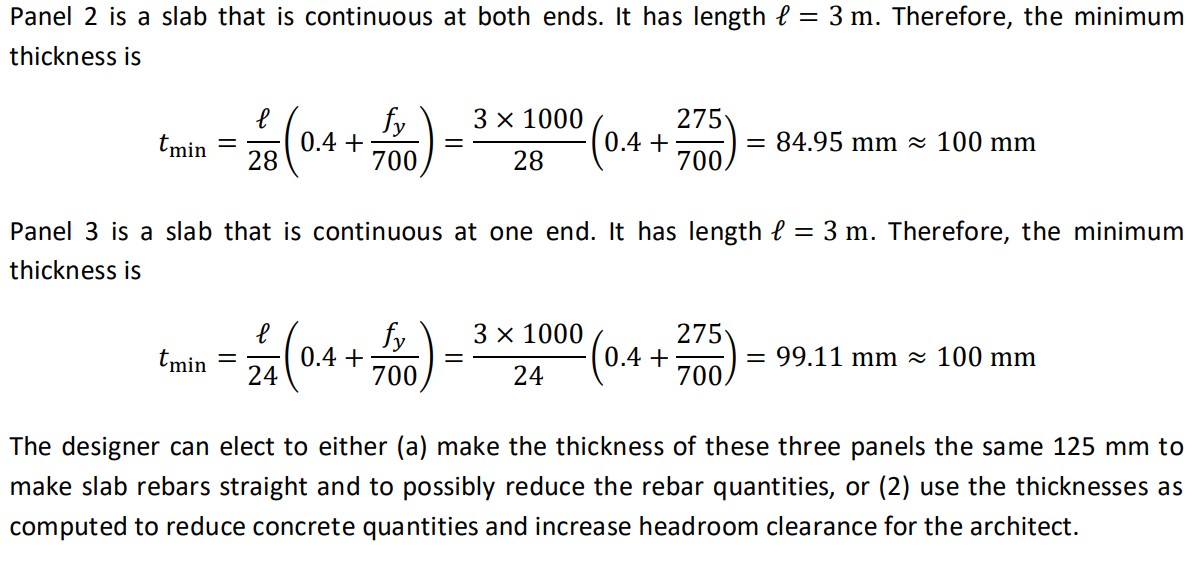
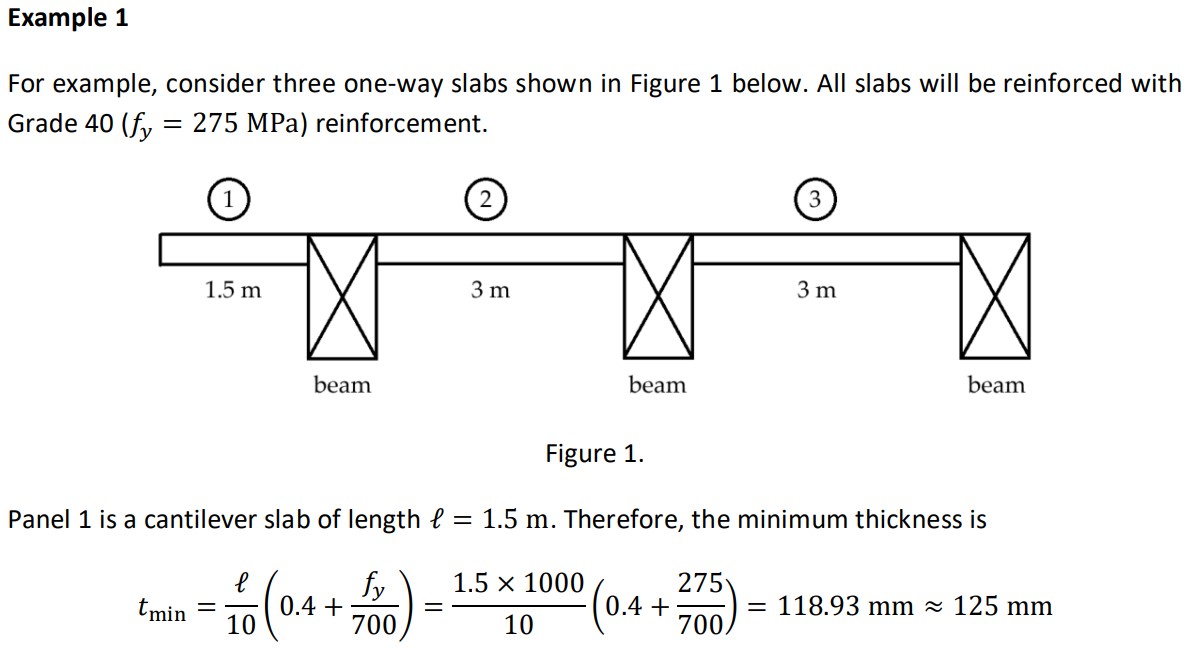
According to ACI 318-19 Section 7.3.1.1, we have the following minimum thicknesses for one-way slabs so that deflections need not be checked, unless the slab carries sensitive partitions and other non-structural members that are likely to be damaged by large deflections.
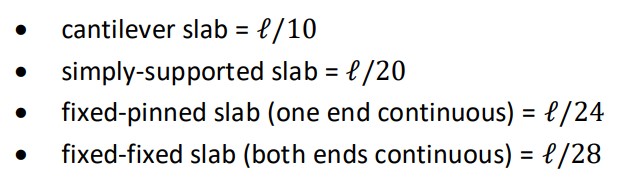

 

One way concrete slabs

one way slab formulas


Example 1Example 1-2

3.2  Two-way concrete slabs


According to ACI 318-19 Section 7.3.1.1, we have the following minimum thicknesses for one-way slabs so that deflections need not be checked, unless the slab carries sensitive partitions and other non-structural members that are likely to be damaged by large deflections.
 

Content visible until here


. Conclusion


About the Editor
Jaydee N. Lucero
Senior Structural Engineer I | Educator Abinales Associates Engineer

Jaydee N. Lucero is a Senior Structural Engineer I at Abinales Associates Engineers Consultants, where he brings over four years of experience in structural design and review. He's also a dedicated educator, having taught various mathematics and civil engineering subjects, and is an author of two books on calculator techniques. His achievements include a first-place finish in the November 2018 Civil Engineering Licensure Examination and a magna cum laude degree from the University of the Philippines Diliman.


👉Learn More About the Editor (click)


※ Click on the keywords below 'Topics' to view related content.

Subscribe to Newsletter

Catch the weekly engineer news!

Rules of Thumb for Preliminary Sizing of Reinforced Concrete Members (Full Text)

Fill out the form below to download the Full Text.

What you may
also like