Would you like to sign out?

Select Country

  • Afghanistan English
  • Albania English
  • Algeria English
  • American Samoa English
  • Andorra English
  • Angola English
  • Anguilla English
  • Antarctica English
  • Antigua and Barbuda English
  • Argentina Español
  • Armenia English
  • Aruba English
  • Australia English
  • Austria English
  • Azerbaijan English
  • Bahamas English
  • Bahrain English
  • Bangladesh English
  • Barbados English
  • Belarus English
  • Belgium English
  • Belize English
  • Benin English
  • Bermuda English
  • Bhutan English
  • Bolivia Español
  • Bosnia and Herzegovina English
  • Botswana English
  • Bouvet Island English
  • Brazil Español
  • British Indian Ocean Territory English
  • British Virgin Islands English
  • Brunei English
  • Bulgaria English
  • Burkina Faso English
  • Burundi English
  • Cambodia English
  • Cameroon English
  • Canada English
  • Cape Verde English
  • Caribbean Netherlands English
  • Cayman Islands English
  • Central African Republic English
  • Chad English
  • Chile Español
  • Christmas Island English
  • Cocos (Keeling) Islands English
  • Colombia Español
  • Comoros English
  • Congo English
  • Cook Islands English
  • Costa Rica Español
  • Côte d’Ivoire English
  • Croatia English
  • Cuba Español
  • Curaçao English
  • Cyprus English
  • Czech Republic English
  • Democratic Republic of the Congo English
  • Denmark English
  • Djibouti English
  • Dominica English
  • Dominican Republic Español
  • Ecuador Español
  • Egypt English
  • El Salvador Español
  • Equatorial Guinea English
  • Eritrea English
  • Estonia English
  • Ethiopia English
  • Falkland Islands English
  • Faroe Islands English
  • Fiji English
  • Finland English
  • France English
  • French Guiana Español
  • French Polynesia English
  • French Southern Territories English
  • Gabon English
  • Gambia English
  • Georgia English
  • Germany English
  • Ghana English
  • Gibraltar English
  • Greece English
  • Greenland English
  • Grenada English
  • Guadeloupe Español
  • Guam English
  • Guatemala Español
  • Guernsey English
  • Guinea English
  • Guinea-Bissau English
  • Guyana English
  • Haiti Español
  • Heard Island and McDonald Islands English
  • Honduras Español
  • Hong Kong English
  • Hungary English
  • Iceland English
  • India English
  • Indonesia English
  • Iran English
  • Iraq English
  • Ireland English
  • Isle of Man English
  • Israel English
  • Italy English
  • Jamaica English
  • Japan 日本語
  • Jersey English
  • Jordan English
  • Kazakhstan English
  • Kenya English
  • Kiribati English
  • South Korea 한국어
  • Kuwait English
  • Kyrgyzstan English
  • Laos English
  • Latvia English
  • Lebanon English
  • Lesotho English
  • Liberia English
  • Libya English
  • Liechtenstein English
  • Lithuania English
  • Luxembourg English
  • Macau English
  • Madagascar English
  • Malawi English
  • Malaysia English
  • Maldives English
  • Mali English
  • Malta English
  • Marshall Islands English
  • Martinique Español
  • Mauritania English
  • Mauritius English
  • Mayotte English
  • Mexico Español
  • Micronesia English
  • Moldova English
  • Monaco English
  • Mongolia English
  • Montenegro English
  • Montserrat English
  • Morocco English
  • Mozambique English
  • Myanmar English
  • Namibia English
  • Nauru English
  • Nepal English
  • Netherlands English
  • New Caledonia English
  • New Zealand English
  • Nicaragua Español
  • Niger English
  • Nigeria English
  • Niue English
  • Norfolk Island English
  • Northern Mariana Islands English
  • Norway English
  • Oman English
  • Pakistan English
  • Palau English
  • Palestine English
  • Panama Español
  • Papua New Guinea English
  • Paraguay Español
  • Peru Español
  • Philippines English
  • Pitcairn Islands English
  • Poland English
  • Portugal Español
  • Puerto Rico Español
  • Qatar English
  • Réunion English
  • Romania English
  • Russia English
  • Rwanda English
  • Saint Barthélemy Español
  • Saint Helena English
  • Saint Kitts and Nevis English
  • Saint Lucia English
  • Saint Martin Español
  • Saint Pierre and Miquelon English
  • Saint Vincent and the Grenadines English
  • Samoa English
  • San Marino English
  • Sao Tome and Principe English
  • Saudi Arabia English
  • Senegal English
  • Serbia English
  • Seychelles English
  • Sierra Leone English
  • Singapore English
  • Sint Maarten English
  • Slovakia English
  • Slovenia English
  • Solomon Islands English
  • Somalia English
  • South Africa English
  • South Georgia English
  • South Sudan English
  • Spain Español
  • Sri Lanka English
  • Sudan English
  • Suriname English
  • Svalbard and Jan Mayen English
  • Eswatini English
  • Sweden English
  • Switzerland English
  • Syria English
  • Taiwan English
  • Tajikistan English
  • Tanzania English
  • Thailand English
  • Togo English
  • Tokelau English
  • Tonga English
  • Trinidad and Tobago English
  • Tunisia English
  • Turkey English
  • Turkmenistan English
  • Turks and Caicos Islands English
  • Tuvalu English
  • U.S. Virgin Islands English
  • Uganda English
  • Ukraine English
  • United Arab Emirates English
  • United Kingdom English
  • United States of America English
  • U.S. Minor Outlying Islands English
  • Uruguay Español
  • Uzbekistan English
  • Vanuatu English
  • Vatican City English
  • Venezuela Español
  • Vietnam English
  • Wallis and Futuna English
  • Western Sahara English
  • Yemen English
  • Zambia English
  • Zimbabwe English
  • Åland Islands English
  • East Timor English
  • Netherlands Antilles English
  • Serbia and Montenegro English
  • North Macedonia English
  • Timor-Leste English
Bridge

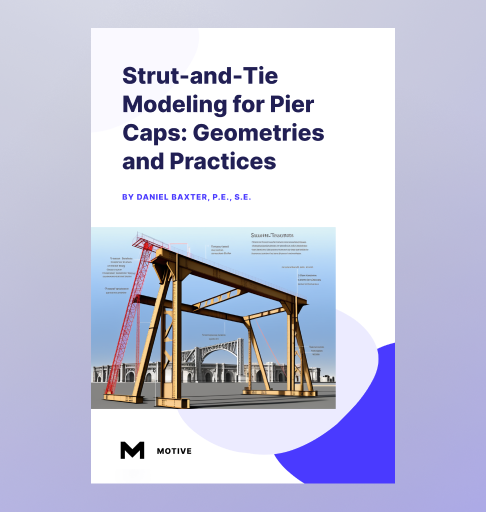
Strut-and-Tie Modeling for Pier Caps: Geometries and Practices

Table of Contents Click the table of contents for details.

What is Strut-and-Tie Analysis? What are "Struts" and "Ties" in Strut-and-Tie Analysis?


Strut-and-tie analysis visualizes the flow of forces through any type of concrete element in the form of internal truss. The tensile members of the internal truss are called "ties" and the compressive members of the internal truss are called "struts" in struct-and-tie analysis. The joints that are needed to join the two types of members together are called "nodes".


When is Strut-and-Tie Analysis Needed? 


Strut-and-tie analysis is suitable for regions of concrete structures that are in vicinity of the application of concentrated loads or are subjected to geometry changes. At those locations, often times the sectional analysis of the beam theory are not applicable. Most pier caps are subjected to concentrated loads from the superstructure, which are supported at the bearings. This results in disturbed regions on the pier cap where again, beam theory is not applicable. However, strut-and-tie analysis can perform design of the pier cap in scenario like this. 


How to Define the Strut-and-Tie Analysis Geometries? 


To perform strut-and-tie analysis for a pier cap shown in figure 1(a), two types of model are created. The first one is a simple frame structure that is modeled using beam elements, as shown in figure 1(b). Superstructure can be included in this model. The second model is a natural strut-and-tie model of the pier cap that represents the internal truss using truss elements in order to model the internal forces. 

Figure 1. (a) Pier cap for strut-and-tie analysis

Figure 1. (a) Pier cap for strut-and-tie analysis. (b) Simple frame structure modeled using beam elements in midas Civil. (c) Strut-and-tie model representing the internal truss force modeled using midas Civil truss elements. 


The first task to define the strut-and-tie analysis structure geometry is by defining the top and bottom ties. They will be placed at the centerlines of the top and bottom longitudinal steel. This is because we are going to use the force in our ties to directly design the reinforcement steel. For some cases where the pier cap might have longitudinal crack control reinforcement, but not all of these bars should be necessarily included as the tie members.


Nodes in the model are going to be placed at the intersection where the bearings of the girders are placed on the pier cap. We also need to place nodes in the model where the pier cap model intersects the columns, and the location of these nodes depends on if the columns are considered fixed support or pinned support to the pier cap. In the example shown in this article, they are considered fixed supports, therefore, the column nodes will be placed at the intersection of the quarter (1/4) points in the column and the steel tie elements at the pier cap bottom.  


Figure 2. (a) Pier cap with top and bottom longitudinal steel reinforcement shown

Figure 2. (a) Pier cap with top and bottom longitudinal steel reinforcement shown. (b) Girder loading locations, for this model the two girders for different spans are slightly offset. (c) Locations where pier cap intersects the column. 


How to Determine the Locations of the Vertical and Diagonal Members in the Strut-and-Tie Model?


Having determined the top and bottom ties and the locations of nodes that represents concentrated loads and supports, the preliminary strut-and-tie model gives a general idea of how the completed geometry would look like. However, to determine the location of additional nodes, vertical members, diagonal members, and additional members, the following steps and rules need to be followed.


  • Follow the direct load path (draw structs from girder nodes to the nearest column nodes). 
  • Follow the 25° rule from AASHTO (no strut/tie should have less than 25° angle in between).
  • Use overlapping X-diagonals between all vertical members. 


The tensile force in the tie elements are used to design the reinforcing steel members. The X-diagonals are not expected to be in tension, but depending on the live load case placed on the superstructure, some may potentially go to tension. Therefore, X-diagonals are defined as compression-only elements in midas Civil.

 

Content visible until here


You can check more of these details in the download file.


How to Determine the Locations of the Vertical and Diagonal Members in the Strut-and-Tie Model?


What are Examples of Good and Bad Strut-and-Tie Models?



About the Editor
Daniel Baxter P.E., S.E.
Bridge Department Manager and Project Manager at Michael Baker International(Minneapolis, MN)

Daniel Baxter is the bridge department manager at Michael Baker's Minneapolis office, excelling as a project manager and senior bridge engineer with expertise in complex bridge projects like the Third Avenue Bridge and Winona Bridge. His technical proficiency extends to advanced finite element analysis, strut-and-tie modeling, and he is an NHI-certified instructor for bridge design courses. Baxter, holding degrees in Physics and Civil Engineering, is a licensed professional and structural engineer in Minnesota and Illinois.

👉Learn More About the Editor (click)
 

Subscribe to Newsletter

Catch the weekly engineer news!

Strut-and-Tie Modeling for Pier Caps: Geometries and Practices (Full Text)

Fill out the form below to download the Full Text.

What you may
also like