
Analysis of suspension bridges - Peery’s methods use integration
To calculate the area of influence lines, Simpson’s method has been applied. Simpson’s method results in a very accurate value if the number of divisions is even and each division has the same length.
Unfortunately, this is not always the case in the influence lines. For moment influence lines, the ordinates at the end of loaded lengths are small and the errors are also minor. However, the ordinates at this location for the Hp influence lines are not minor and we need some countermeasures.
We may have three options:
-
Separate considerations for this end part as applied in the previous calculation
-
Add more divisions to increase the accuracy
-
Exact integrations as closed forms
Even though Simpson’s method gives very accurate results, we have no reason not to use the exact solution. It might be difficult in 1954 to calculate the numerical values with slide rules, but now we have computers.
Loaded length ξL can be found easily by setting the moment equation M(x)=0.
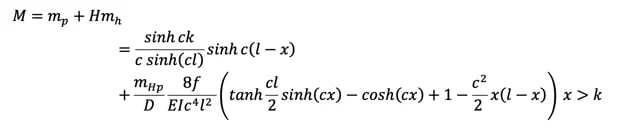
For x/L=0.2 case as previously calculated, ξL=(0.3287)(800)=263.0m is found and very close to (0.3293)(800)=263.4m from the Simpson’s method.
The integrated forms are as follows.
%20min%20case.jpg?width=644&height=115&name=For%20(Hw+Hp)%20min%20case.jpg)
For (Hw+Hp) min case,
![This area in 1823 is again very close to 1825 from the Simpson’s method[1]](https://resource.midasuser.com/hs-fs/hubfs/MOTIVE_Image/Expert%20Tip%20Analysis%20of%20Suspension%20Bridges%204/This%20area%20in%201823%20is%20again%20very%20close%20to%201825%20from%20the%20Simpson%E2%80%99s%20method%5B1%5D.jpg?width=609&height=155&name=This%20area%20in%201823%20is%20again%20very%20close%20to%201825%20from%20the%20Simpson%E2%80%99s%20method%5B1%5D.jpg)
![This area in 1823 is again very close to 1825 from the Simpson’s method[2]](https://resource.midasuser.com/hs-fs/hubfs/MOTIVE_Image/Expert%20Tip%20Analysis%20of%20Suspension%20Bridges%204/This%20area%20in%201823%20is%20again%20very%20close%20to%201825%20from%20the%20Simpson%E2%80%99s%20method%5B2%5D.jpg?width=725&height=433&name=This%20area%20in%201823%20is%20again%20very%20close%20to%201825%20from%20the%20Simpson%E2%80%99s%20method%5B2%5D.jpg)
This area in 1823 is again very close to 1825 from the Simpson’s method. Even though these two methods give very close results, theoretically the value from closed form is more accurate and simpler to calculate with computers, so we have no reason to stick to Simpson’s method.
Analysis of Suspension Bridges - Timoshenko’s trigonometric solution
Many engineers never be aware that Timoshenko also developed a suspension analysis method using a trigonometric function (Timoshenko, S.P., “The Stiffness of Suspension Bridges”, ASCE Trans., May 1928)
Moisseiff’s solution uses an exponential function, Peery’s uses a hyperbolic function, and Timoshenko’s uses sinusoidal functions and theoretically results in a more accurate solution if enough terms are included.
Again, the deflection equation is

If we define
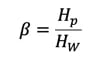
Eq(2) can be written as
%20can%20be%20written%20as.jpg?width=338&height=61&name=Eq(2)%20can%20be%20written%20as.jpg)
Timoshenko solved this equation using the trigonometric function and his solution is

He derived ai for odd terms as
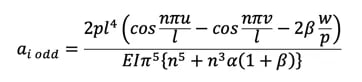
For even terms,
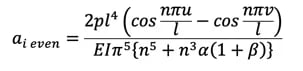
Here,
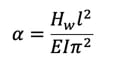
The cable equation is,
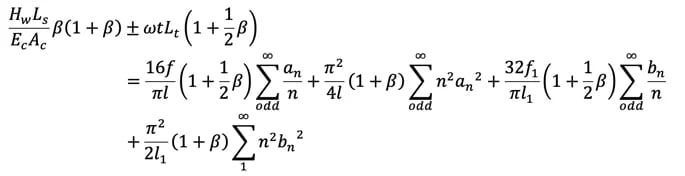
Girder moments can be found easily by differentiation.

We can solve the same problem using Timoshenko’s trigonometric solution
Step 1) Assume
%20Assume.jpg?width=144&height=54&name=Step%201)%20Assume.jpg)
Step 2) for center span
%20for%20center%20span.jpg?width=302&height=63&name=Step%202)%20for%20center%20span.jpg)
Assume
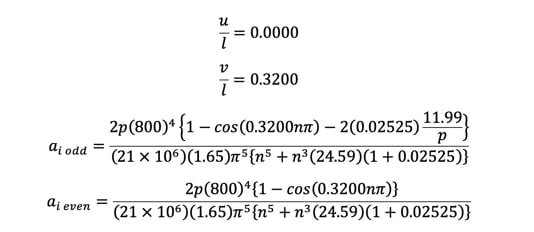
Step 3) for side span
%20for%20side%20span.jpg?width=340&height=63&name=Step%203)%20for%20side%20span.jpg)
Assume
![Assume[2]](https://resource.midasuser.com/hs-fs/hubfs/MOTIVE_Image/Expert%20Tip%20Analysis%20of%20Suspension%20Bridges%204/Assume%5B2%5D.jpg?width=471&height=199&name=Assume%5B2%5D.jpg)
For each i, the term ai can be calculated as follows.
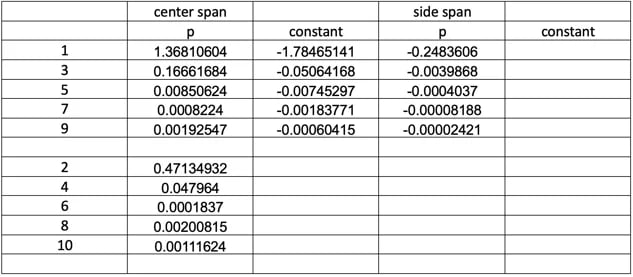
Step 4) apply cable equation to find updated β.
![Step 4) apply cable equation to find updated β[1]](https://resource.midasuser.com/hs-fs/hubfs/MOTIVE_Image/Expert%20Tip%20Analysis%20of%20Suspension%20Bridges%204/Step%204)%20apply%20cable%20equation%20to%20find%20updated%20%CE%B2%5B1%5D.jpg?width=623&height=417&name=Step%204)%20apply%20cable%20equation%20to%20find%20updated%20%CE%B2%5B1%5D.jpg)
![Step 4) apply cable equation to find updated β[2]](https://resource.midasuser.com/hs-fs/hubfs/MOTIVE_Image/Expert%20Tip%20Analysis%20of%20Suspension%20Bridges%204/Step%204)%20apply%20cable%20equation%20to%20find%20updated%20%CE%B2%5B2%5D.jpg?width=684&height=590&name=Step%204)%20apply%20cable%20equation%20to%20find%20updated%20%CE%B2%5B2%5D.jpg)
Repeat step1) to step4) until β matches.
Step 5)
.jpg?width=341&height=42&name=Step%205).jpg)
Comparing Hp=334.5 ton from the deflection theory, the error is less than 1%, and theoretically, Timoshenko’s value has higher accuracy.
Now we can calculate each ai term.
For odd terms,
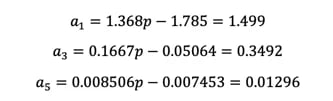
For odd terms,
![For odd terms[2]](https://resource.midasuser.com/hs-fs/hubfs/MOTIVE_Image/Expert%20Tip%20Analysis%20of%20Suspension%20Bridges%204/For%20odd%20terms%5B2%5D.jpg?width=265&height=109&name=For%20odd%20terms%5B2%5D.jpg)
Step6) The girder moment at x/L=0.2=160m is,
%20The%20girder%20moment%20at%20xL=0.2=160m%20is.jpg?width=635&height=229&name=Step6)%20The%20girder%20moment%20at%20xL=0.2=160m%20is.jpg)
Repeat step2) to step) to maximize M.
Moments at x/L=0.2=160m, M=4702 t-m from Timoshenko’s trigonometric method is close to the moment from the deflection theory is 4707 t-m and the error is less than 0.1%.
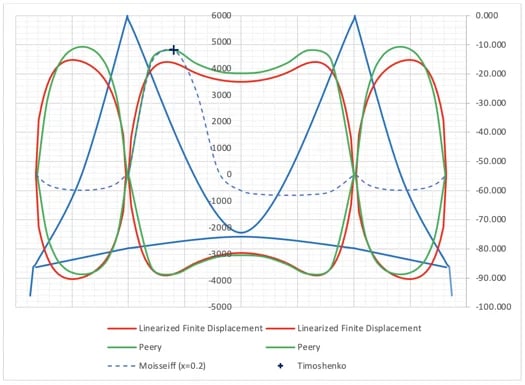
The girder moments calculated by Timoshenko’s trigonometric solution are very close to those from the deflection theory and Peery’s methods.
Now we can have some questions.
-
Q) How many terms should we include in the calculation?
-
A) The simple answer is “The more, the better”
However, the higher order terms contribute little effect to the solution but used to be very tedious to calculate. Now, we have no problem with computers.
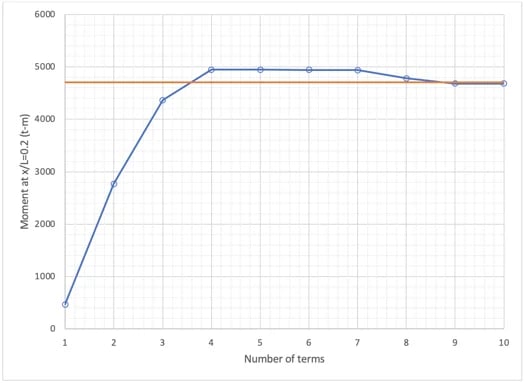
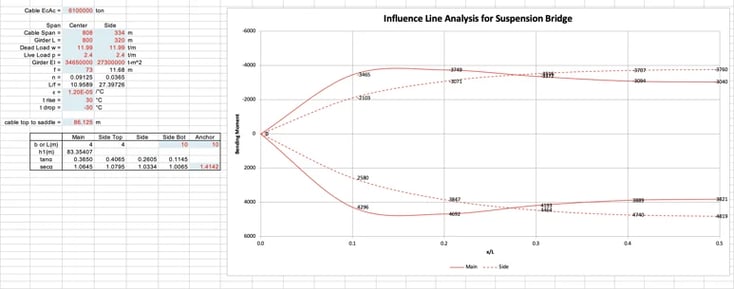
In the figure, the red line shows the moment with an infinite number of terms (O.K., no way to include a real infinite number of terms, it is with lower 42 terms), M=4702 t-m.
With the lower three terms, the error is 7%, with the lower four terms, the error is 5%, with the lower nine terms, the error is 1%, etc.
Interestingly, the error never directly decreases with more terms. It tends to decrease, however, with minor waves because the function itself is trigonometric.
From the author’s view, the lower ten terms should be adequate.
This Timoshenko solution is very systematic and gives very accurate results, however rarely applied in the real design for the early suspension bridges. There might be some reasons and one of them might be it needs much arithmetic calculations with slide rules.
In 1958, three engineers in Bethlehem Steel, Kuntz, Avery, and Durkee, developed a computer program using Timoshenko’s trigonometric methods with some modifications (Kuntz, C.P., Avery, J.P., Durkee, J.L., “Suspension Bridge Truss Analysis by Electronic Computer”, ASCE Conference on Electronic Computation, Nov. 1958).
Limitation of classical theory
The deflection theory, Peery’s methods, and Timoshenko’s methods are called classical theory. These have many advantages and the most important one is we can see the behavior of suspension bridges through a single formula.
For example, if the distance between pylons increases, the cable goes upward. How much it would be? I met an engineer who was trying to find this value with a huge computer model. From the classical theory, this would be a simple problem.
However, there are many limitations. These theories give reliable results for vertical loads, however, do not provide any solution for longitudinal and transverse loadings. In other words, we cannot analyze for wind and seismic loadings which are critical for suspension bridges. Also, we cannot consider the spacing, elongation, and inclination of the hangers. There had been much research to fill these gaps for the classical theory, but none was successful nor practical, at least.
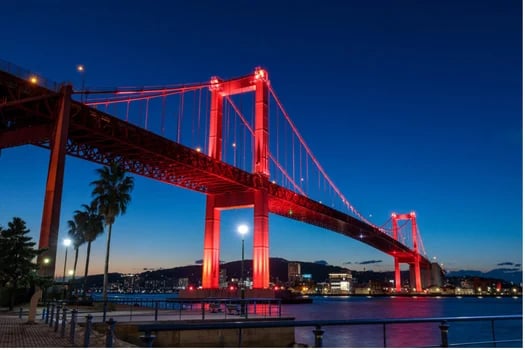
In the early 60s, Japanese engineers started to build suspension bridges and one of the first was the Wakado bridge, main span 367m, opened in 1962. The name Wakato means it connects two towns “Waka”matsu and “To”bata.
With the success of the Wakato Bridge, Japanese engineers started to build long-span suspension bridges and one of the first was Kanmon Bridge.
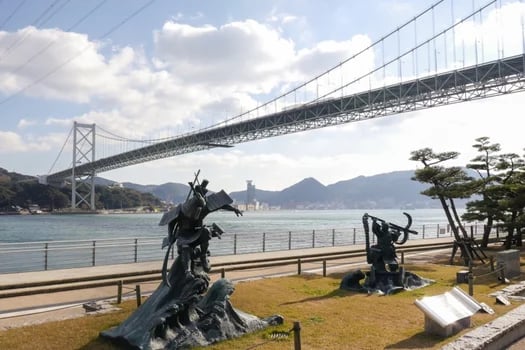
Kanmon Bridge has a main span of 1068m (3504ft) and opened in 1973.
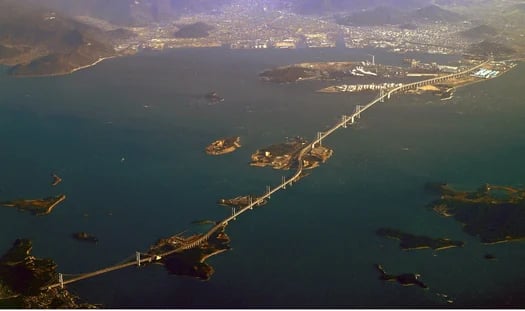
Japanese engineer Dr. Ohtsuki started his career as a suspension bridge engineer in the 70s. He was very well aware of these limitations and also the limitation of computers at that time to incorporate the 3D non-linear displacement theory. He developed a new theory that can consider the effects of elongation, spacing, and inclination of hangers by expanding the three-moment theorem. It is called the five-moment theorem (Ohtuski, A study on the analytical theory of suspension bridges) and he designed many Japanese suspension bridges including the Seto bridges using his method.

He is a Senior Supervising Engineer with a high level of expertise in the design and analysis of suspension bridges. He has a solid fundamental understanding of structures and can apply his knowledge exceptionally well to the design and analysis of highly complex structures. He is also a strong communicator, able to identify and distill the key information that is relevant to the task at hand and present it in a clear and quickly understandable manner.