Would you like to sign out?

Select Country

  • Afghanistan English
  • Albania English
  • Algeria English
  • American Samoa English
  • Andorra English
  • Angola English
  • Anguilla English
  • Antarctica English
  • Antigua and Barbuda English
  • Argentina Español
  • Armenia English
  • Aruba English
  • Australia English
  • Austria English
  • Azerbaijan English
  • Bahamas English
  • Bahrain English
  • Bangladesh English
  • Barbados English
  • Belarus English
  • Belgium English
  • Belize English
  • Benin English
  • Bermuda English
  • Bhutan English
  • Bolivia Español
  • Bosnia and Herzegovina English
  • Botswana English
  • Bouvet Island English
  • Brazil Español
  • British Indian Ocean Territory English
  • British Virgin Islands English
  • Brunei English
  • Bulgaria English
  • Burkina Faso English
  • Burundi English
  • Cambodia English
  • Cameroon English
  • Canada English
  • Cape Verde English
  • Caribbean Netherlands English
  • Cayman Islands English
  • Central African Republic English
  • Chad English
  • Chile Español
  • Christmas Island English
  • Cocos (Keeling) Islands English
  • Colombia Español
  • Comoros English
  • Congo English
  • Cook Islands English
  • Costa Rica Español
  • Côte d’Ivoire English
  • Croatia English
  • Cuba Español
  • Curaçao English
  • Cyprus English
  • Czech Republic English
  • Democratic Republic of the Congo English
  • Denmark English
  • Djibouti English
  • Dominica English
  • Dominican Republic Español
  • Ecuador Español
  • Egypt English
  • El Salvador Español
  • Equatorial Guinea English
  • Eritrea English
  • Estonia English
  • Ethiopia English
  • Falkland Islands English
  • Faroe Islands English
  • Fiji English
  • Finland English
  • France English
  • French Guiana Español
  • French Polynesia English
  • French Southern Territories English
  • Gabon English
  • Gambia English
  • Georgia English
  • Germany English
  • Ghana English
  • Gibraltar English
  • Greece English
  • Greenland English
  • Grenada English
  • Guadeloupe Español
  • Guam English
  • Guatemala Español
  • Guernsey English
  • Guinea English
  • Guinea-Bissau English
  • Guyana English
  • Haiti Español
  • Heard Island and McDonald Islands English
  • Honduras Español
  • Hong Kong English
  • Hungary English
  • Iceland English
  • India English
  • Indonesia English
  • Iran English
  • Iraq English
  • Ireland English
  • Isle of Man English
  • Israel English
  • Italy English
  • Jamaica English
  • Japan 日本語
  • Jersey English
  • Jordan English
  • Kazakhstan English
  • Kenya English
  • Kiribati English
  • South Korea 한국어
  • Kuwait English
  • Kyrgyzstan English
  • Laos English
  • Latvia English
  • Lebanon English
  • Lesotho English
  • Liberia English
  • Libya English
  • Liechtenstein English
  • Lithuania English
  • Luxembourg English
  • Macau English
  • Madagascar English
  • Malawi English
  • Malaysia English
  • Maldives English
  • Mali English
  • Malta English
  • Marshall Islands English
  • Martinique Español
  • Mauritania English
  • Mauritius English
  • Mayotte English
  • Mexico Español
  • Micronesia English
  • Moldova English
  • Monaco English
  • Mongolia English
  • Montenegro English
  • Montserrat English
  • Morocco English
  • Mozambique English
  • Myanmar English
  • Namibia English
  • Nauru English
  • Nepal English
  • Netherlands English
  • New Caledonia English
  • New Zealand English
  • Nicaragua Español
  • Niger English
  • Nigeria English
  • Niue English
  • Norfolk Island English
  • Northern Mariana Islands English
  • Norway English
  • Oman English
  • Pakistan English
  • Palau English
  • Palestine English
  • Panama Español
  • Papua New Guinea English
  • Paraguay Español
  • Peru Español
  • Philippines English
  • Pitcairn Islands English
  • Poland English
  • Portugal Español
  • Puerto Rico Español
  • Qatar English
  • Réunion English
  • Romania English
  • Russia English
  • Rwanda English
  • Saint Barthélemy Español
  • Saint Helena English
  • Saint Kitts and Nevis English
  • Saint Lucia English
  • Saint Martin Español
  • Saint Pierre and Miquelon English
  • Saint Vincent and the Grenadines English
  • Samoa English
  • San Marino English
  • Sao Tome and Principe English
  • Saudi Arabia English
  • Senegal English
  • Serbia English
  • Seychelles English
  • Sierra Leone English
  • Singapore English
  • Sint Maarten English
  • Slovakia English
  • Slovenia English
  • Solomon Islands English
  • Somalia English
  • South Africa English
  • South Georgia English
  • South Sudan English
  • Spain Español
  • Sri Lanka English
  • Sudan English
  • Suriname English
  • Svalbard and Jan Mayen English
  • Eswatini English
  • Sweden English
  • Switzerland English
  • Syria English
  • Taiwan English
  • Tajikistan English
  • Tanzania English
  • Thailand English
  • Togo English
  • Tokelau English
  • Tonga English
  • Trinidad and Tobago English
  • Tunisia English
  • Turkey English
  • Turkmenistan English
  • Turks and Caicos Islands English
  • Tuvalu English
  • U.S. Virgin Islands English
  • Uganda English
  • Ukraine English
  • United Arab Emirates English
  • United Kingdom English
  • United States of America English
  • U.S. Minor Outlying Islands English
  • Uruguay Español
  • Uzbekistan English
  • Vanuatu English
  • Vatican City English
  • Venezuela Español
  • Vietnam English
  • Wallis and Futuna English
  • Western Sahara English
  • Yemen English
  • Zambia English
  • Zimbabwe English
  • Åland Islands English
  • East Timor English
  • Netherlands Antilles English
  • Serbia and Montenegro English
  • North Macedonia English
  • Timor-Leste English
Bridge

Understanding Convergence in Curved Girder Analysis

Table of Contents Click the table of contents for details.

What is Convergence? What is a Convergence Study? 


It is easy to obtain the result from bridge finite element analysis, but to get more accurate results requires extra effort. Even the most robust finite element analysis solvers adopt the method that approximates the structural behavior, by minimizing the associated error function compared with the complex function that represents the realistic structural behavior. 


To make this approximation more accurate, convergence studies need to be done, Typically, convergence refers to the smallness of the elements required in a model to ensure that the results of an analysis are not affected by changing the size of the mesh (The importance of Mesh Convergence, NAFEMS). Convergence study is an iterative process in which the mesh size is refined until the finite element analysis results are within a stable and reasonable range, and further refinement of the mesh size does not affect analysis results.


Why is Convergence Important in Curved Girder Analysis? 


Let's start with an example. To obtain torsional moments in the curved girders from the bridge shown in Figure 1, the bridge is modeled in midas Civil using 1D elements. The bridge has spans of 160 ft - 210 ft - 160 ft measured along the centerline of the bridge. The radius of the bridge is 700 ft at the centerline. All supports are radial with respect to the centerline. Four I girders run along the bridge span, and detailed dimensions and properties can be found in the reference. 
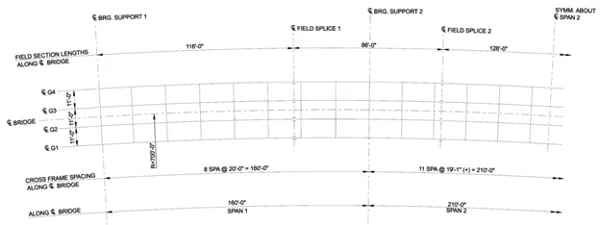
Figure 1. Framing plan of a typical three-span continuous horizontally curved composite steel I-girder bridge

Figure 1. Framing plan of a typical three-span continuous horizontally curved composite steel I-girder bridge (FHWA-IF-12-052 - Vol 23, pg. 13) 


We are modeling G04, the longest girder, as a single-line girder. We divide each span with equally spaced eight elements. The given loading is uniform loads as shown in figure 2, and the torsional moment diagram output is shown in figure 3.  (Download the input file: 8Division). 

Figure 2. (Top) Plane view and (bottom) general view with loading and boundary conditionFigure 2. (Top) Plane view and (bottom) general view with loading and boundary condition.  

Figure 3. Torsional moment due to uniformly distributed load for curved girder G04

Figure 3. Torsional moment due to uniformly distributed load for curved girder G04.


As shown in Figure 3, maximum torsional moments occur at the girder ends where the abutments are. However, torsional moments are relatively low at the pier locations. At the center span, maximum torsional moments occur somewhere near the quarter points.

Figure 4. Torsional moment comparison (1 of 2)

Figure 4. Torsional moment comparison (1 of 2).


The graph in Figure 3 is re-generated in Figure 4 with the grey line. The black line is the torsional moments from classical curved beam theory (Watanabe. N. 1967, Theory and Calculation of Curved Girder, Gihodo, Tokyo). Figure 4 shows the difference in the torsional moments using two methods at the pier location (nodes 8 and 16) is significant. From the classical theory, the torsional moment at node 8 is around 76 kip-ft to -74 kip-ft. However, the value from midas Civil is around 22 kip-ft to -5 kip-ft. 


This difference is because 1) Curved girders are modeled using straight beam elements, 2) Most programs, including midas Civil, assume the torsional moment within an element to be constant. When we look at elements 8-9, where T = -5 kip-ft is close to the average of the torsional moment from classical theory, (-74 kip-ft + 39 kip-ft)/2. Since modeling the curved girder using curved elements is not possible, we can try to refine the size of the straight beam elements used to simulate the girders. As shown in Figure 5, the torsional moments obtained from reducing the beam element size by half are compared with those from Figure 4. (Download input file: 16Division).

Figure 5. Torsional moment comparison (2 of 2)Figure 5. Torsional moment comparison (2 of 2).


From the outlook, the output from the model with more refined curved girder elements has a better resemblance with the theoretical behavior. If we divide each span into 16 elements, midas Civil gives the torsional moments as 46 kip-ft to -34 kip-ft at node 8. Even though this is still not close to the "real" solution, reducing the element size by half has made the result approximation much closer than previously. 


Then how do we know the ideal element size? Do we increase the number of divisions to 32, 64, or even 100? Going back to our original question: why is convergence study important in curved girder bridge analysis? A convergence study is able to help determine when to stop refining element size for the straight beam elements. The formal method of establishing mesh convergence requires a curve of a critical result parameter in a specific location (The importance of Mesh Convergence, NAFEMS), in this case, the parameter could be the torsional moment value at element node 8-9. By plotting the mesh refinement against the torsional moment, a general trend can be observed and engineers can decide what mesh refinement is that no longer affects the analysis result.     



About the Editor
Seungwoo Lee PhD, P.E., S.E.
Senior Supervising Engineer at WSP USAs (Tampa, FL)

He is a Senior Supervising Engineer with a high level of expertise in the design and analysis of suspension bridges. He has a solid fundamental understanding of structures and can apply his knowledge exceptionally well to the design and analysis of highly complex structures. He is also a strong communicator, able to identify and distill the key information that is relevant to the task at hand and present it in a clear and quickly understandable manner.

Subscribe to Newsletter

Catch the weekly engineer news!

What you may
also like