At the beginning,
I first encountered seismic design through a dispatched training program in seismic engineering from the International Institute of Seismology and Earthquake Engineering (IISEE), headquartered at the Japan Architectural Research Institute, in 1985. It was during this time that I gained an understanding of the meaning of response spectra based on dynamics and developed a passion for the field, leading me to decide to study abroad at the University of Tokyo. Even during my tenure as a new employee at the Korea Electric Power Corporation, I came across the term "response spectrum," but the significance remained elusive.
The foundational dynamics of this content were introduced to me through the teachings of the late Professor Watabe, and it was through his lessons that I learned about the concept of seismic design in relation to the resonance phenomenon of earthquakes and structures. Understanding this resonance phenomenon involves solving the differential equations that combine Hooke's elasticity theory with Newton's inertial force, and I believe one must attempt to solve these equations by hand to truly grasp the concept.
The solutions to the vibration equations include those for free vibration without external forces and forced vibration with external forces. Within free vibration, there are solutions both with and without damping. While the process of solving these differential equations may be somewhat challenging compared to undergraduate studies, it is entirely understandable for those who have completed high school mathematics.
Many general textbooks often omit the solution process of differential equations, but in this content, I have endeavored to present it without omission to make it accessible to everyone.
There is a significant difference between understanding the equations of dynamics and encountering seismic design problems, and grasping the concepts without delving into the equations. In-depth understanding of any discipline often leads to a natural understanding of other disciplines.
I hope that future students, through the study of dynamics, can experience the joy of learning and enlightenment. Particularly, understanding the amplification ratio and phase angle in forced vibration, which will be explained in the next section, will provide insight into most vibration problems.
Chapter 1: Fundamentals of Vibrations
1.1 Gravitational Units
In engineering, commonly used units include absolute units and gravitational units, with MKS units and CGS units as examples of absolute units. The term MKS is derived from the initial letters of meters, kilograms, and seconds, while CGS is based on the initial letters of centimeters, grams, and seconds.
One crucial point to note in the relationship between absolute units and gravitational units is the unit of mass. In other words, the mass of an object remains constant, whether the object is on Earth or the moon. However, weight varies based on the magnitude of the gravitational force acting on the object. The weight on Earth is equal to the mass (m) multiplied by the acceleration due to gravity (g).
Since all objects we deal with are considered in relation to objects on Earth, it is important to be aware that values used in the equations of motion for objects will be expressed in gravitational units. In the vibration equations, the mass representing the magnitude of inertial forces should be expressed as m = W/g, and W should not be used.
Even in a spacecraft in a state of weightlessness, the force required for movement follows the same principle where a larger mass, such as metal, requires a greater force compared to a smaller mass, like rubber.
1.2 Vector Representation of Harmonic Oscillation
While vibrations can take various forms, harmonic oscillation is considered the most fundamental. Harmonic oscillation is represented graphically as a sine wave on a graph with time on the horizontal axis and amplitude on the vertical axis. The general equation for harmonic oscillation can be expressed as a sine wave.

Where, let x represent displacement, X denote amplitude, ω denote circular frequency (also known as angular oscillation frequency or angular frequency), Φ represent initial phase, and (ωt + Φ) is referred to as the phase angle. Equation (1.1) is expressed as shown in Figure 1.1.
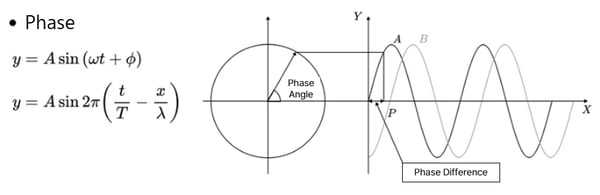
If we designate t=0 as point A in Figure 1.1, the graph shifts to the right, passing through the origin O'. Therefore, Equation (1.1) becomes equation (1.2) :

The angular frequency is the angle through which the vector in the left part of Figure 1.1 rotates in one second. The time taken for the vector to complete one rotation, or the time to draw one cycle in the right part of the figure, is denoted as T and is referred to as the period.

Moreover, the reciprocal of T, denoted as ω/2π, represents the number of times 2π is contained in ω, indicating the frequency of rotations in one second. This is referred to as the frequency f.
Vibrations theory is expressed as a function of time and is simpler compared to wave theory, which is expressed as a function of both time and space.
Wave theory, representing space simultaneously, introduces additional variables such as coordinates and wave numbers.
1.3 Difference Between Dynamics and Statics
Among the loads acting on a structure, dynamic loads refer to those where the magnitude, direction, and point of application vary over time, while static loads refer to loads where these parameters remain constant over time. Within dynamic loads, impact loads are characterized by extremely intense forces acting for very short durations. Wind loads and seismic loads are examples of dynamic loads.
The moment of action of seismic loads transmitted through the foundation soil, at the point where the loads are most intense, can be considered as an impact load.
Dynamic loads act on structures externally, disrupting the static equilibrium previously maintained, resulting in vibration. Therefore, dynamic loads are often referred to as disturbances or external forces.
Structures subject to such loads are called vibrating systems, and the motion of the vibrating system due to external disturbances is referred to as the response. The vibration of a vibrating system can be divided into forced vibration, where vibrations continue even after the external force has caused them, and free vibration, where the system vibrates without external forces after experiencing a temporary external force.
The free vibration experienced in everyday structures does not continue indefinitely; instead, the amplitude of vibration decreases with time, eventually coming to a stop. This is because damping forces, which resist vibrations by acting in the opposite direction, are present in vibrating systems, and such vibrations are referred to as damped vibrations.

You can check more of these details in the download file.
Chapter 2: Single-Degree-of-Freedom Systems
2.1 Degrees of Freedom
2.2 Equations of Motion for Single-Degree-of-Freedom Systems
🌏Explore the next part of our series to deepen your knowledge
: Vibration Theory 1.2: Dynamics of Free Vibrations (👈Click)
/%EC%A0%84%EA%B7%9C%EC%8B%9D_346_240.png)
Dr. Gyusik Jeon, with over 20 years of experience in Architectural Engineering, has a diverse career including roles at KEPCO's Power Research Institute (1980-1997), Technical Director at Unison Construction (1997-2000), and currently works with a seismic base isolators production company. He graduated from Busan National University in Civil Engineering and holds a Master's and Ph.D. from the University of Tokyo's Seismic Research Institute.
※ If you click on the keywords under 'Topics,' you can view related content.