Would you like to sign out?

Select Country

  • Afghanistan English
  • Albania English
  • Algeria English
  • American Samoa English
  • Andorra English
  • Angola English
  • Anguilla English
  • Antarctica English
  • Antigua and Barbuda English
  • Argentina Español
  • Armenia English
  • Aruba English
  • Australia English
  • Austria English
  • Azerbaijan English
  • Bahamas English
  • Bahrain English
  • Bangladesh English
  • Barbados English
  • Belarus English
  • Belgium English
  • Belize English
  • Benin English
  • Bermuda English
  • Bhutan English
  • Bolivia Español
  • Bosnia and Herzegovina English
  • Botswana English
  • Bouvet Island English
  • Brazil Español
  • British Indian Ocean Territory English
  • British Virgin Islands English
  • Brunei English
  • Bulgaria English
  • Burkina Faso English
  • Burundi English
  • Cambodia English
  • Cameroon English
  • Canada English
  • Cape Verde English
  • Caribbean Netherlands English
  • Cayman Islands English
  • Central African Republic English
  • Chad English
  • Chile Español
  • Christmas Island English
  • Cocos (Keeling) Islands English
  • Colombia Español
  • Comoros English
  • Congo English
  • Cook Islands English
  • Costa Rica Español
  • Côte d’Ivoire English
  • Croatia English
  • Cuba Español
  • Curaçao English
  • Cyprus English
  • Czech Republic English
  • Democratic Republic of the Congo English
  • Denmark English
  • Djibouti English
  • Dominica English
  • Dominican Republic Español
  • Ecuador Español
  • Egypt English
  • El Salvador Español
  • Equatorial Guinea English
  • Eritrea English
  • Estonia English
  • Ethiopia English
  • Falkland Islands English
  • Faroe Islands English
  • Fiji English
  • Finland English
  • France English
  • French Guiana Español
  • French Polynesia English
  • French Southern Territories English
  • Gabon English
  • Gambia English
  • Georgia English
  • Germany English
  • Ghana English
  • Gibraltar English
  • Greece English
  • Greenland English
  • Grenada English
  • Guadeloupe Español
  • Guam English
  • Guatemala Español
  • Guernsey English
  • Guinea English
  • Guinea-Bissau English
  • Guyana English
  • Haiti Español
  • Heard Island and McDonald Islands English
  • Honduras Español
  • Hong Kong English
  • Hungary English
  • Iceland English
  • India English
  • Indonesia English
  • Iran English
  • Iraq English
  • Ireland English
  • Isle of Man English
  • Israel English
  • Italy English
  • Jamaica English
  • Japan 日本語
  • Jersey English
  • Jordan English
  • Kazakhstan English
  • Kenya English
  • Kiribati English
  • South Korea 한국어
  • Kuwait English
  • Kyrgyzstan English
  • Laos English
  • Latvia English
  • Lebanon English
  • Lesotho English
  • Liberia English
  • Libya English
  • Liechtenstein English
  • Lithuania English
  • Luxembourg English
  • Macau English
  • Madagascar English
  • Malawi English
  • Malaysia English
  • Maldives English
  • Mali English
  • Malta English
  • Marshall Islands English
  • Martinique Español
  • Mauritania English
  • Mauritius English
  • Mayotte English
  • Mexico Español
  • Micronesia English
  • Moldova English
  • Monaco English
  • Mongolia English
  • Montenegro English
  • Montserrat English
  • Morocco English
  • Mozambique English
  • Myanmar English
  • Namibia English
  • Nauru English
  • Nepal English
  • Netherlands English
  • New Caledonia English
  • New Zealand English
  • Nicaragua Español
  • Niger English
  • Nigeria English
  • Niue English
  • Norfolk Island English
  • Northern Mariana Islands English
  • Norway English
  • Oman English
  • Pakistan English
  • Palau English
  • Palestine English
  • Panama Español
  • Papua New Guinea English
  • Paraguay Español
  • Peru Español
  • Philippines English
  • Pitcairn Islands English
  • Poland English
  • Portugal Español
  • Puerto Rico Español
  • Qatar English
  • Réunion English
  • Romania English
  • Russia English
  • Rwanda English
  • Saint Barthélemy Español
  • Saint Helena English
  • Saint Kitts and Nevis English
  • Saint Lucia English
  • Saint Martin Español
  • Saint Pierre and Miquelon English
  • Saint Vincent and the Grenadines English
  • Samoa English
  • San Marino English
  • Sao Tome and Principe English
  • Saudi Arabia English
  • Senegal English
  • Serbia English
  • Seychelles English
  • Sierra Leone English
  • Singapore English
  • Sint Maarten English
  • Slovakia English
  • Slovenia English
  • Solomon Islands English
  • Somalia English
  • South Africa English
  • South Georgia English
  • South Sudan English
  • Spain Español
  • Sri Lanka English
  • Sudan English
  • Suriname English
  • Svalbard and Jan Mayen English
  • Eswatini English
  • Sweden English
  • Switzerland English
  • Syria English
  • Taiwan English
  • Tajikistan English
  • Tanzania English
  • Thailand English
  • Togo English
  • Tokelau English
  • Tonga English
  • Trinidad and Tobago English
  • Tunisia English
  • Turkey English
  • Turkmenistan English
  • Turks and Caicos Islands English
  • Tuvalu English
  • U.S. Virgin Islands English
  • Uganda English
  • Ukraine English
  • United Arab Emirates English
  • United Kingdom English
  • United States of America English
  • U.S. Minor Outlying Islands English
  • Uruguay Español
  • Uzbekistan English
  • Vanuatu English
  • Vatican City English
  • Venezuela Español
  • Vietnam English
  • Wallis and Futuna English
  • Western Sahara English
  • Yemen English
  • Zambia English
  • Zimbabwe English
  • Åland Islands English
  • East Timor English
  • Netherlands Antilles English
  • Serbia and Montenegro English
  • North Macedonia English
  • Timor-Leste English
Bridge

Wind Load Drag Coefficient Calculation for Bridge Pylons

Table of Contents Click the table of contents for details.


1. Introduction


Wind load is often the dominant load in the case of long span cable and suspension bridge pylons, and accordingly, the importance of the drag coefficient applied to calculate the wind load acting on the pylons is great.

Therefore, we reviewed the direction of applying the drag coefficient of pylon in the future by referring to design cases based on domestic and international design standards.


2. Design Code


(1) In South Korea


  • Design Standards for Road Bridges (Limit State Design Method) - General Bridge

According to the Design Standards for Road Bridges (Limit State Design Method) - General Bridge Section 3.13.2.3 Wind Pressure acting on substructures, it is stated that "For circular and trapezoidal sections, a factor of 0.6 can be used, while for angular sections, a factor of 1.2 can be used."


  • Design Standard for Road Bridges (Limit State Design Method) - Cable Bridge

According to the Design Standards for Road Bridges (Limit State Design Method) – Cable-Stayed Bridge Section 8.6.2 Static Wind Loads on Main Members, it is stated that "The values obtained from wind tunnel tests or numerical analysis are used. However, if wind tunnel tests are not conducted, it must be demonstrated that the drag coefficient Cd applied in the design is reasonable."


  • Design Criteria for Road Bridges (2008)

According to the commentary 2.1.11(6) of the Road Bridge Design Standards (2008), "0.8 is used for circular and track-type cross sections and 1.6 is used for square cross sections.

For other shapes, it may be determined appropriately by the judgment of the technician."


(2) Overseas Design Code


  • Design Standard for Honshu Shikoku Bridge Corporation

The drag coefficient for a rectangular cross-section is defined as 1.8.

This value is approximately calculated by applying corrections based on the aspect ratio of 8 to 40 to the drag coefficient value of 2.1, which corresponds to the case where the long side of the rectangular cross-section (2:1) faces the wind.




1. 혼슈시코쿠연락교공단 설계기준


Honshu Shikoku BridgeHonshu Shikoku Bridge


  • Eurocode

The drag coefficient of the square part of the structural element where the wind blows at right angles to the plane is calculated using the following graph.

EUROCODE 1991-4 General actions - Wind actions, 7.6 Structural elements with rectangular sections
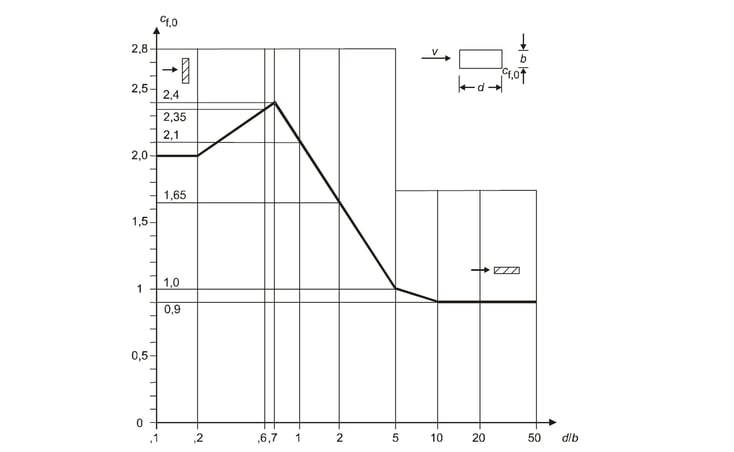
 

2.  Figure 7.23 Force coefficients cf,0 of rectangular sections with sharp corners and without free end flow

Figure 7.23 Force coefficients cf,0 of rectangular sections with sharp corners and without free end flow


Applying the coefficient of reduction for a square with rounded corners.
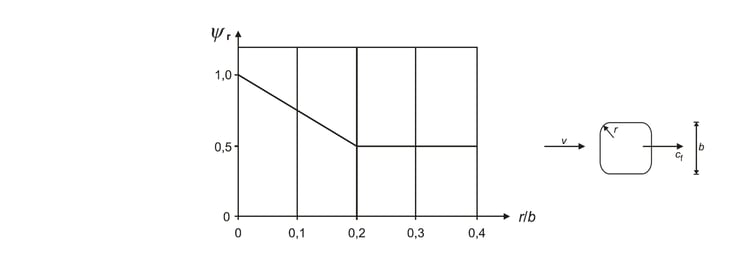
 

3.  Figure 7.24 Reduction factor ψr for a square cross-section with rounded corners

Figure 7.24 Reduction factor ψr for a square cross-section with rounded corners


3. Design Case 


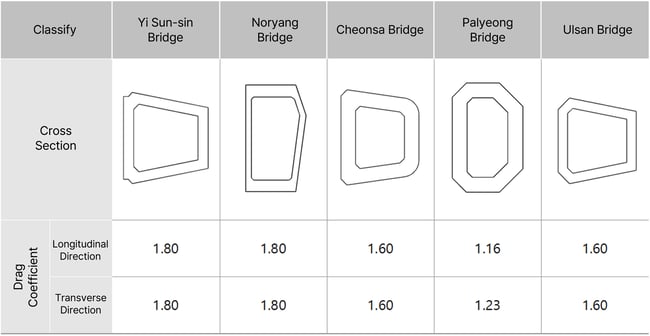
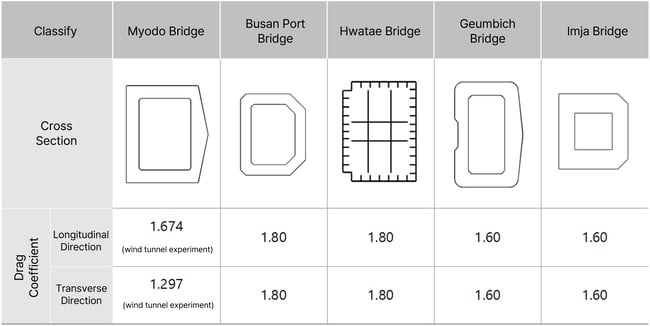
The drag coefficients of the main towers of cable-stayed and suspension bridges designed in South Korea mostly apply values of 1.6 or 1.8. In cases where separate wind tunnel tests have been conducted, the drag coefficients determined by those wind tunnel tests have been applied.

 And this value is generally calculated smaller than the drag coefficient presented in the design criteria.


(1) Cable Stayed Bridge
 

Drag Copefficient for Cable stayed Bridge


(2) Suspension Bridge


Drag Copefficient for Suspension bridge


4. Calculation of the pylon drag coefficient according to the design code


(1) Comparison of drag coefficients
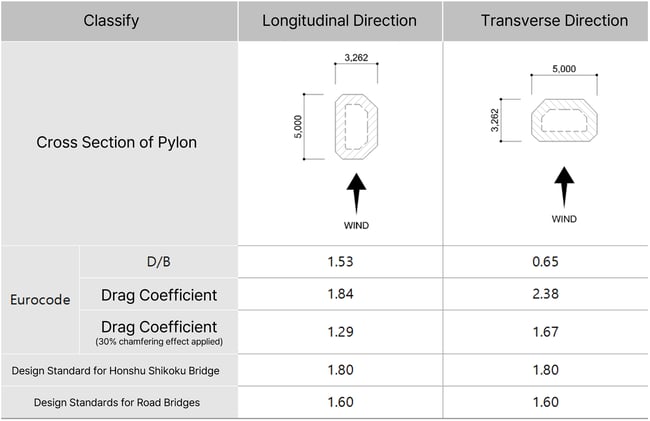
 

Comparison of drag coefficients


(2) Calculation of drag coefficient using cross-sectional ratio (D/B) in Eurocode

7. Eroucode에서 단면비(DB)를 이용한 항력계수 산정


(3) Estimation of drag coefficient through wind tunnel experiment 


After installing the load cell on the model, the air force (drag force) generated at this time is measured by applying a wind having a constant wind speed.
After that, the drag coefficient of the model cross section is calculated through the relationship equation below.

 

drag coefficient through wind tunnel experiment

Source: http://www.tesolution.com


5. Conclusion


If a separate drag coefficient measurement experiment is not conducted, the drag coefficient according to the Eurocode is too conservative, and it is somewhat ambiguous about whether and how to apply effects such as chamfering.

As can be seen from the case of calculating the pylon drag coefficient through wind tunnel experiments, the chamfering of the cross section is expected to reduce the drag coefficient by 15 to 30%, but it is difficult to apply it numerically uniformly because it depends on the chamfer shape and size.

Ignoring the shape ratio of the pylon's cross-section and the presence of Chamfer, applying a uniform drag coefficient of 1.8 can be safe from a design perspective, but it may also become excessively uneconomical.


Therefore, it is reasonable to accurately measure the drag coefficient of the pylon cross section through wind tunnel experiments or computational fluid dynamics analysis and reflect it in the design in order to properly reflect the characteristics of the pylon cross section.

CFD analysis is also performed to calculate characteristic values such as the drag coefficient of the pylon. CFD analysis has the advantage of being able to obtain the result value quickly because it takes less time and cost compared to wind tunnel experiments. However, in the end, it is common to compare the result value with the wind tunnel experiment to verify the validity of the characteristic value obtained through CFD analysis.

In the case of special bridges with pylons such as cable-stayed bridges and suspension bridges, wind tunnel tests must be performed under the relevant design laws. It is not difficult to add a partial model experiment such as a tower girder under these prepared wind tunnel experimental conditions, which is reasonable in terms of economic and temporal terms.


#Drag coefficient

#Wind load

#Bridge pylons

About the Editor
Y.S.LEE
Structural Engineer More than 10 years

For over 10 years, I have been involved in diverse structural design tasks related to bridges, underground passages, noise barriers, and more.

I am an experienced user of Midas Civil for structural analysis, as well as other Midas programs such as Midas FEA and Midas CIM.


👉Learn More About the Editor (click)


※ Click on the keywords below 'Topics' to view related content.

Subscribe to Newsletter

Catch the weekly engineer news!

What you may
also like