Would you like to sign out?

Select Country

  • Afghanistan English
  • Albania English
  • Algeria English
  • American Samoa English
  • Andorra English
  • Angola English
  • Anguilla English
  • Antarctica English
  • Antigua and Barbuda English
  • Argentina Español
  • Armenia English
  • Aruba English
  • Australia English
  • Austria English
  • Azerbaijan English
  • Bahamas English
  • Bahrain English
  • Bangladesh English
  • Barbados English
  • Belarus English
  • Belgium English
  • Belize English
  • Benin English
  • Bermuda English
  • Bhutan English
  • Bolivia Español
  • Bosnia and Herzegovina English
  • Botswana English
  • Bouvet Island English
  • Brazil Español
  • British Indian Ocean Territory English
  • British Virgin Islands English
  • Brunei English
  • Bulgaria English
  • Burkina Faso English
  • Burundi English
  • Cambodia English
  • Cameroon English
  • Canada English
  • Cape Verde English
  • Caribbean Netherlands English
  • Cayman Islands English
  • Central African Republic English
  • Chad English
  • Chile Español
  • Christmas Island English
  • Cocos (Keeling) Islands English
  • Colombia Español
  • Comoros English
  • Congo English
  • Cook Islands English
  • Costa Rica Español
  • Côte d’Ivoire English
  • Croatia English
  • Cuba Español
  • Curaçao English
  • Cyprus English
  • Czech Republic English
  • Democratic Republic of the Congo English
  • Denmark English
  • Djibouti English
  • Dominica English
  • Dominican Republic Español
  • Ecuador Español
  • Egypt English
  • El Salvador Español
  • Equatorial Guinea English
  • Eritrea English
  • Estonia English
  • Ethiopia English
  • Falkland Islands English
  • Faroe Islands English
  • Fiji English
  • Finland English
  • France English
  • French Guiana Español
  • French Polynesia English
  • French Southern Territories English
  • Gabon English
  • Gambia English
  • Georgia English
  • Germany English
  • Ghana English
  • Gibraltar English
  • Greece English
  • Greenland English
  • Grenada English
  • Guadeloupe Español
  • Guam English
  • Guatemala Español
  • Guernsey English
  • Guinea English
  • Guinea-Bissau English
  • Guyana English
  • Haiti Español
  • Heard Island and McDonald Islands English
  • Honduras Español
  • Hong Kong English
  • Hungary English
  • Iceland English
  • India English
  • Indonesia English
  • Iran English
  • Iraq English
  • Ireland English
  • Isle of Man English
  • Israel English
  • Italy English
  • Jamaica English
  • Japan 日本語
  • Jersey English
  • Jordan English
  • Kazakhstan English
  • Kenya English
  • Kiribati English
  • South Korea 한국어
  • Kuwait English
  • Kyrgyzstan English
  • Laos English
  • Latvia English
  • Lebanon English
  • Lesotho English
  • Liberia English
  • Libya English
  • Liechtenstein English
  • Lithuania English
  • Luxembourg English
  • Macau English
  • Madagascar English
  • Malawi English
  • Malaysia English
  • Maldives English
  • Mali English
  • Malta English
  • Marshall Islands English
  • Martinique Español
  • Mauritania English
  • Mauritius English
  • Mayotte English
  • Mexico Español
  • Micronesia English
  • Moldova English
  • Monaco English
  • Mongolia English
  • Montenegro English
  • Montserrat English
  • Morocco English
  • Mozambique English
  • Myanmar English
  • Namibia English
  • Nauru English
  • Nepal English
  • Netherlands English
  • New Caledonia English
  • New Zealand English
  • Nicaragua Español
  • Niger English
  • Nigeria English
  • Niue English
  • Norfolk Island English
  • Northern Mariana Islands English
  • Norway English
  • Oman English
  • Pakistan English
  • Palau English
  • Palestine English
  • Panama Español
  • Papua New Guinea English
  • Paraguay Español
  • Peru Español
  • Philippines English
  • Pitcairn Islands English
  • Poland English
  • Portugal Español
  • Puerto Rico Español
  • Qatar English
  • Réunion English
  • Romania English
  • Russia English
  • Rwanda English
  • Saint Barthélemy Español
  • Saint Helena English
  • Saint Kitts and Nevis English
  • Saint Lucia English
  • Saint Martin Español
  • Saint Pierre and Miquelon English
  • Saint Vincent and the Grenadines English
  • Samoa English
  • San Marino English
  • Sao Tome and Principe English
  • Saudi Arabia English
  • Senegal English
  • Serbia English
  • Seychelles English
  • Sierra Leone English
  • Singapore English
  • Sint Maarten English
  • Slovakia English
  • Slovenia English
  • Solomon Islands English
  • Somalia English
  • South Africa English
  • South Georgia English
  • South Sudan English
  • Spain Español
  • Sri Lanka English
  • Sudan English
  • Suriname English
  • Svalbard and Jan Mayen English
  • Eswatini English
  • Sweden English
  • Switzerland English
  • Syria English
  • Taiwan English
  • Tajikistan English
  • Tanzania English
  • Thailand English
  • Togo English
  • Tokelau English
  • Tonga English
  • Trinidad and Tobago English
  • Tunisia English
  • Turkey English
  • Turkmenistan English
  • Turks and Caicos Islands English
  • Tuvalu English
  • U.S. Virgin Islands English
  • Uganda English
  • Ukraine English
  • United Arab Emirates English
  • United Kingdom English
  • United States of America English
  • U.S. Minor Outlying Islands English
  • Uruguay Español
  • Uzbekistan English
  • Vanuatu English
  • Vatican City English
  • Venezuela Español
  • Vietnam English
  • Wallis and Futuna English
  • Western Sahara English
  • Yemen English
  • Zambia English
  • Zimbabwe English
  • Åland Islands English
  • East Timor English
  • Netherlands Antilles English
  • Serbia and Montenegro English
  • North Macedonia English
  • Timor-Leste English
Structure

3 Tips for passing the FE exam | by Richard Racz

Table of Contents Click the table of contents for details.

Intro


Have you heard about the Fundamentals of Engineering (FE) exam, which engineers commonly take in the United States before obtaining a P.E. license? The FE exam is a prerequisite that must be passed to take the Principles and Practice of Engineering (PE) exam, that you must take to obtain a P.E. License. Today's content is based on the YouTube channel "Kestävä," run by Richard Racz. I'll introduce the basic information about the FE exam and share preparation tips from Richard, who initially failed but later passed the FE exam easily.


What is FE Exam?


The table below summarizes the differences between the FE exam and the PE exam.


FUNDAMENTALS OF ENGINEERING (FE) EXAM

PRINCIPLES AND PRACTICE OF ENGINEERING (PE) EXAM

Summary

First step in the process of becoming a licensed professional engineer (P.E.).

Test for a minimum level of competency in a particular engineering discipline.

Requirements

Graduate of an EAC/ABET accredited engineering curriculum of four years or more or currently enrolled and in your final two semesters (or equivalent) of an EAC/ABET accredited engineering curriculum.

Successfully complete the Fundamentals of Engineering (FE) Exam.

Four years of work experience under a P.E.

Number of Questions / Duration

110 questions / 6 hours

80 questions / 9 hours

Exam Fee

$225

$400

Reference Website

FE Exam | NCEES

 PE Exam | NCEES 

*This table is based on the NCEES EXAMINEE GUIDE revised on November 1, 2023.
*Individuals with foreign degrees or without a degree can also take the exam, regardless of whether they are from the United States or another country. This topic will be covered in future content.


Now, let's explore 3 tips for passing the FE exam based on Richard's experience.


1. It’s not about the memorization
 

FE Reference HandbookFE Reference Handbook, you can download it at NCEES


All engineers taking the exam receive the same handbook, and to pass the exam, you must use the provided handbook. Richard made a mistake by not referring to this handbook PDF when solving practice problems. Instead, he studied based on his university major knowledge and memorized solution methods.


This was the wrong approach. One common thing between the PE and FE exams is that they are not memory tests Whether you're a junior engineer or still a student, the ability to quickly and effectively find and apply information from the provided handbook is crucial. That's all there is to it – that's engineering. You can't memorize solutions to every problem, and, in most cases, each problem you encounter as an engineer is entirely unique. You need to have the confidence and knowledge to find the information and know where to find it. That is the key to passing the FE and PE exams. So, you must study based on the provided handbook.


2. Familiarize Yourself with the Structure of Reference Materials


The answer to the problem is somewhere in the provided handbook. He accepted this concept to pass on his second attempt. He practiced the problems again, solved more, and started thinking, "This problem is related to XX. Where should I reference in the handbook?" When he started a problem, he thought about where to find the formulas or information needed to solve it in the handbook PDF.


Instead of memorizing every formula, every line, and every piece of text in the book, he memorized how the book was organized, how it was laid out, and where each piece of information was located. That was the key to success for him on his second attempt, and once the concepts became clear, the exam became really easy for him.


3. Prepare an approved calculator
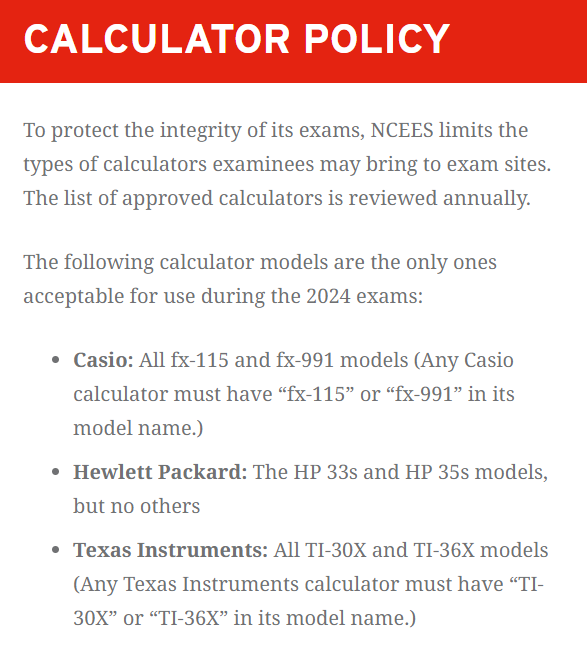
 

The list of approved calculators for 2024 by NCEES

The list of approved calculators for 2024 by NCEES (Link : Exams | NCEES - Calculator policy)


In the FE exam, only specific calculators are allowed. The following calculator models are the only ones acceptable for use during the 2024 exams:

  • Casio: All fx-115 and fx-991 models (Any Casio calculator must have “fx-115” or “fx-991” in its model name.)
  • Hewlett Packard: The HP 33s and HP 35s models, but no others
  • Texas Instruments: All TI-30X and TI-36X models (Any Texas Instruments calculator must have “TI-30X” or “TI-36X” in its model name.)

The list of approved calculators changes every year, so if you are reading this in 2025, please click the link above to check the calculators allowed for that year. If you arrive at the exam site and find that your calculator is missing from your bag, you may panic. While you can use the computer's built-in calculator program with a mouse, it may not be helpful when time is running out. Make sure to prepare and bring an approved calculator in advance.


Conclusion


Richard shared his experience with the hope of inspiring other FE exam takers. While his video was focused on the FE exam, the tips he discussed are similarly applicable to the PE exam.


If you want to directly see his vivid experiences and words of encouragement for engineers preparing for the exam, which I haven't introduced in this article, please click the link below to visit his YouTube channel. The YouTube channel Kestävä covers the following contents.

Link to his original video that became the MOTIVE of the this content :

Why I FAILED the F.E. Exam | Then How I Passed it EASILY | Civil Engineering

  • Civil PE Exam review example problems and best practices to pass the PE exam

  • Insights and real world design examples in professional engineering

  • Design of wood | steel | concrete | and masonry structures

  • Helping young engineers advance their engineering careers


NOTE


For you information, in his original content, he mentioned that you could take any material to the PE exam. However, the PE exam now doesn't allow you to bring other materials. The PE exam has transitioned to CBT, and all NCEES exams are now CBT. You cannot bring reference materials to the exam; everything you need for the exam will be provided.


References


Kestävä : www.youtube.com/@Kestava_Engineering
Exams | NCEES : ncees.org
Civil FE Exam and Course Guide : civilengineeringacademy.com


About the MOTIVATOR
Richard Racz, P.E.
Content Creator Professional Engineer

My name is Rich, and I'm a licensed civil engineer with a B.S and M.S. from the University of Massachusetts Amherst. I've designed structures for coastal floods, hurricane force winds, active seismic zones, and some of the country’s highest snowfall. I've designed a wide range of building structures using conventional wood, mass timber, steel, concrete, and masonry.


Youtube : Kestävä

LinkedIn Profile: Richard Racz


👉Learn More About the MOTIVATOR (click)


※ If you click on the keywords below "Topics," you can view related contents.

Subscribe to Newsletter

Catch the weekly engineer news!

What you may
also like