Would you like to sign out?

Select Country

  • Afghanistan English
  • Albania English
  • Algeria English
  • American Samoa English
  • Andorra English
  • Angola English
  • Anguilla English
  • Antarctica English
  • Antigua and Barbuda English
  • Argentina Español
  • Armenia English
  • Aruba English
  • Australia English
  • Austria English
  • Azerbaijan English
  • Bahamas English
  • Bahrain English
  • Bangladesh English
  • Barbados English
  • Belarus English
  • Belgium English
  • Belize English
  • Benin English
  • Bermuda English
  • Bhutan English
  • Bolivia Español
  • Bosnia and Herzegovina English
  • Botswana English
  • Bouvet Island English
  • Brazil Español
  • British Indian Ocean Territory English
  • British Virgin Islands English
  • Brunei English
  • Bulgaria English
  • Burkina Faso English
  • Burundi English
  • Cambodia English
  • Cameroon English
  • Canada English
  • Cape Verde English
  • Caribbean Netherlands English
  • Cayman Islands English
  • Central African Republic English
  • Chad English
  • Chile Español
  • Christmas Island English
  • Cocos (Keeling) Islands English
  • Colombia Español
  • Comoros English
  • Congo English
  • Cook Islands English
  • Costa Rica Español
  • Côte d’Ivoire English
  • Croatia English
  • Cuba Español
  • Curaçao English
  • Cyprus English
  • Czech Republic English
  • Democratic Republic of the Congo English
  • Denmark English
  • Djibouti English
  • Dominica English
  • Dominican Republic Español
  • Ecuador Español
  • Egypt English
  • El Salvador Español
  • Equatorial Guinea English
  • Eritrea English
  • Estonia English
  • Ethiopia English
  • Falkland Islands English
  • Faroe Islands English
  • Fiji English
  • Finland English
  • France English
  • French Guiana Español
  • French Polynesia English
  • French Southern Territories English
  • Gabon English
  • Gambia English
  • Georgia English
  • Germany English
  • Ghana English
  • Gibraltar English
  • Greece English
  • Greenland English
  • Grenada English
  • Guadeloupe Español
  • Guam English
  • Guatemala Español
  • Guernsey English
  • Guinea English
  • Guinea-Bissau English
  • Guyana English
  • Haiti Español
  • Heard Island and McDonald Islands English
  • Honduras Español
  • Hong Kong English
  • Hungary English
  • Iceland English
  • India English
  • Indonesia English
  • Iran English
  • Iraq English
  • Ireland English
  • Isle of Man English
  • Israel English
  • Italy English
  • Jamaica English
  • Japan 日本語
  • Jersey English
  • Jordan English
  • Kazakhstan English
  • Kenya English
  • Kiribati English
  • South Korea 한국어
  • Kuwait English
  • Kyrgyzstan English
  • Laos English
  • Latvia English
  • Lebanon English
  • Lesotho English
  • Liberia English
  • Libya English
  • Liechtenstein English
  • Lithuania English
  • Luxembourg English
  • Macau English
  • Madagascar English
  • Malawi English
  • Malaysia English
  • Maldives English
  • Mali English
  • Malta English
  • Marshall Islands English
  • Martinique Español
  • Mauritania English
  • Mauritius English
  • Mayotte English
  • Mexico Español
  • Micronesia English
  • Moldova English
  • Monaco English
  • Mongolia English
  • Montenegro English
  • Montserrat English
  • Morocco English
  • Mozambique English
  • Myanmar English
  • Namibia English
  • Nauru English
  • Nepal English
  • Netherlands English
  • New Caledonia English
  • New Zealand English
  • Nicaragua Español
  • Niger English
  • Nigeria English
  • Niue English
  • Norfolk Island English
  • Northern Mariana Islands English
  • Norway English
  • Oman English
  • Pakistan English
  • Palau English
  • Palestine English
  • Panama Español
  • Papua New Guinea English
  • Paraguay Español
  • Peru Español
  • Philippines English
  • Pitcairn Islands English
  • Poland English
  • Portugal Español
  • Puerto Rico Español
  • Qatar English
  • Réunion English
  • Romania English
  • Russia English
  • Rwanda English
  • Saint Barthélemy Español
  • Saint Helena English
  • Saint Kitts and Nevis English
  • Saint Lucia English
  • Saint Martin Español
  • Saint Pierre and Miquelon English
  • Saint Vincent and the Grenadines English
  • Samoa English
  • San Marino English
  • Sao Tome and Principe English
  • Saudi Arabia English
  • Senegal English
  • Serbia English
  • Seychelles English
  • Sierra Leone English
  • Singapore English
  • Sint Maarten English
  • Slovakia English
  • Slovenia English
  • Solomon Islands English
  • Somalia English
  • South Africa English
  • South Georgia English
  • South Sudan English
  • Spain Español
  • Sri Lanka English
  • Sudan English
  • Suriname English
  • Svalbard and Jan Mayen English
  • Eswatini English
  • Sweden English
  • Switzerland English
  • Syria English
  • Taiwan English
  • Tajikistan English
  • Tanzania English
  • Thailand English
  • Togo English
  • Tokelau English
  • Tonga English
  • Trinidad and Tobago English
  • Tunisia English
  • Turkey English
  • Turkmenistan English
  • Turks and Caicos Islands English
  • Tuvalu English
  • U.S. Virgin Islands English
  • Uganda English
  • Ukraine English
  • United Arab Emirates English
  • United Kingdom English
  • United States of America English
  • U.S. Minor Outlying Islands English
  • Uruguay Español
  • Uzbekistan English
  • Vanuatu English
  • Vatican City English
  • Venezuela Español
  • Vietnam English
  • Wallis and Futuna English
  • Western Sahara English
  • Yemen English
  • Zambia English
  • Zimbabwe English
  • Åland Islands English
  • East Timor English
  • Netherlands Antilles English
  • Serbia and Montenegro English
  • North Macedonia English
  • Timor-Leste English
Geotechnical

Deadliest earthquakes of the 21st Century

Table of Contents Click the table of contents for details.

Intro


We live with earthquakes. According to the National Earthquake Information Center, there are about 55 earthquakes worldwide every day. That adds up to approximately 20,000 earthquakes in a year. In South Korea, where I live, an average of 70.6 earthquakes with a magnitude of 2.0 or higher occur annually (Source: Korea Meteorological Administration). In this content, we'll explore the earthquakes that caused the most casualties each year in the 21st century. Also we’ll be able to identify regions where earthquakes occur frequently and areas vulnerable to earthquakes.


Animated Map of Deadliest earthquakes of the 21st Century


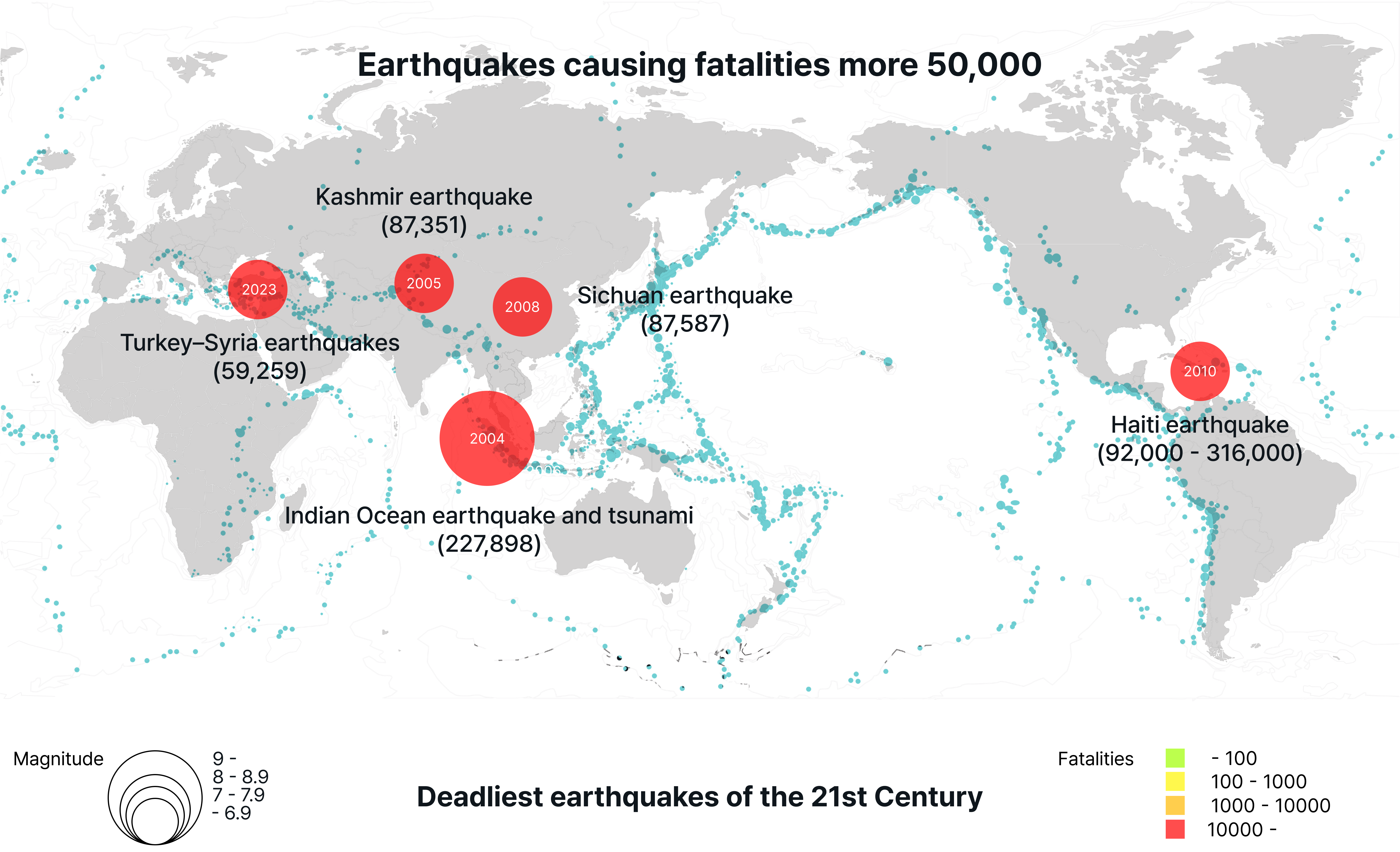
The video displays the earthquakes that caused the most fatalities each year, with a world map depicting the Ring of Fire. As shown in the video, deadly earthquakes tend to occur predominantly around the Ring of Fire.


21st-century earthquakes that have caused the most fatalities each year


The table below summarizes the top 5 earthquakes that caused the most fatalities.


Year

Event

Magnitude

Location

Depth (km)

Fatalities

2004

2004 Indian Ocean earthquake and tsunami

9.1

Indonesia, Sumatra offshore

30.0

227,898

2010

2010 Haiti earthquake

7.0

Haiti, Léogâne

13.0

92,000 - 316,000

2008

2008 Sichuan earthquake

7.9

China, Sichuan

19.0

87,587

2005

2005 Kashmir earthquake

7.6

Pakistan, Balakot

15.0

87,351

2023

2023 Turkey–Syria earthquakes

7.8

Turkey, Syria, Southeastern Anatolia, Aleppo, Idlib

17.9/10.0

59,259


Deadliest earthquakes of the 21st Century

Top 5 Deadliest Earthquakes of the 21st Century, causing more than 50,000 fatalities


The table below lists the earthquakes that have caused the most fatalities each year from 2001 to 2023 in the 21st century.


Year

Event

Magnitude

Location

Depth (km)

Fatalities

2001

2001 Gujarat earthquake

7.7

India, Bhuj

16.0

20,085

2002

2002 Hindu Kush earthquakes

7.4 & 6.1

Afghanistan, Baghlan Province

8.0

1,166

2003

2003 Bam earthquake

6.6

Iran, Bam

10.0

26,271

2004

2004 Indian Ocean earthquake and tsunami

9.1

Indonesia, Sumatra offshore

30.0

227,898

2005

2005 Kashmir earthquake

7.6

Pakistan, Balakot

15.0

87,351

2006

2006 Yogyakarta earthquake

6.4

Indonesia, Yogyakarta

10.0

28,903

2007

2007 Peru earthquake

8.0

Peru, Ica offshore

39.0

519

2008

2008 Sichuan earthquake

7.9

China, Sichuan

19.0

87,587

2009

2009 Sumatra earthquakes

7.6

Indonesia, Padang offshore

90.0

1,115

2010

2010 Haiti earthquake

7.0

Haiti, Léogâne

13.0

92,000 - 316,000

2011

2011 Tōhoku earthquake and tsunami

9.1

Japan, Sendai offshore

29.0

19,747

2012

2012 East Azerbaijan earthquakes

6.4

Iran, East Azerbaijan

9.0

306

2013

2013 Balochistan earthquakes

7.7

Pakistan, Balochistan

15.0

825

2014

2014 Ludian earthquake

6.2

China, Ludian County

10.0

729

2015

2015 Nepal earthquake

7.8

Nepal, Gorkha District

8.2

9,182

2016

2016 Ecuador earthquake

7.8

Ecuador, Esmeraldas

20.6

676

2017

2017 Iran–Iraq earthquake

7.3

IranIraq Iran–Iraq border Region

19.0

630

2018

2018 Sulawesi earthquake and tsunami

7.5

Indonesia, Palu

20.0

4,340

2019

2019 Albania earthquake

6.4

Albania, Durrës

10.0

51

2020

2020 Aegean Sea earthquake

7.0

Greece, Turkey, Aegean Sea

21.0

119

2021

2021 Haiti earthquake

7.2

Haiti, Nippes

10.0

2,248

2022

2022 Afghanistan earthquake

6.0

Afghanistan, Khost

10.0

1,163

2023

2023 Turkey–Syria earthquakes

7.8

Turkey, Syria, Southeastern Anatolia, Aleppo, Idlib

17.9/10.0

59,259


Summary


In summary, considering fatalities, the 2004 Indian Ocean earthquake stands as the most devastating incident, resulting in 227,898 confirmed deaths, followed by the 2010 Haiti earthquake.

As you can see from the table, having a higher magnitude does not necessarily mean a higher number of fatalities. The reason for this is that factors such as the distance from the epicenter, population density, structural design, and ground conditions can influence the outcome.

In particular, looking at the 2011 Tōhoku earthquake and tsunami, despite its massive magnitude of 9.1, the number of fatalities was not as high. However, it led to the Fukushima nuclear accident, causing over $360 billion in costs.


About the MOTIVATOR
Jegeon Ryu
Project Manager & Content Creator MOTIVE

Hello, I am Jegeon Ryu, a Project Manager responsible for developing MOTIVE for engineers dedicated to creating a safer and better world. During my two years of military service, I learned that creating a safer world is achievable through the sharing of technology and motivating each other. My goal is to contribute to the happiness of the world by creating a global platform that facilitates mutual knowledge sharing and growth.


Profile: Jegeon Ryu


※ If you click on the keywords below "Topics," you can view related contents.

Subscribe to Newsletter

Catch the weekly engineer news!

What you may
also like