Would you like to sign out?

Select Country

  • Afghanistan English
  • Albania English
  • Algeria English
  • American Samoa English
  • Andorra English
  • Angola English
  • Anguilla English
  • Antarctica English
  • Antigua and Barbuda English
  • Argentina Español
  • Armenia English
  • Aruba English
  • Australia English
  • Austria English
  • Azerbaijan English
  • Bahamas English
  • Bahrain English
  • Bangladesh English
  • Barbados English
  • Belarus English
  • Belgium English
  • Belize English
  • Benin English
  • Bermuda English
  • Bhutan English
  • Bolivia Español
  • Bosnia and Herzegovina English
  • Botswana English
  • Bouvet Island English
  • Brazil Español
  • British Indian Ocean Territory English
  • British Virgin Islands English
  • Brunei English
  • Bulgaria English
  • Burkina Faso English
  • Burundi English
  • Cambodia English
  • Cameroon English
  • Canada English
  • Cape Verde English
  • Caribbean Netherlands English
  • Cayman Islands English
  • Central African Republic English
  • Chad English
  • Chile Español
  • Christmas Island English
  • Cocos (Keeling) Islands English
  • Colombia Español
  • Comoros English
  • Congo English
  • Cook Islands English
  • Costa Rica Español
  • Côte d’Ivoire English
  • Croatia English
  • Cuba Español
  • Curaçao English
  • Cyprus English
  • Czech Republic English
  • Democratic Republic of the Congo English
  • Denmark English
  • Djibouti English
  • Dominica English
  • Dominican Republic Español
  • Ecuador Español
  • Egypt English
  • El Salvador Español
  • Equatorial Guinea English
  • Eritrea English
  • Estonia English
  • Ethiopia English
  • Falkland Islands English
  • Faroe Islands English
  • Fiji English
  • Finland English
  • France English
  • French Guiana Español
  • French Polynesia English
  • French Southern Territories English
  • Gabon English
  • Gambia English
  • Georgia English
  • Germany English
  • Ghana English
  • Gibraltar English
  • Greece English
  • Greenland English
  • Grenada English
  • Guadeloupe Español
  • Guam English
  • Guatemala Español
  • Guernsey English
  • Guinea English
  • Guinea-Bissau English
  • Guyana English
  • Haiti Español
  • Heard Island and McDonald Islands English
  • Honduras Español
  • Hong Kong English
  • Hungary English
  • Iceland English
  • India English
  • Indonesia English
  • Iran English
  • Iraq English
  • Ireland English
  • Isle of Man English
  • Israel English
  • Italy English
  • Jamaica English
  • Japan 日本語
  • Jersey English
  • Jordan English
  • Kazakhstan English
  • Kenya English
  • Kiribati English
  • South Korea 한국어
  • Kuwait English
  • Kyrgyzstan English
  • Laos English
  • Latvia English
  • Lebanon English
  • Lesotho English
  • Liberia English
  • Libya English
  • Liechtenstein English
  • Lithuania English
  • Luxembourg English
  • Macau English
  • Madagascar English
  • Malawi English
  • Malaysia English
  • Maldives English
  • Mali English
  • Malta English
  • Marshall Islands English
  • Martinique Español
  • Mauritania English
  • Mauritius English
  • Mayotte English
  • Mexico Español
  • Micronesia English
  • Moldova English
  • Monaco English
  • Mongolia English
  • Montenegro English
  • Montserrat English
  • Morocco English
  • Mozambique English
  • Myanmar English
  • Namibia English
  • Nauru English
  • Nepal English
  • Netherlands English
  • New Caledonia English
  • New Zealand English
  • Nicaragua Español
  • Niger English
  • Nigeria English
  • Niue English
  • Norfolk Island English
  • Northern Mariana Islands English
  • Norway English
  • Oman English
  • Pakistan English
  • Palau English
  • Palestine English
  • Panama Español
  • Papua New Guinea English
  • Paraguay Español
  • Peru Español
  • Philippines English
  • Pitcairn Islands English
  • Poland English
  • Portugal Español
  • Puerto Rico Español
  • Qatar English
  • Réunion English
  • Romania English
  • Russia English
  • Rwanda English
  • Saint Barthélemy Español
  • Saint Helena English
  • Saint Kitts and Nevis English
  • Saint Lucia English
  • Saint Martin Español
  • Saint Pierre and Miquelon English
  • Saint Vincent and the Grenadines English
  • Samoa English
  • San Marino English
  • Sao Tome and Principe English
  • Saudi Arabia English
  • Senegal English
  • Serbia English
  • Seychelles English
  • Sierra Leone English
  • Singapore English
  • Sint Maarten English
  • Slovakia English
  • Slovenia English
  • Solomon Islands English
  • Somalia English
  • South Africa English
  • South Georgia English
  • South Sudan English
  • Spain Español
  • Sri Lanka English
  • Sudan English
  • Suriname English
  • Svalbard and Jan Mayen English
  • Eswatini English
  • Sweden English
  • Switzerland English
  • Syria English
  • Taiwan English
  • Tajikistan English
  • Tanzania English
  • Thailand English
  • Togo English
  • Tokelau English
  • Tonga English
  • Trinidad and Tobago English
  • Tunisia English
  • Turkey English
  • Turkmenistan English
  • Turks and Caicos Islands English
  • Tuvalu English
  • U.S. Virgin Islands English
  • Uganda English
  • Ukraine English
  • United Arab Emirates English
  • United Kingdom English
  • United States of America English
  • U.S. Minor Outlying Islands English
  • Uruguay Español
  • Uzbekistan English
  • Vanuatu English
  • Vatican City English
  • Venezuela Español
  • Vietnam English
  • Wallis and Futuna English
  • Western Sahara English
  • Yemen English
  • Zambia English
  • Zimbabwe English
  • Åland Islands English
  • East Timor English
  • Netherlands Antilles English
  • Serbia and Montenegro English
  • North Macedonia English
  • Timor-Leste English
Webinar
Ongoing Registration In Progress Closed
Stability of Complex Dam Structures
Using Advanced FEA Techniques
    SESSION TIME WILL VARY PER REGION
Location : Online (Webinar link will be sent to you)
✨ Overview

As dam structures become larger and more complex, accurate stability assessment and realistic foundation modeling are becoming increasingly important in structural engineering practice. Engineers are often required to evaluate how different base assumptions and boundary conditions influence structural behavior, stress distribution, and overall stability performance.


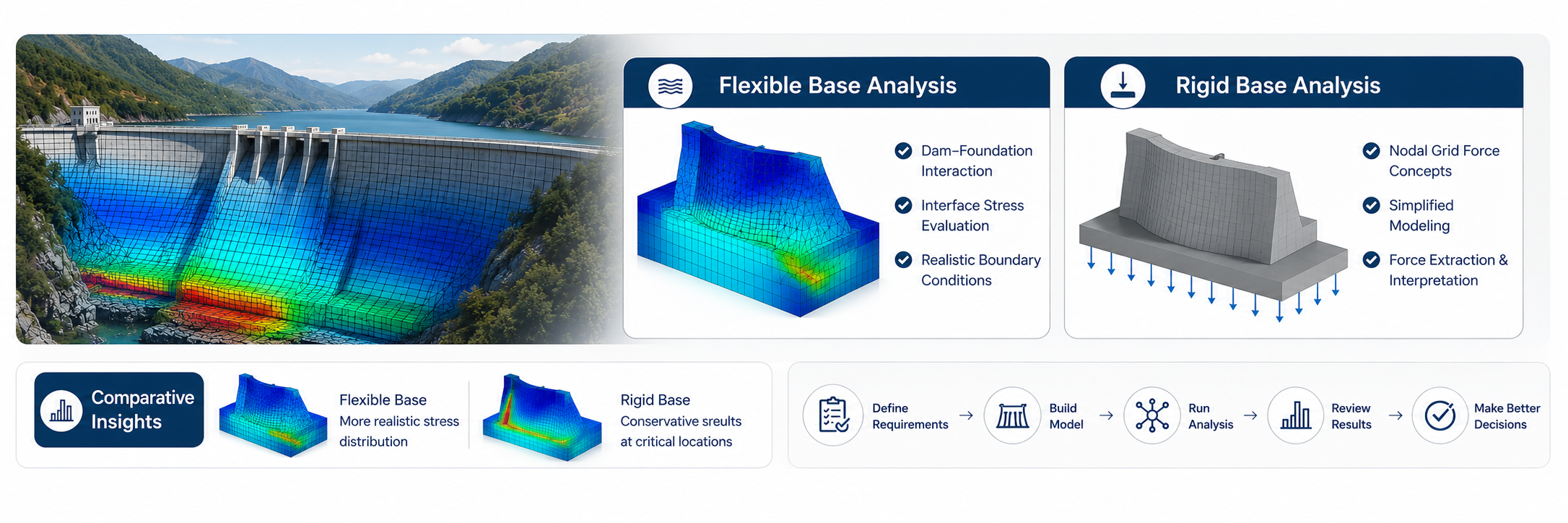
In this webinar, we will introduce practical stability assessment workflows for dam structures using MIDAS FEA NX. The session will cover both flexible base and rigid base analysis approaches, including dam–foundation interaction concepts, interface stress evaluation, nodal grid force applications, and practical modeling considerations.


The webinar will also provide comparative engineering insights between flexible and rigid base assumptions, helping engineers better understand their impact on analysis results and design decisions. Through practical examples and workflow demonstrations, participants will learn effective modeling approaches and stability evaluation techniques applicable to real-world dam engineering projects.
📝 Learning Objectives

-  Understand the importance of stability assessment and realistic foundation modeling for complex dam structures. 

-  Learn the overall workflow and engineering considerations for flexible base and rigid base analysis using MIDAS FEA NX. 

-  Explore dam–foundation interaction concepts, interface stress evaluation, and nodal grid force applications through practical examples. 

-  Understand the differences between flexible and rigid base assumptions and their impact on stress distribution and stability results. 

-  Apply practical modeling approaches and stability evaluation techniques to real-world dam engineering projects. 

 leaning objectives _ dam

📆 Agenda
  • Part 1
    (10 mins)

    Introduction 1. Overview of the webinar
    2. Introduction to MIDAS FEA NX
    3. Importance of stability assessment for dam structures

  • Part 2
    (15 mins)

    Flexible Base Analysis 1. Dam–foundation interaction concepts
    2. Interface stress evaluation using MIDAS
    3. Realistic boundary condition considerations

  • Part 3
    (15 mins)

    Rigid Base Analysis 1. Nodal grid force concepts in MIDAS FEA NX
    2. Simplified modeling vs. accuracy trade-offs
    3. Force extraction and interpretation workflow

  • PART 4
    (15 mins)

    Comparative Engineering Insights 1. Flexible vs. rigid base assumptions
    2. Impact on stress distribution and stability results
    3. Practical modeling tips for real projects

  • PART 5
    (5 mins)

    Summay with Q&A

🤵 Speaker
  • Chetan Aggarwal

    Principal Civil Engineer

    Chetan Aggarwal is a civil engineer specializing in dam engineering and advanced structural analysis. He has extensive experience in finite element modeling,  stability assessment of complex hydraulic structures, and dam–foundation interaction analysis using MIDAS FEA NX. He provides practical insights into dam–foundation interaction, interface stress evaluation, and stability assessment for real-world engineering applications.

📌 DATE

-DATE:

Thursday, 4 June 2026


-TIME:

Check your region!


Region Time
OCEANIA 12:30 (AEST)
SOUTH EAST ASIA 10:30 (HKT/UTC+8)
INDIA 15:00 (IST)
MIDDLE EAST ASIA 13:30 (GMT+4)
EUROPE / AFRICA 13:00 (GMT+1)
AMERICA 13:00 (EST)


-Platform:

Gotowebinar

📢 NOTICE

- Webinar link will be delivered to your email address upon your given information.

- If you’re unable to attend, a recording will be available on demand.
- All attendees will receive the materials used during the webinar.