Preview ended
Fill out the form to keep watching
AI Summary
- Demonstrates how Python automation integrates into modeling, analysis, and reporting workflows in MIDAS CIVIL NX.
- Shows automated processes such as extracting result images and tables, and generating Excel reports.
- Explains practical use cases like updating alignment through Python code and rerunning analyses efficiently.
- Connects automation concepts with real project workflows to reduce manual errors and repetitive work.
Chapters
Your submission has been
successfully received
If you meet the certification criteria,
Your Certificate of Completion will be sent to your email.
If you need urgent support, contact us via
here.
We truly appreciate your participation!

Open Access Has Ended
The open access period has ended.
If you have a MIDAS account, sign in
and complete the access form to watch this session.
Full access is one step away 👀
Complete a short form to continue
On-Demand Session Overview
Understanding Python Automation in Structural Engineering
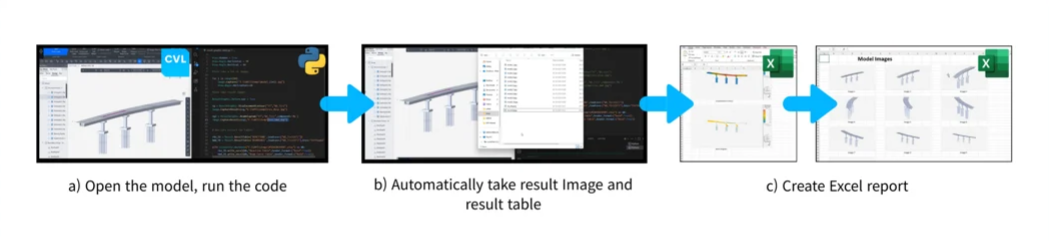
Learn how Python automation boosts structural engineering efficiency and reduces manual errors.
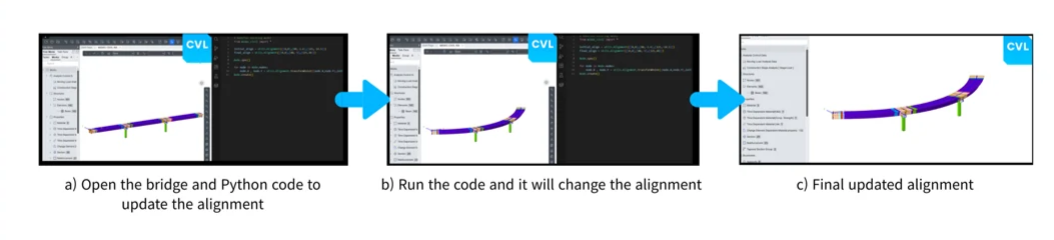
Discover practical Python integration in MIDAS CIVIL NX through expert-led real-world cases.
Automate, Optimize, Accelerate:
Structural Engineering with Python
- Overview of automation in structural engineering
- How Python fits into modeling, analysis, and reporting workflows
- Mini-assignment to reinforce key concepts through simple hands-on practice
Speaker

Vishal Jagad
Technical Support Engineer
MIDAS R&D Center Pvt. Ltd
Vishal is a Technical Support Engineer at MIDAS R&D Center Pvt. Ltd. with expertise in structural analysis and design of bridges and buildings. He supports a wide range of MIDAS users across government and private organizations and specializes in automation-driven solutions using the MIDAS API. His experience includes Python, Grasshopper, and Excel VBA to improve engineering workflows. Vishal has worked closely with engineers from India, the UK, Europe, the US, and Australia on international projects.
