Would you like to sign out?

Select Country

  • Afghanistan English
  • Albania English
  • Algeria English
  • American Samoa English
  • Andorra English
  • Angola English
  • Anguilla English
  • Antarctica English
  • Antigua and Barbuda English
  • Argentina Español
  • Armenia English
  • Aruba English
  • Australia English
  • Austria English
  • Azerbaijan English
  • Bahamas English
  • Bahrain English
  • Bangladesh English
  • Barbados English
  • Belarus English
  • Belgium English
  • Belize English
  • Benin English
  • Bermuda English
  • Bhutan English
  • Bolivia Español
  • Bosnia and Herzegovina English
  • Botswana English
  • Bouvet Island English
  • Brazil Español
  • British Indian Ocean Territory English
  • British Virgin Islands English
  • Brunei English
  • Bulgaria English
  • Burkina Faso English
  • Burundi English
  • Cambodia English
  • Cameroon English
  • Canada English
  • Cape Verde English
  • Caribbean Netherlands English
  • Cayman Islands English
  • Central African Republic English
  • Chad English
  • Chile Español
  • Christmas Island English
  • Cocos (Keeling) Islands English
  • Colombia Español
  • Comoros English
  • Congo English
  • Cook Islands English
  • Costa Rica Español
  • Côte d’Ivoire English
  • Croatia English
  • Cuba Español
  • Curaçao English
  • Cyprus English
  • Czech Republic English
  • Democratic Republic of the Congo English
  • Denmark English
  • Djibouti English
  • Dominica English
  • Dominican Republic Español
  • Ecuador Español
  • Egypt English
  • El Salvador Español
  • Equatorial Guinea English
  • Eritrea English
  • Estonia English
  • Ethiopia English
  • Falkland Islands English
  • Faroe Islands English
  • Fiji English
  • Finland English
  • France English
  • French Guiana Español
  • French Polynesia English
  • French Southern Territories English
  • Gabon English
  • Gambia English
  • Georgia English
  • Germany English
  • Ghana English
  • Gibraltar English
  • Greece English
  • Greenland English
  • Grenada English
  • Guadeloupe Español
  • Guam English
  • Guatemala Español
  • Guernsey English
  • Guinea English
  • Guinea-Bissau English
  • Guyana English
  • Haiti Español
  • Heard Island and McDonald Islands English
  • Honduras Español
  • Hong Kong English
  • Hungary English
  • Iceland English
  • India English
  • Indonesia English
  • Iran English
  • Iraq English
  • Ireland English
  • Isle of Man English
  • Israel English
  • Italy English
  • Jamaica English
  • Japan 日本語
  • Jersey English
  • Jordan English
  • Kazakhstan English
  • Kenya English
  • Kiribati English
  • South Korea 한국어
  • Kuwait English
  • Kyrgyzstan English
  • Laos English
  • Latvia English
  • Lebanon English
  • Lesotho English
  • Liberia English
  • Libya English
  • Liechtenstein English
  • Lithuania English
  • Luxembourg English
  • Macau English
  • Madagascar English
  • Malawi English
  • Malaysia English
  • Maldives English
  • Mali English
  • Malta English
  • Marshall Islands English
  • Martinique Español
  • Mauritania English
  • Mauritius English
  • Mayotte English
  • Mexico Español
  • Micronesia English
  • Moldova English
  • Monaco English
  • Mongolia English
  • Montenegro English
  • Montserrat English
  • Morocco English
  • Mozambique English
  • Myanmar English
  • Namibia English
  • Nauru English
  • Nepal English
  • Netherlands English
  • New Caledonia English
  • New Zealand English
  • Nicaragua Español
  • Niger English
  • Nigeria English
  • Niue English
  • Norfolk Island English
  • Northern Mariana Islands English
  • Norway English
  • Oman English
  • Pakistan English
  • Palau English
  • Palestine English
  • Panama Español
  • Papua New Guinea English
  • Paraguay Español
  • Peru Español
  • Philippines English
  • Pitcairn Islands English
  • Poland English
  • Portugal Español
  • Puerto Rico Español
  • Qatar English
  • Réunion English
  • Romania English
  • Russia English
  • Rwanda English
  • Saint Barthélemy Español
  • Saint Helena English
  • Saint Kitts and Nevis English
  • Saint Lucia English
  • Saint Martin Español
  • Saint Pierre and Miquelon English
  • Saint Vincent and the Grenadines English
  • Samoa English
  • San Marino English
  • Sao Tome and Principe English
  • Saudi Arabia English
  • Senegal English
  • Serbia English
  • Seychelles English
  • Sierra Leone English
  • Singapore English
  • Sint Maarten English
  • Slovakia English
  • Slovenia English
  • Solomon Islands English
  • Somalia English
  • South Africa English
  • South Georgia English
  • South Sudan English
  • Spain Español
  • Sri Lanka English
  • Sudan English
  • Suriname English
  • Svalbard and Jan Mayen English
  • Eswatini English
  • Sweden English
  • Switzerland English
  • Syria English
  • Taiwan English
  • Tajikistan English
  • Tanzania English
  • Thailand English
  • Togo English
  • Tokelau English
  • Tonga English
  • Trinidad and Tobago English
  • Tunisia English
  • Turkey English
  • Turkmenistan English
  • Turks and Caicos Islands English
  • Tuvalu English
  • U.S. Virgin Islands English
  • Uganda English
  • Ukraine English
  • United Arab Emirates English
  • United Kingdom English
  • United States of America English
  • U.S. Minor Outlying Islands English
  • Uruguay Español
  • Uzbekistan English
  • Vanuatu English
  • Vatican City English
  • Venezuela Español
  • Vietnam English
  • Wallis and Futuna English
  • Western Sahara English
  • Yemen English
  • Zambia English
  • Zimbabwe English
  • Åland Islands English
  • East Timor English
  • Netherlands Antilles English
  • Serbia and Montenegro English
  • North Macedonia English
  • Timor-Leste English
Bridge

Material Properties' Time Functions in Concrete Structures

Table of Contents Click the table of contents for details.

In the blog article intro to Time-dependent Analysis for Concrete Structures, we have touched upon the importance of construction stage analysis for concrete structures. The material time function can be plotted and inputted into analysis software like midas Civil to simulate their changing material behavior in various stages of the construction. This article will go over the process of calculating various parameters that contribute to the shape and location of the material's time functions. 


How to Obtain the Time Function of the Modulus of Elasticity?


The modulus of elasticity of concrete at age t may be estimated by: 
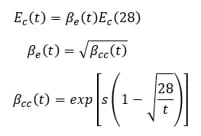
 The modulus of elasticity of concrete

with s being a coefficient depending on the type of cement; s is equal to 0.2, 0.25, and 0.38, respectively, for rapidly hardening high-strength cement, normal and rapidly hardening cement, and slowly hardening cement.


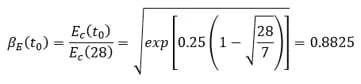
Assume normal and rapidly hardening cement, therefore s = 0.25. 


The modulus of elasticity of concrete at age 28 days, Ec(28), for normal-weight concrete can be estimated by: 
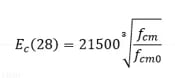
concrete at age 28 days

where fcm0 = 10 MPa.


When the mean compressive strength fcm is not known, Ec(28) may be estimated from the characteristic compressive strength, fck at 28 days by the equation:
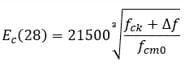
fck at 28 days by the equation

where Δf = 8 MPa. 


These equations apply when quartzitic aggregates are used. For other aggregates, multiply Ec(28) by a factor varying between 0.7 and 1.2. These equations give the tangent modulus of elasticity, which is equal to the slope of the stress-strain diagram at the origin. 


When the modulus of elasticity is for used in an elastic analysis, without considering creep, the value Ec(28) should be reduced by a factor of 0.85 to account for the quasi-instantaneous strain, which occurs shortly (within one day) after loading. 


Assume fck = 7 ksi = 48.26 MPa, 
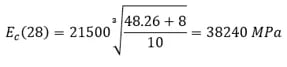
 

Assume fck = 7 ksi = 48.26 MPa

Ec (MPa) can therefore be plotted against time (number of days)below, 
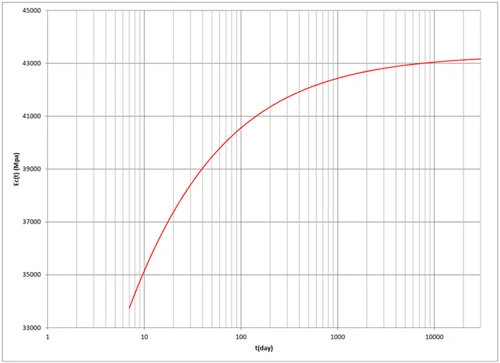
 

Figure 1. Plot of Ec

Figure 1. Plot of Ec (t) with characteristic compressive strength fck = 7 ksi at 28 days. CEB-FIP 1.01.xlsm 
 

How to Determine the Final Modulus of Elasticity of the Concrete? 


At t = ∞,

the final modulus of elasticity

Therefore, the final modulus of elasticity is dependent on the cement type and its compressive strength. 


How to Determine the Time Function of Creep Coefficient? 


We recall the definition of the creep coefficient from the article Intro to Time-dependent Analysis for Concrete Structures as the ratio of creep at time t to the instantaneous strain due to constant stress introduced at time t0. MC-90 gives a coefficient φCEB(t, t0), which is equal to φ(t, t0) divided by
The equation given by MC-90 for φCEB

The equation given by MC-90 for φCEB is adjusted below to give the creep coefficient φ(t, t0), 

where βc is a coefficient describing the development of creep with time after loading

where βc is a coefficient describing the development of creep with time after loading; ?0 is a notional creep coefficient given by:
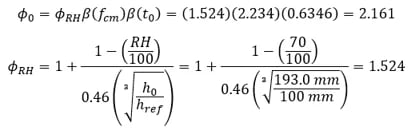
where href = 100mm, RH

where href = 100mm, RH is relative humidity and assumed as 70%.  


The symbol h0 (mm) is the notional size of member defined by 

The symbol h0 (mm)

where Ac and u are the area and perimeter of the cross-section of the considered member that is  in contact with the atmosphere. 
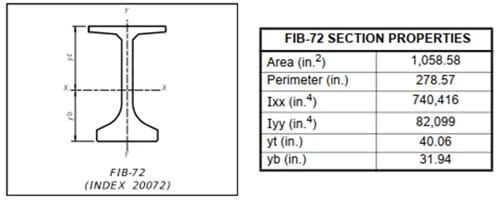
Figure 2. Section properties of FIB-72 I-beam

Figure 2. Section properties of FIB-72 I-beam. 


Assume the section is FIB-72, and the age at loading t0 = 7 days.  
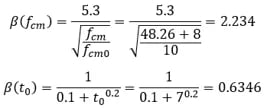
the section is FIB-72

Development of creep with time is expressed by: 

Development of creep with time

βH is a function of the notional size h0 and the relative humidity, RH: 

 βH is a function of the notional size h0 and the relative humidity

Therefore, we obtain the time function for the creep coefficient and plot it below with respect to time. 

Figure 3. Plot of φ(t, t0) with fck = 7 ksi

Figure 3. Plot of ?(t, t0) with fck = 7 ksi at 28 days, t0 = 7 days, RH = 70%, h0 = 193.0 mm. CEB-FIP 1.01.xlsm 


What is the Final Creep Coefficient? 


At t (or t – t0) = ∞, 

Therefore, the final creep coefficient is dependent on relative humidity, notional size of member, concrete strength, and age at loading

Therefore, the final creep coefficient is dependent on relative humidity, notional size of member, concrete strength, and age at loading. 


How to Determine the Time Function of Shrinkage?


When does shrinkage start? Shrinkage starts at time ts (days) when curing is stopped. On the other hand, concrete starts to swell at time ts when immersed in water. The shrinkage or the swelling at any time t (days) may be estimated by: 

Assume ts = 3 days, where εcs0 is the notional shrinkage

Assume ts = 3 days, where εcs0 is the notional shrinkage given by: 

βcs equaling 4, 5, or 8, respectively, for slowly hardening cement

with βcs equaling 4, 5, or 8, respectively, for slowly hardening cement, for normal or rapidly hardening cement, and for rapidly hardening high-strength cement.


For 40% ≤ RH < 99%, 

For RH ≥ 99% (immersed in water)

For RH ≥ 99% (immersed in water), βRH = +0.25, with positive βRH indicates swelling.


βs(t − ts) is a function describing the development of shrinkage or swelling with time, given by:

βs(t − ts) is a function describing the development of shrinkage or swelling with time

Therefore, we obtain the time function of shrinkage and plot it below with respect to time, 
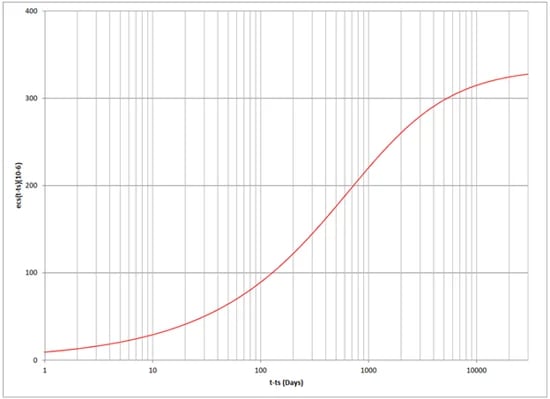
Figure 4. Plot of εcs with fck = 7 ksi

Figure 4. Plot of εcs with fck = 7 ksi, normal and rapidly hardening cements, ts = 3 days, RH = 70%, h0 = 193.0 mm.


CEB-FIP 1.01.xlsm


What is the Final Shrinkage?


At  ts (or t – ts) = ∞,

The final shrinkage is dependent on the type of cement

The final shrinkage is dependent on the type of cement, concrete strength, and relative humidity. Final shrinkage is dependent on the notional size of a member. 


Finally, it should be mentioned that the code equations above for the creep coefficient φ(t, t0) are valid for a mean temperature of 20 °C (68 °F), taking into account seasonal variations between −20 °C (-4 °F) and + 40 °C (+104 °F). When the prevailing temperature is higher or lower than 20 degree Celsius, the effect of temperature on the maturity of concrete may be accounted for. 



About the Editor
Seungwoo Lee PhD, P.E., S.E.
Senior Supervising Engineer at WSP USAs (Tampa, FL)

He is a Senior Supervising Engineer with a high level of expertise in the design and analysis of suspension bridges. He has a solid fundamental understanding of structures and can apply his knowledge exceptionally well to the design and analysis of highly complex structures. He is also a strong communicator, able to identify and distill the key information that is relevant to the task at hand and present it in a clear and quickly understandable manner.

Subscribe to Newsletter

Catch the weekly engineer news!

What you may
also like