01. What is Seismic Analysis?
Seismic analysis is a part of the structural analysis which is carried out to investigate the response structures to earthquakes.
Seismic Design Process
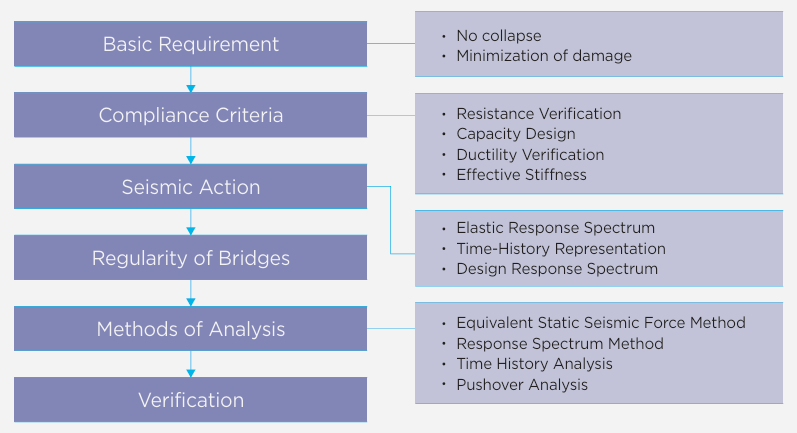 Figure 1. Seismic design process
Most of the structures need to be designed for earthquake or seismic events by performing seismic analysis which could be a simple static seismic load or a dynamic analysis in which ground acceleration is applied to the structure and the response is captured. Figure 1 describes the general seismic design process recommended by various design standards. Different seismic analysis methods are used, and some are shown in below figure 2:
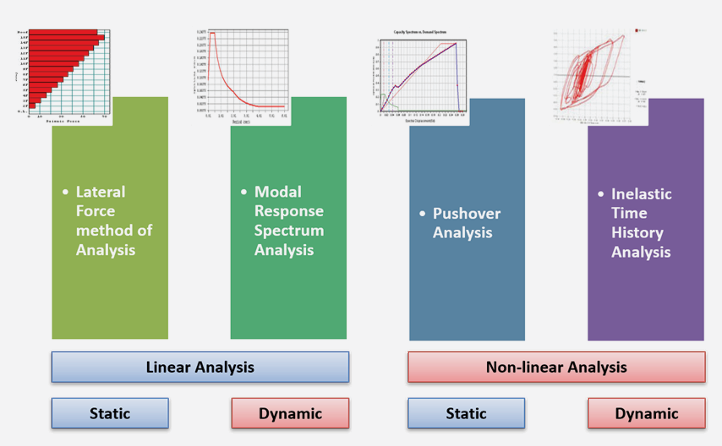 Figure 2. Seismic analysis methods
Based on the type of bridge, seismic zone, and regularity of the bridge, a particular method of seismic analysis is recommended by AASHTO LRFD (Figure 3).
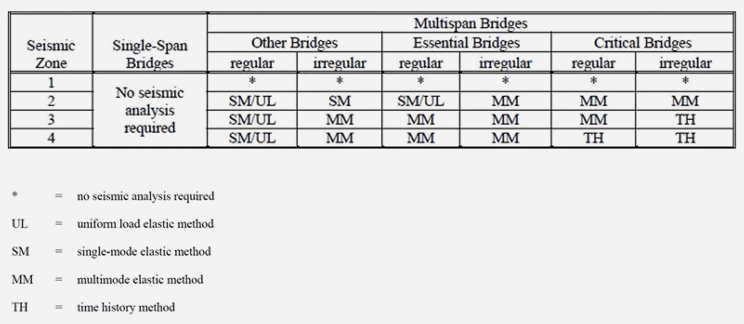 Figure 3. Methods as per AASHTO LRFD
02. Key Concepts/Methods of Seismic Analysis
02-1. Equivalent Static Seismic Force Method
The static seismic analysis assumes that load does not change with time and the structural response is linear. Dynamic analysis requires sophisticated techniques to capture the structural response as the load intensity can drastically change with time. Inertial effects are ignored in the static analysis, unlike dynamic analysis.
However, generally dynamic analysis isn’t done for most of the structures, but an equivalent static seismic lateral load is applied instead. This static equivalent load is derived based on the zone factor, importance factor, response reduction factor, and code-based spectral acceleration. This method is simple, does not need rigorous calculation, and is relatively fast. In midas Civil, we calculate the equivalent static load manually and then apply it using the Element Beam Load option
02-2. Modal Analysis
Modal analysis is the process of determining the dynamic characteristics of the structure of an undamped free vibration. We determine the natural vibration modes, natural frequencies of the given structure. When the applied load frequency matches with the natural frequency of the structure, then the amplitude of structural vibrations will tremendously increase which is called resonance, hence modal analysis is a crucial tool to determine the natural dynamic characteristics of the structure.
Mode shapes and natural periods of an undamped free vibration are obtained from the characteristic equation below.
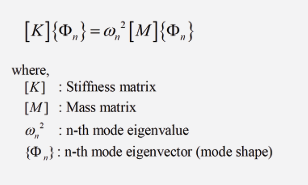
For example, natural frequencies of a multi-degree of freedom system are shown in the figure below which is obtained from the modal analysis.
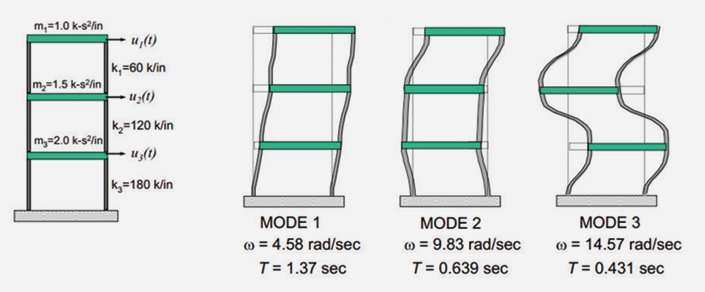 Figure 4. Mode shapes and period of vibrations
To analyze the dynamic behavior of a structure accurately, the analysis must closely reflect the mass and stiffness, which are the important factors to determine the eigenvalues. In most cases, finite element models can readily estimate the stiffness components of structural members. In the case of mass, however, particular attention to an accurate estimate is required. The dynamic characteristics obtained by an eigenvalue analysis include:
|
• Vibration modes (mode shapes)
• Natural periods of vibration (natural frequencies) • Modal participation factors |
Types of Eigen Value Methods available in midas Civil:
Lanczos method
Adopted for a relatively simpler structure to study lower modes. The Lanczos method may miss some Eigen pairs in the required ones.
Subspace Iteration method
When performing Eigenvalue analysis for a finite element system of a large scale (large matrix
system), the Subspace Iteration method can be effectively used.
critically assess software outputs encountered in professional practice from first principles.

👉🏻 Download Now