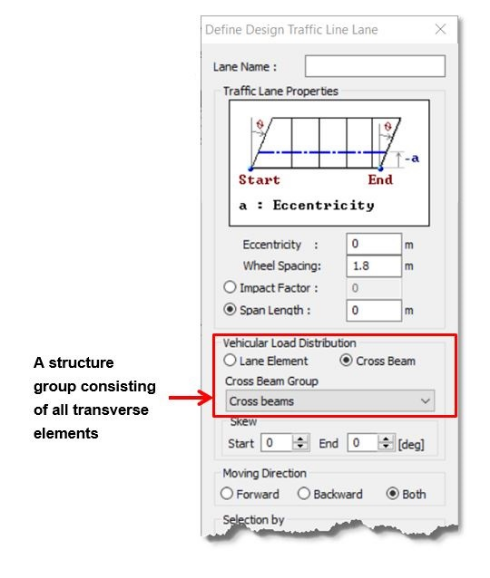
The difference between lane element and cross beam element for vehicular load distribution is in considering the transverse rigidity of the system and the kind of model generated (line, plate, or grillage model)
Live-load distribution is an important step in the analysis of bridge superstructures. There are two methods to determine the distribution of live loads among individual girders, i.e. approximate method and refined analysis.
The Live Load Distribution Factor (or LLDF) of AASHTO LRFD is one of the approximate methods. LLDF allows for a simple, approximate analysis of bridge superstructures. LLDF uncouples the transverse and longitudinal distribution of force effects in the superstructure. The approximate method distributes live-load force effects transversely by proportioning the design lanes to individual girders through the application of distribution factors. Subsequently, this method distributes the force effects longitudinally between the supports through the one-dimensional, line-girder structural analysis over the length of the girders. Distribution factors reduce the necessity of applying 2-D/3-D analysis modeling to the entire bridge. However, it should be used with some limitations, i.e. constant width of the deck, parallel beams, small curvature, etc.
Use refined analysis methods, either grid or finite element analysis methods, for the analysis of bridges without limitations. Distribution factors from the refined analysis are smaller than those calculated from the AASHTO LRFD formula as shown in the figure below, which represents a 120-ft single-span precast beam bridge with no skew.
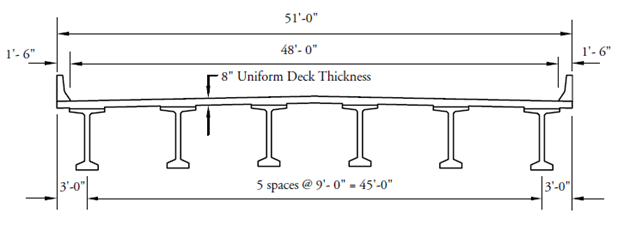

The distribution factor for girders in a multi-girder cross-section was determined without consideration of diaphragm or cross-frames. If diaphragms are provided within the span, the transverse load distribution characteristics of the bridge will be improved to some degree. Diaphragms contribute different load distributions for internal and external girders, hence resulting in a larger force in external girders and a smaller force in internal girders.
In case, the structure is modeled as a line element and is assigned whole transverse
cross-sectional property, lane element for vehicular load distribution option is used.
For grillage models, live load distribution occurs as per the rigidity of transverse members (slab/diaphragm), hence the cross beam method for vehicular load distribution is used.
In the cross beam method, a cross-beam structure group (transverse elements group)
has to be defined and selected for transverse distribution of vehicular load as shown.