
A reinforced earth retaining wall is simultaneously a geotechnical problem and a structural one. Yet for decades, engineers in both disciplines have approached the same wall with entirely separate models, separate software, and separate analyses — only to produce results that can never truly be reconciled.
This article examines why that disconnect exists, the real cost it imposes on engineering teams, and how the direct result transfer from MIDAS GTS NX to CIVIL NX resolves it — without requiring the structural engineer to re-run a single analysis.
1. The Problem
What Geotechnical Engineers Typically Do With Their Results
When a geotechnical engineer completes a nonlinear continuum analysis of a retaining wall in GTS NX, the model captures a rich picture of soil-structure interaction: wall displacements, earth pressure distributions, shear force diagrams, bending moment envelopes, and more. These results reflect the full complexity of the ground conditions, nonlinear material behaviour, and staged construction effects.
Yet in most workflows, only a fraction of this richness is ever formally used. The geotechnical engineer typically extracts what the project standards require: settlement checks, lateral displacement against permissible limits, and bearing capacity verification. These are serviceability-level checks, and they are entirely appropriate — but they represent a narrow slice of what the model has produced.
⚠ The Overlooked Output
The wall forces — shear forces, bending moments, axial loads — computed by the nonlinear FEM are largely set aside. They are outputs of the most physically rigorous model on the project, yet they play no formal role in the structural design of that same wall.
This is not negligence. It reflects a long-established division of responsibility: the geotechnical engineer owns the ground model; the structural engineer owns the design. The problem is that this division was never designed to integrate seamlessly at the point where both disciplines intersect — the wall itself.
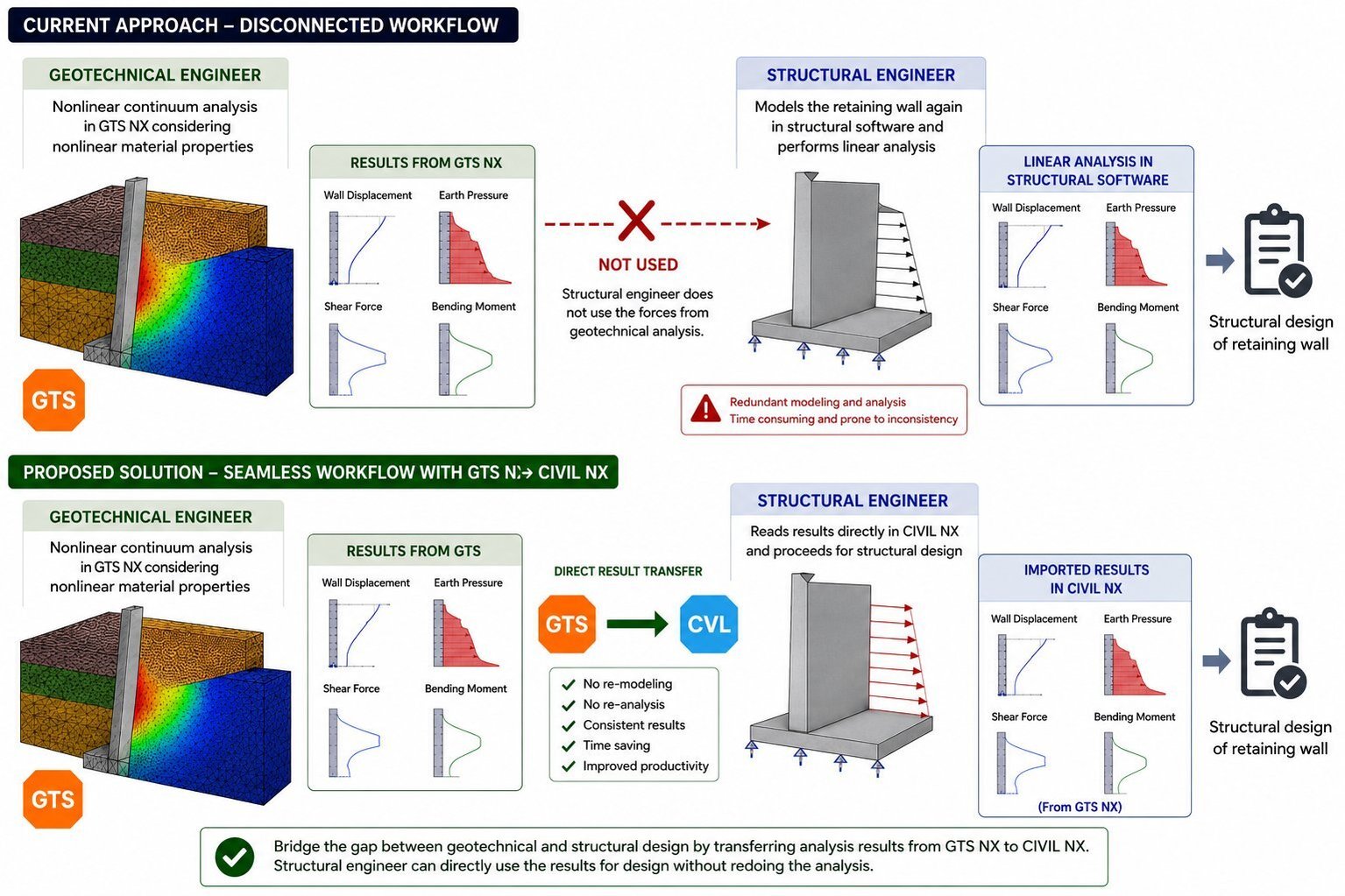
Figure 1. Current vs. proposed workflow. In the disconnected approach (top), GTS NX results are not transferred and the structural engineer re-models from scratch. In the integrated MIDAS workflow (bottom), results flow directly from GTS NX to CIVIL NX, eliminating redundant analysis and inconsistency.
2. The Structural Side
What Happens Next Door: The Structural Engineer's Separate Analysis
Once the geotechnical analysis is complete, the structural engineer begins their own process. They open a structural software package, rebuild the retaining wall geometry, apply earth pressures — typically derived from simplified methods or hand calculations — and run a linear elastic analysis to obtain the design forces.
1. Re-modelling from scratch
The structural model is an independent creation. It does not import geometry or material properties from the GTS NX model. Any staging, surcharge configuration, or construction sequence modelled geotechnically must be manually recreated or approximated.
2. Linear analysis only
Structural software is designed for linear elastic analysis of structural members. It does not model the soil continuum. Earth pressures are applied as simplified external loads — typically triangular or trapezoidal distributions — rather than the interaction-derived distributions computed in GTS NX.
3. Unavoidable inconsistency in results
Because one model is nonlinear and soil-coupled while the other is linear and load-simplified, the design forces will differ. The structural engineer's bending moments may be higher or lower than those computed in GTS NX — but neither engineer has a straightforward way to reconcile them.
4. Duplicated effort across the project team
Two models are maintained, updated, and documented separately. When site conditions change or design iterations are needed, both models must be updated independently. This doubles coordination overhead and creates version-control risk at every revision cycle.
"The structural engineer re-builds the same wall that was just analysed — using simplified loads from the very model whose detailed results were never passed across."
3. The Solution
The Integrated MIDAS Workflow: GTS NX → CIVIL NX
The direct result transfer from GTS NX to CIVIL NX changes this dynamic entirely. Instead of treating geotechnical and structural analysis as two separate pipelines that happen to share a common object, MIDAS connects them at the output — meaning the rigorous forces computed in the nonlinear GTS NX model become the direct input to structural design in CIVIL NX.
The structural engineer no longer needs to re-run an analysis. They open CIVIL NX, import the transferred results, and proceed directly to code-based design checks. The forces they are designing to are the same forces that emerged from the physically consistent, nonlinear, soil-coupled geotechnical model.
✓ What transfers from GTS NX to CIVIL NXWall displacement profiles, earth pressure distributions, shear force diagrams, and bending moment envelopes — the full structural force output of the nonlinear continuum analysis, ready for direct use in design code checks within CIVIL NX.
Critically, CIVIL NX is not simply a viewer for these results. It applies the appropriate structural design standards — including reinforced concrete design provisions — to the transferred forces and generates a complete structural design report. The engineer moves from geotechnical analysis output to code-compliant design documentation in a single integrated environment. |
4. The Difference
Side-by-Side: What Changes and What Doesn't
| Aspect | Disconnected workflow | GTS NX → CIVIL NX |
|---|---|---|
| Wall force source | Simplified linear analysis in structural software | Nonlinear continuum FEM (GTS NX) |
| Earth pressure input | Assumed triangular / trapezoidal distribution | Interaction-derived distribution from soil-structure model |
| Analysis effort | Two separate analyses (geotech + structural) | One analysis; results transferred directly |
| Result consistency | Inherent inconsistency between models | Single source of truth across disciplines |
| Serviceability checks | Performed in GTS NX as before | Performed in GTS NX as before — no change |
| Design report | Generated from structural software only | Full structural design report from CIVIL NX with code checks |
| Revision handling | Both models updated independently | Update GTS NX; re-transfer to CIVIL NX |
5. Benefits
What This Means in Practice
| ⚙ No re-modelling
The structural engineer works directly with transferred results. No geometry re-entry, no load re-application, no model duplication. |
📐 Physically consistent forces
Design forces reflect nonlinear soil-structure interaction, not simplified assumptions. The structural design is grounded in the most rigorous available analysis. |
| 📋 Full design report
CIVIL NX generates a code-compliant structural design report directly from the imported results — ready for submission or peer review. |
⏱ Time and cost efficiency
Eliminating the parallel structural model and its associated re-analysis saves engineering hours at every stage of the project lifecycle. |
6. Closing Thoughts
A More Honest Approach to Wall Design
The traditional disconnected workflow was never a deliberate choice — it was an artefact of software that did not communicate across disciplines. Geotechnical and structural tools evolved in parallel, solving their respective sub-problems well, but without a mechanism to share results at the level of detail that modern projects require.
The GTS NX to CIVIL NX result transfer is not simply a time-saving feature. It represents a more intellectually coherent approach to the engineering problem. A retaining wall is one physical object — it should, as far as possible, be the product of one integrated analysis. When the forces used for structural design are the same forces that emerged from the geotechnical model, engineers on both sides of the discipline boundary are working from the same understanding of how the wall actually behaves.
Serviceability checks remain the responsibility of the geotechnical engineer, performed in GTS NX against applicable standards — nothing about that changes. What changes is what happens to the rest of the geotechnical model's output: instead of being set aside after the displacement checks are done, the structural forces are carried forward, directly and efficiently, into the hands of the engineer who needs them most.
Key TakeawayThe integrated MIDAS workflow — GTS NX analysis followed by direct result transfer to CIVIL NX — eliminates the structural engineer's need for a separate linear re-analysis. The nonlinear geotechnical model becomes the single source of design forces for both serviceability assessment and structural design, with CIVIL NX providing code-compliant design output and a full documentation trail. One model. One analysis. One source of truth. |

Related On-Demand
This on-demand session is recommended for viewers interested in how MIDAS GEN is applied in real structural engineering workflows. Cristian Antonio shares how Anotech uses MIDAS for structural design, modelling efficiency, data input, design checks, and nonlinear analysis across local and international projects.
/Seepage%20%26%20Stress%20Analysis.png)