Would you like to sign out?

Select Country

  • Afghanistan English
  • Albania English
  • Algeria English
  • American Samoa English
  • Andorra English
  • Angola English
  • Anguilla English
  • Antarctica English
  • Antigua and Barbuda English
  • Argentina Español
  • Armenia English
  • Aruba English
  • Australia English
  • Austria English
  • Azerbaijan English
  • Bahamas English
  • Bahrain English
  • Bangladesh English
  • Barbados English
  • Belarus English
  • Belgium English
  • Belize English
  • Benin English
  • Bermuda English
  • Bhutan English
  • Bolivia Español
  • Bosnia and Herzegovina English
  • Botswana English
  • Bouvet Island English
  • Brazil English
  • British Indian Ocean Territory English
  • British Virgin Islands English
  • Brunei English
  • Bulgaria English
  • Burkina Faso English
  • Burundi English
  • Cambodia English
  • Cameroon English
  • Canada English
  • Cape Verde English
  • Caribbean Netherlands English
  • Cayman Islands English
  • Central African Republic English
  • Chad English
  • Chile Español
  • Christmas Island English
  • Cocos (Keeling) Islands English
  • Colombia Español
  • Comoros English
  • Congo English
  • Cook Islands English
  • Costa Rica Español
  • Côte d’Ivoire English
  • Croatia English
  • Cuba Español
  • Curaçao English
  • Cyprus English
  • Czech Republic English
  • Democratic Republic of the Congo English
  • Denmark English
  • Djibouti English
  • Dominica English
  • Dominican Republic Español
  • Ecuador Español
  • Egypt English
  • El Salvador Español
  • Equatorial Guinea English
  • Eritrea English
  • Estonia English
  • Ethiopia English
  • Falkland Islands English
  • Faroe Islands English
  • Fiji English
  • Finland English
  • France English
  • French Guiana Español
  • French Polynesia English
  • French Southern Territories English
  • Gabon English
  • Gambia English
  • Georgia English
  • Germany English
  • Ghana English
  • Gibraltar English
  • Greece English
  • Greenland English
  • Grenada English
  • Guadeloupe Español
  • Guam English
  • Guatemala Español
  • Guernsey English
  • Guinea English
  • Guinea-Bissau English
  • Guyana English
  • Haiti Español
  • Heard Island and McDonald Islands English
  • Honduras Español
  • Hong Kong English
  • Hungary English
  • Iceland English
  • India English
  • Indonesia English
  • Iran English
  • Iraq English
  • Ireland English
  • Isle of Man English
  • Israel English
  • Italy English
  • Jamaica English
  • Japan 日本語
  • Jersey English
  • Jordan English
  • Kazakhstan English
  • Kenya English
  • Kiribati English
  • South Korea 한국어
  • Kuwait English
  • Kyrgyzstan English
  • Laos English
  • Latvia English
  • Lebanon English
  • Lesotho English
  • Liberia English
  • Libya English
  • Liechtenstein English
  • Lithuania English
  • Luxembourg English
  • Macau English
  • Madagascar English
  • Malawi English
  • Malaysia English
  • Maldives English
  • Mali English
  • Malta English
  • Marshall Islands English
  • Martinique English
  • Mauritania English
  • Mauritius English
  • Mayotte English
  • Mexico Español
  • Micronesia English
  • Moldova English
  • Monaco English
  • Mongolia English
  • Montenegro English
  • Montserrat English
  • Morocco English
  • Mozambique English
  • Myanmar English
  • Namibia English
  • Nauru English
  • Nepal English
  • Netherlands English
  • New Caledonia English
  • New Zealand English
  • Nicaragua Español
  • Niger English
  • Nigeria English
  • Niue English
  • Norfolk Island English
  • Northern Mariana Islands English
  • Norway English
  • Oman English
  • Pakistan English
  • Palau English
  • Palestine English
  • Panama Español
  • Papua New Guinea English
  • Paraguay Español
  • Peru Español
  • Philippines English
  • Pitcairn Islands English
  • Poland English
  • Portugal Español
  • Puerto Rico Español
  • Qatar English
  • Réunion English
  • Romania English
  • Russia English
  • Rwanda English
  • Saint Barthélemy Español
  • Saint Helena English
  • Saint Kitts and Nevis English
  • Saint Lucia English
  • Saint Martin Español
  • Saint Pierre and Miquelon English
  • Saint Vincent and the Grenadines English
  • Samoa English
  • San Marino English
  • São Tomé and Príncipe English
  • Saudi Arabia English
  • Senegal English
  • Serbia English
  • Seychelles English
  • Sierra Leone English
  • Singapore English
  • Sint Maarten English
  • Slovakia English
  • Slovenia English
  • Solomon Islands English
  • Somalia English
  • South Africa English
  • South Georgia English
  • South Sudan English
  • Spain English
  • Sri Lanka English
  • Sudan English
  • Suriname English
  • Svalbard and Jan Mayen English
  • Eswatini English
  • Sweden English
  • Switzerland English
  • Syria English
  • Taiwan English
  • Tajikistan English
  • Tanzania English
  • Thailand English
  • Togo English
  • Tokelau English
  • Tonga English
  • Trinidad and Tobago English
  • Tunisia English
  • Turkey English
  • Turkmenistan English
  • Turks and Caicos Islands English
  • Tuvalu English
  • U.S. Virgin Islands English
  • Uganda English
  • Ukraine English
  • United Arab Emirates English
  • United Kingdom English
  • United States English
  • U.S. Minor Outlying Islands English
  • Uruguay Español
  • Uzbekistan English
  • Vanuatu English
  • Vatican City English
  • Venezuela Español
  • Vietnam English
  • Wallis and Futuna English
  • Western Sahara English
  • Yemen English
  • Zambia English
  • Zimbabwe English
  • Åland Islands English
  • East Timor English
  • Netherlands Antilles English
  • Serbia and Montenegro English
  • North Macedonia English
  • Timor-Leste English
Blog

Blog | How to define the construction sequence?

2020.06.18

Construction stage in geotechnical engineering


👇 Watch the popular case study webinar

How to quickly master the geotechnical design report


Most numerical analysis for ground over the entire construction process is done through construction stage analysis. The ground analysis is normally material non-linear analysis and the material non-linear properties can be obtained from the initial conditions within the ground. Here, the initial conditions are the in-situ conditions of the site before construction.
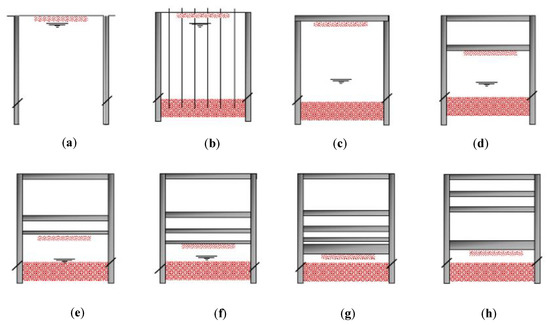
 

construction stage

The general geotechnical analysis uses the in-situ stress of the ground state as the initial values. The analysis software considers the calculation of in-situ stresses from self-weight analysis to be the base. Here, self-weight analysis is the static analysis that only considers the self-weight as the external force when appropriate ground boundary conditions are applied. For consolidation analysis, the drained condition is added such that excessive pore pressure does not occur.


1. K0 method


A method that modifies the stress calculated from self-weight analysis to satisfy the K0 condition is
provided. The K0 condition for the stress components can be expressed using vertical stress σv and
horizontal stress σh as follows:

K0 = σh / σv


The K0 method uses the vertical stress calculated from self-weight analysis to calculate the horizontal
stress. The modified stress field generally does not maintain the equilibrium state with the self-weight.
If the stress is adjusted when the equilibrium state is not maintained, the stress in the continued stress
analysis continuously changes to be in equilibrium with the external force, even when there is no
change in external force, hence generating a deformation. Therefore, the K0 method is applicable
when this additional stress change is relatively small.


The general usable conditions for stress modification using the K0 method are as follows:


► When the ground shape change in the horizontal direction is insignificant
► When the pore pressure distribution does not change in the horizontal direction
► When the horizontal stress is generated by the horizontal free edge/surface boundary condition
► When the material axis is perpendicular or identical to the horizontal axis when a transversely isotropic material is used


And precautions need to be taken when applying K0 to other cases.
In particular, if the ground surface is not horizontal (sloped), the obtained stress state is not in equilibrium with the self-weight. Hence, when using the K0 method to calculate the in-situ stress for these cases, analysis needs to be performed using the unbalanced internal forces between the self-weight and calculated stress state to create equilibrium. This stage can be performed by introducing a NULL Stage, where no conditions change.


2. Self-weight analysis method


When the ground surface is horizontal, this method is equal to the K0 method where K0 = ν/(1-ν). If not, a horizontal strain exists and a different result from the K0 method is deduced along with shear stress. Hence, it is generally recommended that the self-weight analysis method be used for sloped ground. However, it is impossible to use a K0 value larger than 1 and the K0 method needs to be used when using a large K0 value.


After the initial stresses have been obtained from the initial conditions, the excavation loading and Shear strength from applying material properties can also be obtained. Hence, construction stage analysis includes the sequential construction process, starting from the initial ground conditions. Because on-site construction stages are very complex and subject to change, the analysis simplifies the process and focuses on the important construction stages.


For example, the construction stages for a tunnel are as follows.


1 Stage: Initial ground stress

2 Stage: 1st face excavation

3 Stage: 1st reinforcement + 2nd face excavation

4 Stage: 2nd reinforcement + 3rd face excavation

5 Stage: 3rd reinforcement + 4th face excavation ……

(Repeat) ……


GTS NX has a special wizard to efficiently define the construction stages. A regular number (postfix) needs to be assigned to each set to define the construction stage using the wizard. This number can be assigned using the [Rename] function for mesh sets. Sets that are only used once in the entire construction stage process don't need to be assigned a number.


GTS NX does not create an independent analysis model for each construction stage. Rather, it uses a cumulative model concept where only the structural or loading changes are input for each construction stage and the analysis results are accumulated from the previous stage analysis results. Therefore in the construction stage analysis, the structural changes and loading history from the previous stage affect the next stage analysis results.


The definition of the construction stage is done by dragging & dropping the mesh set, boundary setting, load set, and contact set into the activated data column or deactivated data column.
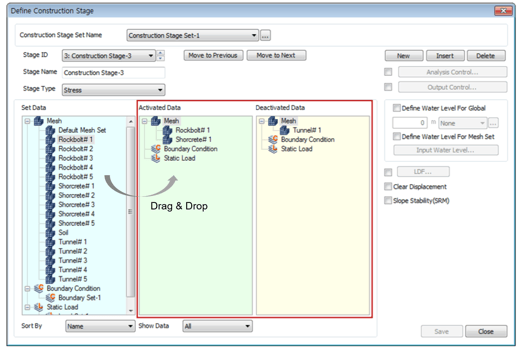
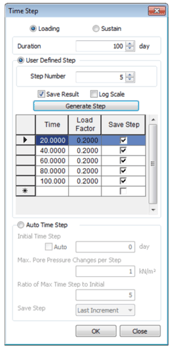
 

Construction stage window      Constructio stage time

Define Construction Stage


The video below shows the easiest way to automatically generate the construction stage. Auto Set enables to automatically register the displayed meshes, boundary conditions, load conditions on the activated data column and the un-displayed meshes, boundary conditions, load conditions on the deactivated data column.


👇 Watch the popular case study webinar

[GTS NX] Auto-Construction Stage Feature



btn_trial

Topics Deep excavation MIDAS GTS NX Construction Stages Excavation Work

MIDAS GEO TEAM

Written by MIDAS GEO TEAM

Want Engineering tips
& Tech-trends in your inbox?