Expertise · WSP
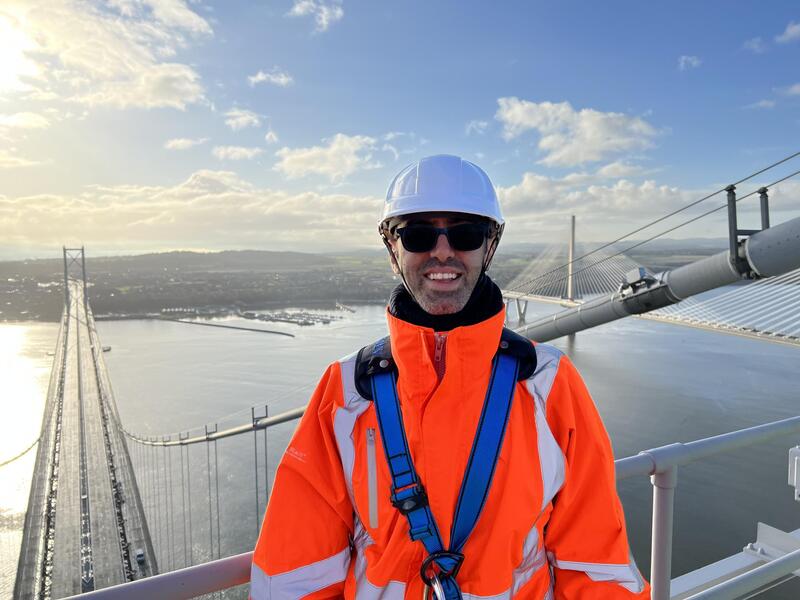
Andrea Caristo is Associate for Complex and Signature Bridges at WSP. When measurements from site disagree with a model, the structure is normally the first thing suspected. On the River Irwell Network Arch Bridge the conclusion went the other way, and it had to be proved before the project would stop planning remedial work.
In Andrea Caristo's own words.
"The most important lesson has been that a model is only as good as the engineering judgement behind it."
I always challenge results, validate them against first principles, and compare them with observed structural behaviour whenever possible. Engineering software is a powerful tool, but understanding how a structure behaves remains the engineer's primary responsibility.
I am a fundamentals-first engineer who believes the best analysis is the one that can be built safely, efficiently and with confidence, with deep understanding of every step and its results. Throughout my career I have used advanced finite element modelling not as an end in itself, but as a tool to solve real construction and operational challenges on complex bridges around the world.
The first Network Arch railway bridge constructed in the UK
During the construction of the River Irwell Network Arch Bridge, concerns arose on site regarding measured cable forces and the apparent behaviour of the structure during erection. There was a risk that the bridge was not behaving as originally intended, which could have led to costly investigations, delays and potentially unnecessary strengthening measures.
As Category III checker for the erection engineering, I developed and maintained a detailed MIDAS Civil construction-stage model of the bridge and continuously compared analytical predictions against site measurements, including deck geometry, arch geometry, jack reactions and cable forces.
Rather than focusing solely on the reported force readings, I examined the overall behaviour of the structure and compared observed deformations and hydraulic jack readings with those predicted by the finite element model.
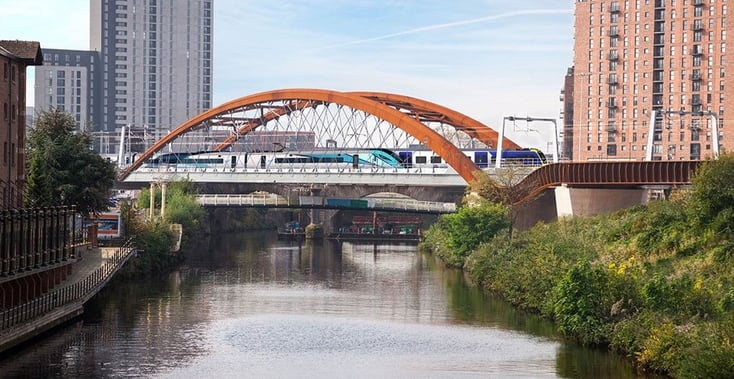
The bridge as a complete system
Rather than looking at a single data point, I used the model to assess the behaviour of the bridge as a complete system. As the arch was lifted, the hangers stressed, and the structure transitioned from temporary works to its final configuration, the predicted deflections, arch geometry, deck geometry and support reactions all closely matched the values observed on site.
Through this process, I concluded that the bridge itself was behaving as expected and that the discrepancy originated from the interpretation of the cable force measurements rather than from any structural issue. By demonstrating that the measured geometry closely matched the predicted behaviour throughout the erection sequence, I was able to show that the structure was performing correctly and that the monitoring system required recalibration. The cable force readings were subsequently re-zeroed and brought into agreement with the observed structural behaviour.
This outcome avoided unnecessary remedial measures, provided confidence to the project team and reinforced the importance of combining advanced analysis with engineering judgement.
Q. River Irwell also led to your first technical publication with MIDAS. What has stayed with you from it?
The experience remains one of the best examples in my career of how finite element modelling should be used, not simply to generate results, but to understand and explain the real behaviour of a structure. Over the years, I have used MIDAS on some of the world's most complex cable-stayed, suspension and arch bridge projects, but the River Irwell project remains the clearest example of analysis directly influencing engineering decisions and project outcomes.
This reinforced a principle that has guided me ever since: models should not replace engineering judgement, they should enhance it. What stayed with me was not the model itself, but the realization that engineering software is at its most powerful when it helps explain reality.
River Irwell is one project, and it is enough to show how an engineer can think about a model. Andrea Caristo used the model to explain what the bridge was doing on site, and that explanation settled the question. We share Andrea Caristo's view that engineering software is at its best when it helps explain reality, and this story is a clear example of it. [Read the full article on River Irwell Network Arch Bridge modelling]