Contribution · H&T Consulting Engineers
Tzyy Wooi Teh is Director at H&T Consulting Engineers in Malaysia and works across bridge and rail. The analysis results on a project can look perfectly acceptable while the site condition says otherwise, and an engineer who stops at the output never finds out. The story below names two projects where not stopping produced something specific.
In Tzyy Wooi Teh's own words.
"I do not accept results simply because the numbers look right. I verify the assumptions, understand the structural behaviour, and consider how the design will actually be built and perform in the real world."
I put fundamentals first, practical solutions always. For me, getting it right means delivering a solution that is safe, practical, and buildable.
Throughout my career, I have encountered projects where the analysis results appeared acceptable, but the actual structural behaviour or site condition suggested otherwise. In such situations, I do not rely solely on computer output. I go back to first principles, reviewing the load path, structural behaviour, assumptions, boundary conditions and actual construction conditions. These have been applied in the value engineering design project like DASH Expressway like below.

On several major bridge and rail projects, this approach has helped identify issues that were not immediately obvious from the numerical results and allowed the team to refine the design before they became construction or performance problems.
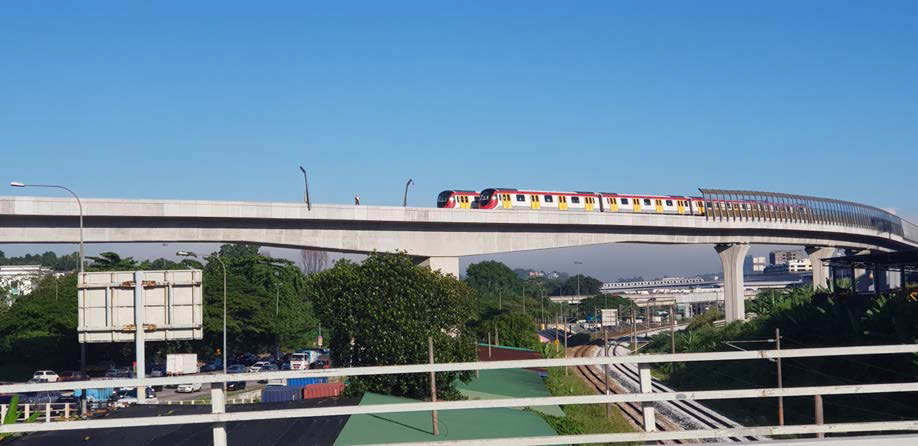
A damping bearing on the KVMRT SSP line
The innovation of using Natural High Damping bearing on the KVMRT SSP line was to provide a structure resilience approach. I also consider how a structure will actually be built, because a technically correct design is not necessarily a good design if it is difficult or impractical to construct.
My approach is therefore simple: understand the structure first, use analysis tools to verify that understanding, and apply engineering judgment to make the final decision.
Q. When a MIDAS result surprises you, what is the first thing you do?
I question "Does this make engineering sense?" first. I go back to the load path, structural behaviour and simple hand calculations before examining the model assumptions and results again.
A complete model, never trusted blindly
Earlier in my career, much of our understanding came from simplified calculations and engineering judgment. As projects became larger and more complex, from curved and long-span viaducts to cable-stayed bridges, MIDAS gave me the ability to model the structure as a complete system and investigate behaviours that were difficult to capture with simplified methods.
The most important lesson for me was not to trust a sophisticated model blindly. I believe this combination of fundamentals, experience and practical thinking is what enables an engineer to turn a difficult problem into a safe, buildable and reliable solution.
Neither the value engineering on DASH nor the damping bearings on the SSP line would have been reached by an engineer treating an acceptable set of numbers as a finished answer. Tzyy Wooi Teh tells us to ask one question before accepting any result: does this make engineering sense?