Beomsoo Cho, Changho Sun and Yungi Son all work in Korea, and all three learn from the site as much as from the model. In each of their stories, a question raised on site sent the engineer back to the analysis, and the design came out better for it.
In their own words.
01
Beomsu Cho
Manager · H&H Engineering · Korea
"Even when the analysis says it is safe, I do not call it a good design
if it is difficult to build or difficult to manage on the actual site."
Conversely, if even a small problem on site has its cause analysed technically and fed back into the design, I believe a better solution can come out of it. I am an engineer who connects the realities of the site with the results of analysis. I care less about the design value itself than about what it means on a real site, and rather than applying given conditions as they are. I think about site conditions and constructability together.
Fitting a self-supported retaining wall to the site
On the Yongin Cluster project, I reviewed a self-supported earth retaining system suited to the site conditions in comparison with conventional retaining methods. I carried out temporary works and ground analysis using MIDAS GEO X. I looked at construction conditions such as excavation, backfilling and prestress management alongside the design conditions, to make the design work better on site.
Not passing it off as a construction problem
Working with the self-supported method, I repeatedly met situations where the design I expected and the conditions on site did not match. Rather than simply keeping the existing design, I looked for a solution, reviewed it structurally again and worked out what reinforcement was needed.
For example, when site conditions made it difficult to apply the tension planned for a pile, I did not treat it as a construction problem. I examined alternatives such as an adjusted tension and an upper reinforcing member. Using MIDAS as a tool to compare alternatives for a problem that had arisen on site and to support the decision, I came to think that existing analysis and design methods need to be reapplied to suit practice.
Q. What did repeated temporary-works analysis teach you about the program?
It taught me to understand why a result comes out the way it does. Even with the same program, the result can change depending on the input conditions and the analysis method. I learned this by analysing temporary works in MIDAS on several projects and comparing the results.
02
Changho Sun
Professor · University of Ulsan · Korea
"No judgement without a basis, and every result gets verified."
Checking the method before trusting it
Rather than applying an existing method as it stands, I start by checking whether that method properly explains the actual behaviour of the problem in front of me. The more complex the problem, the more it has to be structured first, with the assumptions and the basis made clear, and then calculation, experiment and code cross-verified against each other to raise the completeness of the project.
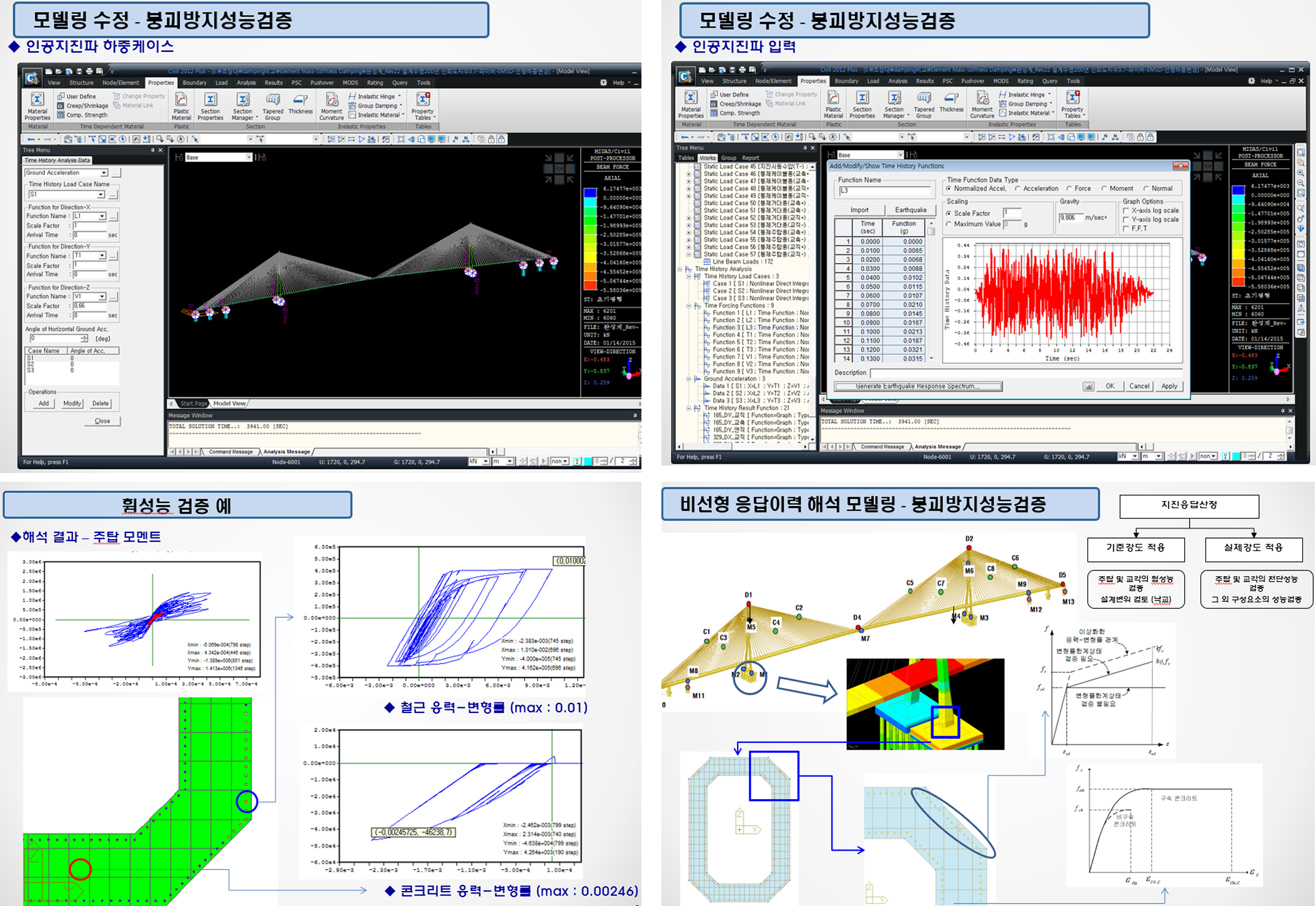
One case was a seismic retrofit whose construction cost had become excessive. Through nonlinear analysis, I was able to propose the minimum seismic retrofit that still satisfies the required seismic performance. For analyses like this, I now carry out most of my structural work in MIDAS, including complex and difficult nonlinear analysis, and I compare it with various other structural analysis programs as a tool to verify engineering judgement.
Writing the codes, and explaining them for practitioners
In 2018 I was one of the authors of KDS 17 00 00 General Seismic Design and of KDS 24 17 11 and 24 17 12, the seismic design codes for bridges (limit state design and cable bridges). Since then I have continued to help practitioners understand them, writing the base-isolated bridge examples for the bridge seismic performance evaluation manual (2022), the commentary on the detailed guidelines for bridges (2024), and commentaries and examples for dams, rivers and water supply and sewerage.
I am now principal investigator for performance tests on anchor rebars at bridge bearing anchorages (2025–2027), carrying out seismic performance evaluation that reflects the actual reinforcement details of bearings and feeding the results into the evaluation guidelines.
03
Yoonki Son
CEO · ENVICO · Korea
"The varied structural problems that appear on site have to be solved on a site basis."
I respect the structural mechanics that bridge engineering is founded on, and I think that continually searching for new solutions is what an engineer's ability consists of.
New solutions grounded in structural mechanics
Çanakkale Bridge · Cable geometry with the curvature of the earth
On the Çanakkale Bridge (2019–2023), where I was project director for the erection engineering of the towers, girders and cables, the cable geometry used the curvature of the earth, which improved the accuracy of the cable during erection.
Noryang Bridge · Torsion in a three-dimensional cable
I carried out an analysis of the mechanical meaning of band torsion in a three-dimensional cable, and of its stage-by-stage torsional behaviour during erection.
New Millennium Bridge · Korea's first three-pylon system
On the New Millennium Bridge (2009–2011), where I led the design of the suspension span, I introduced a three-pylon system to Korea's first multi-span suspension bridge, reducing the cable quantity and rationalising the system.
Contributing to the suspension bridge module
Taking part in the development when the suspension bridge module was being put into MIDAS Civil, and contributing to module development led by engineers, was meaningful to me. So was the opportunity to write columns on how long-span cable-supported bridges have developed and on the analytical engineering points that matter in them.
On site, a design meets conditions that the model did not fully predict. For these three engineers, that gap was a reason to go back to the analysis, check the assumptions and bring the answer back to the site. What question has your last site visit raised about your model?