Expertise · HDR
Yasser Al-Anany is Bridge Engineering Technical Lead at HDR in Canada. A new concrete box structure had to go in beneath an active railway corridor in the Region of Durham. The usual route to that involves temporary modular bridges, a diverted track and long work blocks. The account below reaches the same finished structure without any of them.
In Yasser Al-Anany's own words.
"A structural model can provide precise results, but those results are only meaningful when the assumptions, site conditions, construction methods, and actual behaviour of the structure are properly understood."
I approach each challenge by going back to the fundamentals, questioning assumptions, and using analysis as a tool to develop reliable and well-informed solutions. At the same time, I believe engineering solutions must be practical, constructible, and grounded in real-world conditions.

Beneath an active railway corridor
One example was the expansion of a railway corridor in the Region of Durham, where a new concrete box structure was required to accommodate the proposed roadway expansion beneath an active railway corridor. A key challenge was developing a construction approach that would allow the new structure to be installed while maintaining railway operations and minimizing disruption to the surrounding roadway network.
Pushed into its final position
Our engineering judgment led to the use of a box-jacking technique, in which the new structure was constructed adjacent to the railway and then pushed into its final position beneath the existing tracks.
A major advantage of this approach was that it enabled the bridge installation to proceed under live rail operations without the need for temporary modular bridges and temporary substructures to support a diverted track, avoiding extended work blocks and minimizing impacts to rail service.
It also reduced the amount of heavy construction activity immediately adjacent to the railway and roadway, helping to minimize construction noise and traffic disruption. This project demonstrated the value of considering structural design and innovative construction methodologies together to develop a safe, practical, and efficient engineering solution.
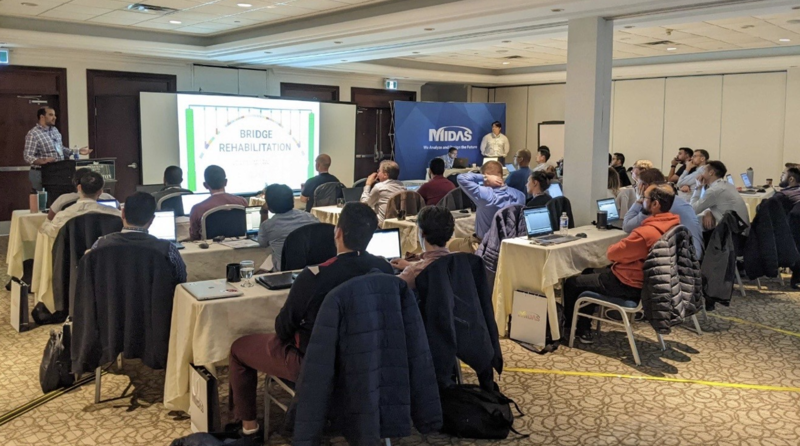
Q. You train and support other engineers in using MIDAS Civil for bridge analysis. What does that give you?
Seeing them gain confidence in using the software has been just as rewarding as using it myself. It reminded me that the value of an engineering tool is not only in what it allows one engineer to accomplish, but also in how knowledge can be shared to help improve the quality of engineering across a team.
Over the years, MIDAS Civil changed the way I approach complex structural problems by allowing me to explore different structural behaviours, challenge assumptions, and better understand how individual components interact within the overall structure. It has become an important part of how I investigate a problem and develop confidence in my engineering decisions.
It was good to hear a story in which confidence grows at every step. He gained it from a box-jacking method that kept trains running above the work, and now passes it on by training other engineers.
Helping more engineers feel that confidence is a Right MIDAS wants to hold as its own.