1. Introduction
A cable is a tension-only member that sags under its self-weight. As pretension increases, the sag decreases, and the cable becomes taut, behaving more like a straight truss. If the sag effect is ignored, the cable's axial stiffness and frequency will be overestimated. The pretension also contributes to the cable's geometric stiffness and its transverse vibration modes.
This article explains how MIDAS CIVIL NX accounts for both these effects and how we can set up an eigenvalue analysis for cable structures. We've also included verification of the eigenvalue analysis for a 5 m long cable under different pretension loads, accounting for both sag effects and geometric stiffness.
1.1 Axial Stiffness of Cable (Sag Effect)
In MIDAS CIVIL NX, the tension-only cable element reflects the change in stiffness as a function of its internal tension force. For eigenvalue analysis, cable elements are converted into equivalent truss elements.
The axial stiffness of a truss element is:
Kelastic = EA / L
The resultant axial stiffness of a cable is a series combination of the elastic and sag stiffnesses:
Keq = 1 / (1/Kelastic + 1/Ksag) = EeqA / L
The Ernst equation gives the equivalent modulus of elasticity,
Eeq = E / [1 + (w2L2EA) / (12T3)]
- E = Elastic modulus of the cable
- L = Horizontal projected length of the cable element
- w = Cable weight per unit length
- A = Cross-sectional area of the cable
- T = Axial force of the cable element
- L0 or LU = Unstrained initial length of the cable element
1.2 Geometric Stiffness of Cable
The element stiffness matrix of a cable element can be separated into two parts: the elastic stiffness matrix, kE, and the geometric stiffness matrix, kG. The approximation T/L ≈ T/L0 is accurate enough for most applications.
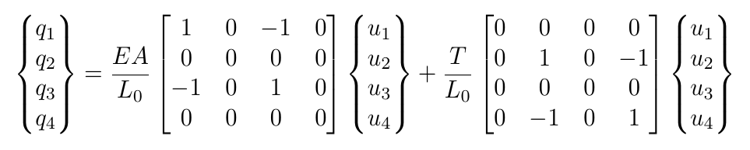
Figure 1. Elastic and geometric stiffness matrices of an equivalent truss element
2. Eigenvalue Analysis Workflow in MIDAS CIVIL NX
- Define tension-only cable elements with pretension, horizontal force, or unstrained length inputs. The geometric stiffness is calculated based on these inputs in the cable element definition.
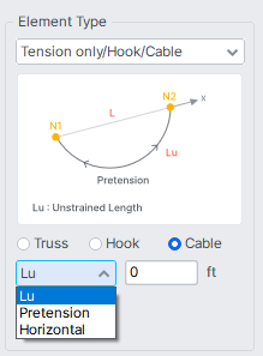 Figure 2. Tension-only Cable Element Definition
- Create a construction stage analysis model by defining structure, boundary, and load groups.
- In Analysis > Construction Stage > Construction Stage Analysis Control Data, check the two options below.


Figure 3. Convert cable elements to equivalent truss elements with geometric stiffness in the Post C.S. - Project > Structure Type > Define Mass Control Parameters.
- Load > Masses > Define Nodal Masses / Loads to Masses.
- Analysis > Analysis Control > Eigenvalue Analysis Control.
- Perform the analysis and review Results > Mode Shapes > Vibration Mode Shapes.

You can check more of these details in the download file.
3. Verification Example
- Problem Statement
- Variation of Frequencies with Pretension
- Cable Efficiency and Pretension
4. Conclusion
Author

Related On-Demand
In this session, we will share innovative approaches to real-time data processing with geo In this session, we will share innovative approaches to real-time data processing with geo-ession, we will share innovative approaches to real-time data processing with geo-