Abstract
Tunnel engineering has traditionally been dominated by mechanical thinking to control deformation and to secure structural stability. However, in practice, many of the most serious problems encountered are related to groundwater. This paper revisits tunnel engineering from a hydraulic perspective.
This paper is organized into four main parts: (1) why groundwater matters in tunnel design; (2) implications from current hydraulic design and construction practices; (3) a reinterpretation of tunnel hydraulics; and (4) future challenges in tunnel hydraulic design.
1. Why Groundwater Matters in Tunnel Design
1.1 Significance of Groundwater in Tunnel Design
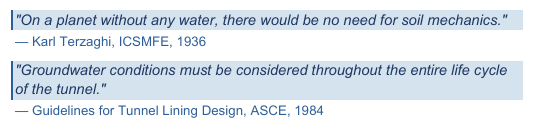
The significance of groundwater in tunnel engineering is highlighted by the following well known statements:

To understand tunnel hydraulics, it is necessary to begin with the natural hydrological system. Tunnel excavation introduces a new hydraulic boundary, changing the groundwater flow system and inevitably disturbing the hydrological balance. As a result, both hydrological and hydraulic effects may occur due to tunnelling.
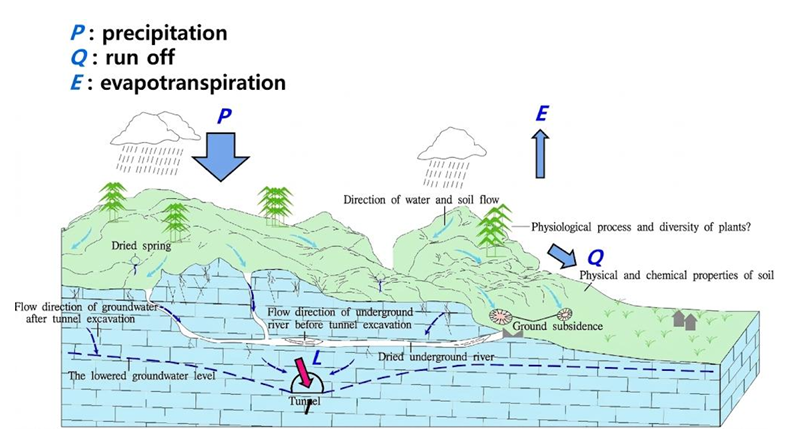
Figure 1.1 — Water balance and effects of tunnel construction
One type of impact, which is a hydrological problem, is the flooding of surface water into a tunnel. This is demonstrated by recent metro flooding incidents in China, South Korea, and the United States.
In China, the Jeong Jou Metro incident was a tragic event in which 25 persons died. These cases demonstrate the significance of hydrological processes in tunnel design. In hydraulic aspects, groundwater plays a critical role from construction to operation. During tunnel excavation, groundwater can strongly affect tunnel stability.
In 1994, a tunnel collapse occurred in Munich; a bus fell into the collapse and the bus driver died — the cause of death was reported as drowning due to groundwater. However, the influence of groundwater does not end after construction.
Inflow into a tunnel can also produce critical environmental consequences. Drawdown of the groundwater table can cause a variety of environmental problems, such as ecological damage in forests and ground settlement. Thus, tunnel hydraulics is not only an engineering problem, but also an environmental issue.
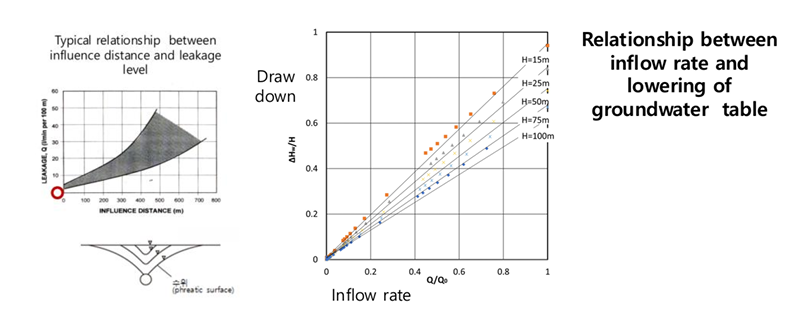 Figure 1.2 — Environmental effects: inflow-induced drawdown of groundwater table
Another important aspect is long-term hydraulic deterioration. The drainage capacity of a drained tunnel may decrease and water pressure on the lining may gradually increase with time. Meanwhile, the waterproofing systems of an undrained tunnel may also deteriorate, causing leakage. Therefore, the effect of groundwater must be considered over the entire service life of a tunnel.
One more specific hydraulic interaction during tunnel operation is Tunnel Floor Uplift (TFL). TFL occurs due to long-term groundwater interaction leading to uplift of the invert. This phenomenon can lead to deformation and cracking of the tunnel invert, posing significant risks to structural performance and threatening public safety. Several mechanisms can cause this phenomenon, including squeezing and swelling behavior related to groundwater intrusion, and direct water pressure acting on the invert. These processes highlight the complex interaction between tunnels and groundwater.
%20causes%20and%20mechanisms.png?width=889&height=311&name=Tunnel%20Floor%20Uplift%20(TFL)%20causes%20and%20mechanisms.png) Figure 1.3 — Tunnel Floor Uplift (TFL): causes and mechanisms
Figure 1.3 — Tunnel Floor Uplift (TFL): causes and mechanisms
1.2 Summary
Water influences tunnels through several pathways, including hydrological, hydraulic, environmental, and long-term effects. From these observations we can draw an important conclusion : "Groundwater governs tunnel performance."
Author

Related On-Demand
Tunnel construction is often described as a constant challenge with groundwater. Yet, traditional design has mainly focused on geotechnical factors and has not fully addressed the groundwater conditions that determine long-term performance and durability. This session presents a new way of viewing tunnels as integrated Hydro-Geo-Structure systems rather than simple underground spaces. It introduces an advanced design framework, supported by AI and digital twin–based maintenance strategies for the full life cycle of the structure.