🗂️ Download Now
Please fill out the Download Section below the Comment Section to download the 80 Masterworks of CIVIL Engineering

1. Arch Bridge Definition and Classifications
An arch bridge is usually defined as a vertically curved and axially compressed structural member spanning an opening and providing support for the moving loads above the opening. The deck can be supported or hung from this main structure, and depending on the position of the arch relative to the deck, arch bridges can be classified as deck arch, through arch, and half-through arch bridges as shown below:
 Figure 1. Deck Arch Bridge
 Figure 2. Through Arch Bridge
 Figure 3. Half-Through Arch Bridge
2. Design Considerations for Arch Bridges
Many factors affect the design of an arch bridge. In general, these factors are related to function, cost, safety, aesthetics, traffic demand capacity, foundation conditions, erection procedure, clearance requirements, and so on. General design recommendations focus mainly on the arch-to-span ratio, the arch and deck slenderness, and the number of hangers or piers.
a. Rise-to-Span Ratio
The rise-to-span ratio for arches may vary widely because an arch can be very shallow or, at the other extreme, could be a half-circle. Most arches would have rise-to-span ratios within the range of 1:4.5 to 1:6.
There are typical spans used for different types of materials. Below are some:
- Filled spandrel masonry arch bridges are suitable for spans < 20 m.
- Spans of masonry arch bridges range from a few meters to 146 m.
- Concrete arch bridges are suitable for spans ranging from 35 m to 200 m, though there are some bridges with spans well over 200 m.
- Steel and CFST (concrete-filled steel Tube) arch bridges have a larger capacity than the ones mentioned above, allowing larger spans because of the higher material strength.
3. Vortex Shedding
Vortex shedding should be taken into consideration when designing an arch bridge. There are times when an arch is identified that is having problems with hanger vibrations especially those with I-section hangers. These vibration issues are usually solved by connecting the hangers as shown below, reducing the length of the hangers, and changing their natural frequency.
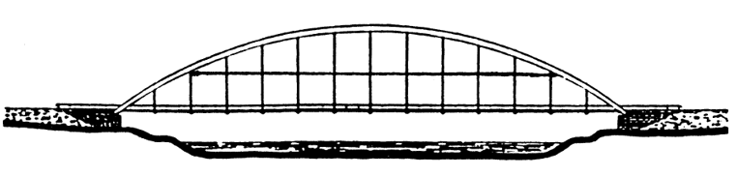 Figure 4. Horizontal Cable Connecting Hangers (The Bridge Engineering Handbook by Wai-Fah Chen and Lian Duan)
4. Buckling of Arch Rib
Since the curved rib of the arch bridge is subject to a high axial force, the chance of failure due to buckling of the rib must be taken into consideration when designing an arch bridge.
5. FEM Analysis
With the development of computer technology and its applications to structural analysis, various challenging arch shapes have turned up in practice that previously may have been imagined but were impossible to design. MIDAS has played a major role in the infrastructure of the world and MIDAS CIVIL has been used to design some of the most beautiful arch bridges in the world.
As an example, look at some of the MIDAS CIVIL project applications below:
.png?width=733&name=Arch%20Bridge%20(Taipei%2c%20Taiwan).png) Figure 5. Arch Bridge (Taipei, Taiwan)
Figure 5. Arch Bridge (Taipei, Taiwan)
.png?width=733&name=Steel%20Arch%20Bridge%20(Nanning%2c%20China).png) Figure 6. Steel Arch Bridge (Nanning, China)
Figure 6. Steel Arch Bridge (Nanning, China)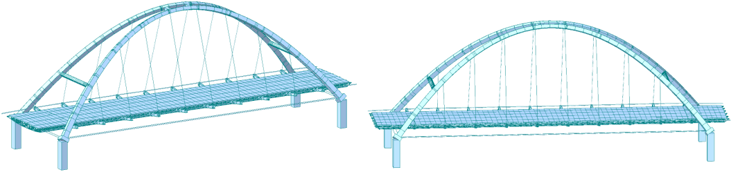 Figure 7. Laguna Española Bridge, Aruba