Would you like to sign out?

Select Country

  • Afghanistan English
  • Albania English
  • Algeria English
  • American Samoa English
  • Andorra English
  • Angola English
  • Anguilla English
  • Antarctica English
  • Antigua and Barbuda English
  • Argentina Español
  • Armenia English
  • Aruba English
  • Australia English
  • Austria English
  • Azerbaijan English
  • Bahamas English
  • Bahrain English
  • Bangladesh English
  • Barbados English
  • Belarus English
  • Belgium English
  • Belize English
  • Benin English
  • Bermuda English
  • Bhutan English
  • Bolivia Español
  • Bosnia and Herzegovina English
  • Botswana English
  • Bouvet Island English
  • Brazil English
  • British Indian Ocean Territory English
  • British Virgin Islands English
  • Brunei English
  • Bulgaria English
  • Burkina Faso English
  • Burundi English
  • Cambodia English
  • Cameroon English
  • Canada English
  • Cape Verde English
  • Caribbean Netherlands English
  • Cayman Islands English
  • Central African Republic English
  • Chad English
  • Chile Español
  • Christmas Island English
  • Cocos (Keeling) Islands English
  • Colombia Español
  • Comoros English
  • Congo English
  • Cook Islands English
  • Costa Rica Español
  • Côte d’Ivoire English
  • Croatia English
  • Cuba Español
  • Curaçao English
  • Cyprus English
  • Czech Republic English
  • Democratic Republic of the Congo English
  • Denmark English
  • Djibouti English
  • Dominica English
  • Dominican Republic Español
  • Ecuador Español
  • Egypt English
  • El Salvador Español
  • Equatorial Guinea English
  • Eritrea English
  • Estonia English
  • Ethiopia English
  • Falkland Islands English
  • Faroe Islands English
  • Fiji English
  • Finland English
  • France English
  • French Guiana Español
  • French Polynesia English
  • French Southern Territories English
  • Gabon English
  • Gambia English
  • Georgia English
  • Germany English
  • Ghana English
  • Gibraltar English
  • Greece English
  • Greenland English
  • Grenada English
  • Guadeloupe Español
  • Guam English
  • Guatemala Español
  • Guernsey English
  • Guinea English
  • Guinea-Bissau English
  • Guyana English
  • Haiti Español
  • Heard Island and McDonald Islands English
  • Honduras Español
  • Hong Kong English
  • Hungary English
  • Iceland English
  • India English
  • Indonesia English
  • Iran English
  • Iraq English
  • Ireland English
  • Isle of Man English
  • Israel English
  • Italy English
  • Jamaica English
  • Japan 日本語
  • Jersey English
  • Jordan English
  • Kazakhstan English
  • Kenya English
  • Kiribati English
  • South Korea 한국어
  • Kuwait English
  • Kyrgyzstan English
  • Laos English
  • Latvia English
  • Lebanon English
  • Lesotho English
  • Liberia English
  • Libya English
  • Liechtenstein English
  • Lithuania English
  • Luxembourg English
  • Macau English
  • Madagascar English
  • Malawi English
  • Malaysia English
  • Maldives English
  • Mali English
  • Malta English
  • Marshall Islands English
  • Martinique English
  • Mauritania English
  • Mauritius English
  • Mayotte English
  • Mexico Español
  • Micronesia English
  • Moldova English
  • Monaco English
  • Mongolia English
  • Montenegro English
  • Montserrat English
  • Morocco English
  • Mozambique English
  • Myanmar English
  • Namibia English
  • Nauru English
  • Nepal English
  • Netherlands English
  • New Caledonia English
  • New Zealand English
  • Nicaragua Español
  • Niger English
  • Nigeria English
  • Niue English
  • Norfolk Island English
  • Northern Mariana Islands English
  • Norway English
  • Oman English
  • Pakistan English
  • Palau English
  • Palestine English
  • Panama Español
  • Papua New Guinea English
  • Paraguay Español
  • Peru Español
  • Philippines English
  • Pitcairn Islands English
  • Poland English
  • Portugal Español
  • Puerto Rico Español
  • Qatar English
  • Réunion English
  • Romania English
  • Russia English
  • Rwanda English
  • Saint Barthélemy Español
  • Saint Helena English
  • Saint Kitts and Nevis English
  • Saint Lucia English
  • Saint Martin Español
  • Saint Pierre and Miquelon English
  • Saint Vincent and the Grenadines English
  • Samoa English
  • San Marino English
  • São Tomé and Príncipe English
  • Saudi Arabia English
  • Senegal English
  • Serbia English
  • Seychelles English
  • Sierra Leone English
  • Singapore English
  • Sint Maarten English
  • Slovakia English
  • Slovenia English
  • Solomon Islands English
  • Somalia English
  • South Africa English
  • South Georgia English
  • South Sudan English
  • Spain English
  • Sri Lanka English
  • Sudan English
  • Suriname English
  • Svalbard and Jan Mayen English
  • Eswatini English
  • Sweden English
  • Switzerland English
  • Syria English
  • Taiwan English
  • Tajikistan English
  • Tanzania English
  • Thailand English
  • Togo English
  • Tokelau English
  • Tonga English
  • Trinidad and Tobago English
  • Tunisia English
  • Turkey English
  • Turkmenistan English
  • Turks and Caicos Islands English
  • Tuvalu English
  • U.S. Virgin Islands English
  • Uganda English
  • Ukraine English
  • United Arab Emirates English
  • United Kingdom English
  • United States English
  • U.S. Minor Outlying Islands English
  • Uruguay Español
  • Uzbekistan English
  • Vanuatu English
  • Vatican City English
  • Venezuela Español
  • Vietnam English
  • Wallis and Futuna English
  • Western Sahara English
  • Yemen English
  • Zambia English
  • Zimbabwe English
  • Åland Islands English
  • East Timor English
  • Netherlands Antilles English
  • Serbia and Montenegro English
  • North Macedonia English
  • Timor-Leste English

CIVIL NX AtoZ : Deformed vs. Original, Setting Boundary Condition for Elastic Links in Construction Stage Analysis

January 3, 2024
BLOG BRIDGE INSIGHT

Happy New years 🌞 civil engineers . This is CoBen!! 👬

It's time for a review, as usual. Do you remember Offset function in CIVIL NX?

Let me reiterate. You cannot apply a Beam End Offset at the same time when a Section Offset is in place. It is not possible to apply Offsets simultaneously.

For more details, you can click on 'Offset function in CIVIL NX' to check it out!

Then let's move on to today's topic.

Today, we'll explore 'When modeling considering the construction stage in MIDAS CIVIL NX, whether to select Deformed or Original for the boundary condition of the Elastic Link'. Many users are modeling considering the construction stage, and at this time, there is a concern about whether to choose Deformed or Original when activating or deactivating the boundary condition of the Elastic Link.


Today's question: “During the construction stage, should the boundary condition of the Elastic link be set to Deformed or Original?”


We're going to share the reason for that today.

When activating the boundary condition, apply Original and Deformed by considering the difference in the position of the nodes.


Try this simple and useful method to use MIDAS CIVIL NX more easily and effectively!

First, please check the corresponding model.
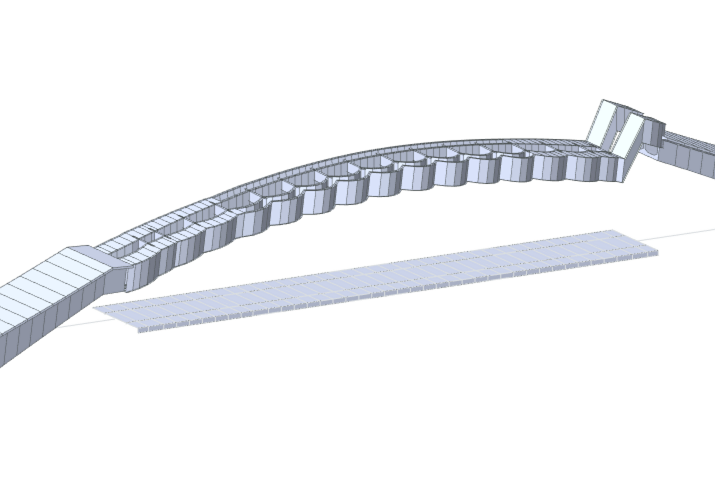
 

Modeling ExampleModeling Example


This model is in the construction stage analysis, with a concrete slab created on top of a steel box. During the slab creation, the ‘Deformed’ option of the Elastic Link was used, but in this stage, the slab is positioned far below the top of the steel box.

On the other hand, choosing the ‘Original’ option seems to render the shape correctly, but the reaction and sectional force results appear to be more appropriate with the ‘Deformed’ option. Therefore, there has been difficulty in deciding whether to select Original or Deformed.

The displacement shape displayed on the screen is an exaggerated form, which is the actual displacement multiplied by a scale factor. To view the displacement shape in actual scale, the corresponding option needs to be set.


Real Displacement (Auto-Scale Off)Real Displacement (Auto-Scale Off)


Additionally, when activating boundary conditions during the construction phase, the ‘Original’ option applies a load that restores the nodes to their initial positions, creating additional member forces, while the ‘Deformed’ option creates boundary conditions as is, based on the displaced positions of the nodes.

Thus, under the Deformed option, no additional member forces are generated.

From the perspective of member forces that match the actual construction of the structure, it is appropriate to analyze using the Deformed option. Since this does not forcibly apply displacement to the structure, it is common to apply the displacement occurring after analysis with the Deformed option with camber.


Pretty simple, isn’t it?


This small tip for MIDAS CIVIL NX will make your work much easier. Now become a wizard of the 'Boundary Condition for Elastic Link' while using MIDAS CIVIL NX more effectively! 🎩🔮


Susbcribe
MIDAS Newsletter

Thank you, See you soon!
Share
CoBen | MIDAS IT HQ

Hello, we are the tip masters, Connor and Ben, from the MIDAS blog! Join us and become a CIVIL NX master with our expert tips!


Connor: Here to enlighten you about the essential features of CIVIL NX that are often overlooked. I'll help you easily understand and utilize useful functions that you might not have been aware of.


Ben: I provide practical tips for more effective use of CIVIL NX. With small but impactful tips often missed by users, I'll help you significantly improve your workflow efficiency.

Comments
Keep exploring engineering ideas