Would you like to sign out?

Select Country

  • Afghanistan English
  • Albania English
  • Algeria English
  • American Samoa English
  • Andorra English
  • Angola English
  • Anguilla English
  • Antarctica English
  • Antigua and Barbuda English
  • Argentina Español
  • Armenia English
  • Aruba English
  • Australia English
  • Austria English
  • Azerbaijan English
  • Bahamas English
  • Bahrain English
  • Bangladesh English
  • Barbados English
  • Belarus English
  • Belgium English
  • Belize English
  • Benin English
  • Bermuda English
  • Bhutan English
  • Bolivia Español
  • Bosnia and Herzegovina English
  • Botswana English
  • Bouvet Island English
  • Brazil English
  • British Indian Ocean Territory English
  • British Virgin Islands English
  • Brunei English
  • Bulgaria English
  • Burkina Faso English
  • Burundi English
  • Cambodia English
  • Cameroon English
  • Canada English
  • Cape Verde English
  • Caribbean Netherlands English
  • Cayman Islands English
  • Central African Republic English
  • Chad English
  • Chile Español
  • Christmas Island English
  • Cocos (Keeling) Islands English
  • Colombia Español
  • Comoros English
  • Congo English
  • Cook Islands English
  • Costa Rica Español
  • Côte d’Ivoire English
  • Croatia English
  • Cuba Español
  • Curaçao English
  • Cyprus English
  • Czech Republic English
  • Democratic Republic of the Congo English
  • Denmark English
  • Djibouti English
  • Dominica English
  • Dominican Republic Español
  • Ecuador Español
  • Egypt English
  • El Salvador Español
  • Equatorial Guinea English
  • Eritrea English
  • Estonia English
  • Ethiopia English
  • Falkland Islands English
  • Faroe Islands English
  • Fiji English
  • Finland English
  • France English
  • French Guiana Español
  • French Polynesia English
  • French Southern Territories English
  • Gabon English
  • Gambia English
  • Georgia English
  • Germany English
  • Ghana English
  • Gibraltar English
  • Greece English
  • Greenland English
  • Grenada English
  • Guadeloupe Español
  • Guam English
  • Guatemala Español
  • Guernsey English
  • Guinea English
  • Guinea-Bissau English
  • Guyana English
  • Haiti Español
  • Heard Island and McDonald Islands English
  • Honduras Español
  • Hong Kong English
  • Hungary English
  • Iceland English
  • India English
  • Indonesia English
  • Iran English
  • Iraq English
  • Ireland English
  • Isle of Man English
  • Israel English
  • Italy English
  • Jamaica English
  • Japan 日本語
  • Jersey English
  • Jordan English
  • Kazakhstan English
  • Kenya English
  • Kiribati English
  • South Korea 한국어
  • Kuwait English
  • Kyrgyzstan English
  • Laos English
  • Latvia English
  • Lebanon English
  • Lesotho English
  • Liberia English
  • Libya English
  • Liechtenstein English
  • Lithuania English
  • Luxembourg English
  • Macau English
  • Madagascar English
  • Malawi English
  • Malaysia English
  • Maldives English
  • Mali English
  • Malta English
  • Marshall Islands English
  • Martinique English
  • Mauritania English
  • Mauritius English
  • Mayotte English
  • Mexico Español
  • Micronesia English
  • Moldova English
  • Monaco English
  • Mongolia English
  • Montenegro English
  • Montserrat English
  • Morocco English
  • Mozambique English
  • Myanmar English
  • Namibia English
  • Nauru English
  • Nepal English
  • Netherlands English
  • New Caledonia English
  • New Zealand English
  • Nicaragua Español
  • Niger English
  • Nigeria English
  • Niue English
  • Norfolk Island English
  • Northern Mariana Islands English
  • Norway English
  • Oman English
  • Pakistan English
  • Palau English
  • Palestine English
  • Panama Español
  • Papua New Guinea English
  • Paraguay Español
  • Peru Español
  • Philippines English
  • Pitcairn Islands English
  • Poland English
  • Portugal Español
  • Puerto Rico Español
  • Qatar English
  • Réunion English
  • Romania English
  • Russia English
  • Rwanda English
  • Saint Barthélemy Español
  • Saint Helena English
  • Saint Kitts and Nevis English
  • Saint Lucia English
  • Saint Martin Español
  • Saint Pierre and Miquelon English
  • Saint Vincent and the Grenadines English
  • Samoa English
  • San Marino English
  • São Tomé and Príncipe English
  • Saudi Arabia English
  • Senegal English
  • Serbia English
  • Seychelles English
  • Sierra Leone English
  • Singapore English
  • Sint Maarten English
  • Slovakia English
  • Slovenia English
  • Solomon Islands English
  • Somalia English
  • South Africa English
  • South Georgia English
  • South Sudan English
  • Spain English
  • Sri Lanka English
  • Sudan English
  • Suriname English
  • Svalbard and Jan Mayen English
  • Eswatini English
  • Sweden English
  • Switzerland English
  • Syria English
  • Taiwan English
  • Tajikistan English
  • Tanzania English
  • Thailand English
  • Togo English
  • Tokelau English
  • Tonga English
  • Trinidad and Tobago English
  • Tunisia English
  • Turkey English
  • Turkmenistan English
  • Turks and Caicos Islands English
  • Tuvalu English
  • U.S. Virgin Islands English
  • Uganda English
  • Ukraine English
  • United Arab Emirates English
  • United Kingdom English
  • United States English
  • U.S. Minor Outlying Islands English
  • Uruguay Español
  • Uzbekistan English
  • Vanuatu English
  • Vatican City English
  • Venezuela Español
  • Vietnam English
  • Wallis and Futuna English
  • Western Sahara English
  • Yemen English
  • Zambia English
  • Zimbabwe English
  • Åland Islands English
  • East Timor English
  • Netherlands Antilles English
  • Serbia and Montenegro English
  • North Macedonia English
  • Timor-Leste English

[API] Temperature Gradient Self-Equilibrating Stress Calculator

April 11, 2024
BLOG BRIDGE INSIGHT

1. Why do bridge engineers consider Non-linear Temperature Gradients?

Temperature loads threaten bridge safety, especially for long-span bridges. If the bridge is located with a big temperature difference, A structural engineer analyzes and designs a bridge based on the beam theory. The temperature gradient should be considered with the beam theory. The beam theory assumes the beam deforms primarily in one direction, the material behaves linearly elastic, and the beam has a uniform cross-section. It means even if the beam cross-section gets a different thermal expansion depending on the depth, the cross-section does not change, and it is also possible to substitute thermal stress as a self-equilibrating stress in restraint conditions.

For more information, I recommend reading the Non-linear temperature gradient series.


(Click to see the each post)


a. Difference things within existing functions and plug-in

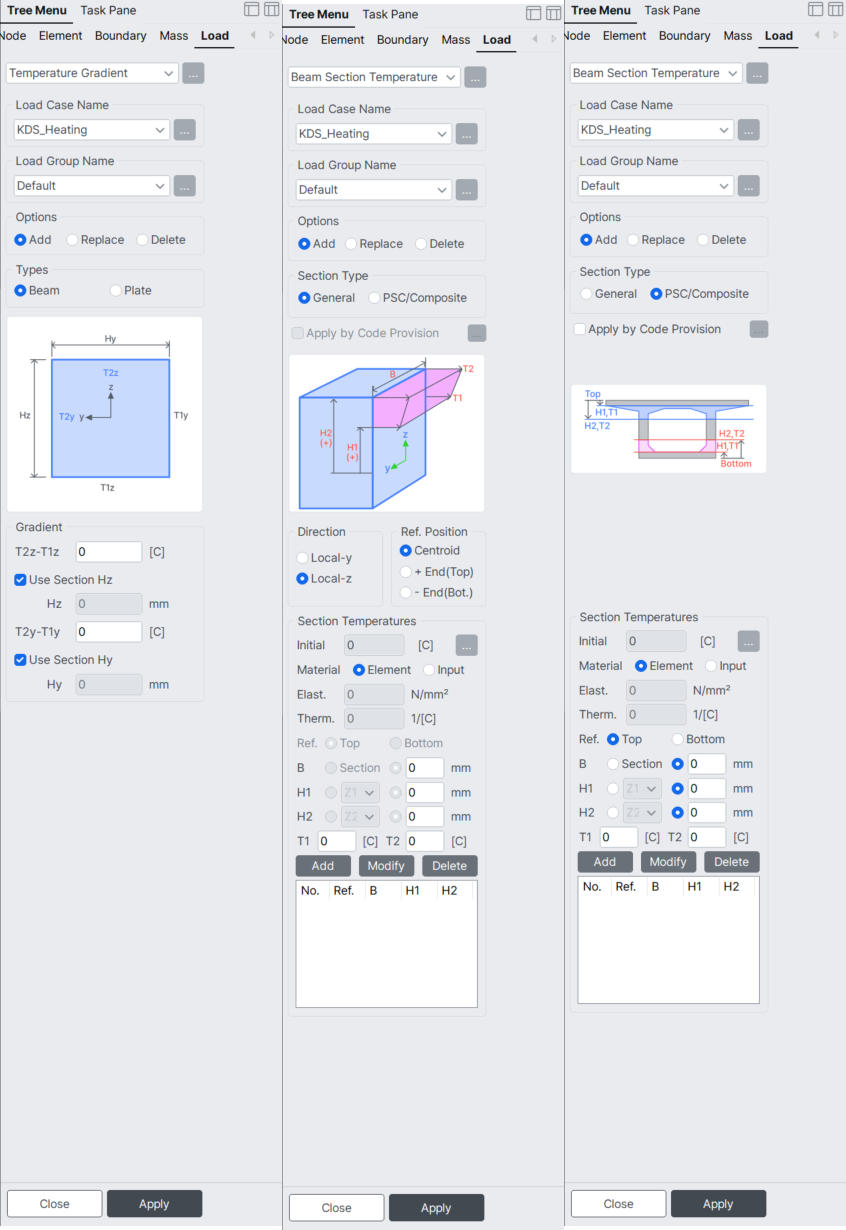
Most CIVIL users already know a function to apply temperature gradient depending on the section properties. I will make sure to show you a simple example for comparison.

 

UntitledLoad> Temperature > Temperature Loads > Temp. Gradient & Beam Section Temp.
 

Untitled 1

Temperature gradient input for general & PSC section


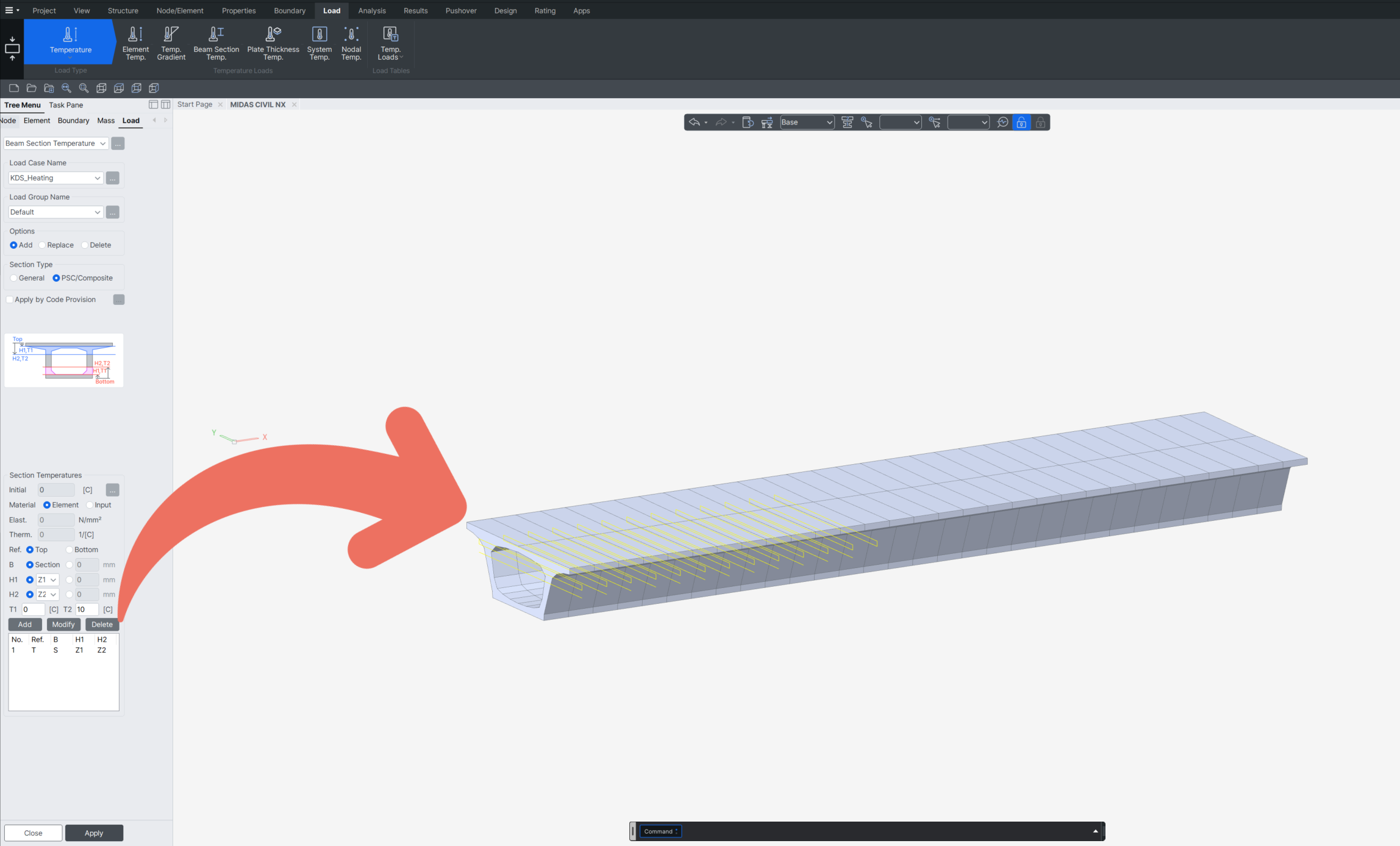
Add the section temperatures to apply a temperature gradient on the PSC beam. The user must add depth, temperature change locations, and temperature variation, select an element and then use loads. The loads applied do not show any stress values.
 

Untitled 2

Apply Temperature Gradient on the PSC beam
 

Untitled 3

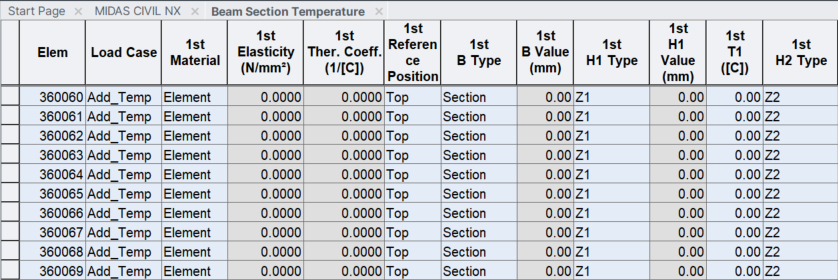
The table shows the applied new temperature load on the PSC beam


This is the most significant difference thing between traditional methods and plug-ins. The plug-in shows self-equilibrating stress in the stress summary table. The user can check non-linear temperature gradient graphs and self-equilibrating stress charts on the right side.


Untitled 4


2. Temperature Gradient Self-Equilibrating Stresses Calculator Plug-in


This part will explain the operating steps and each component in detail.

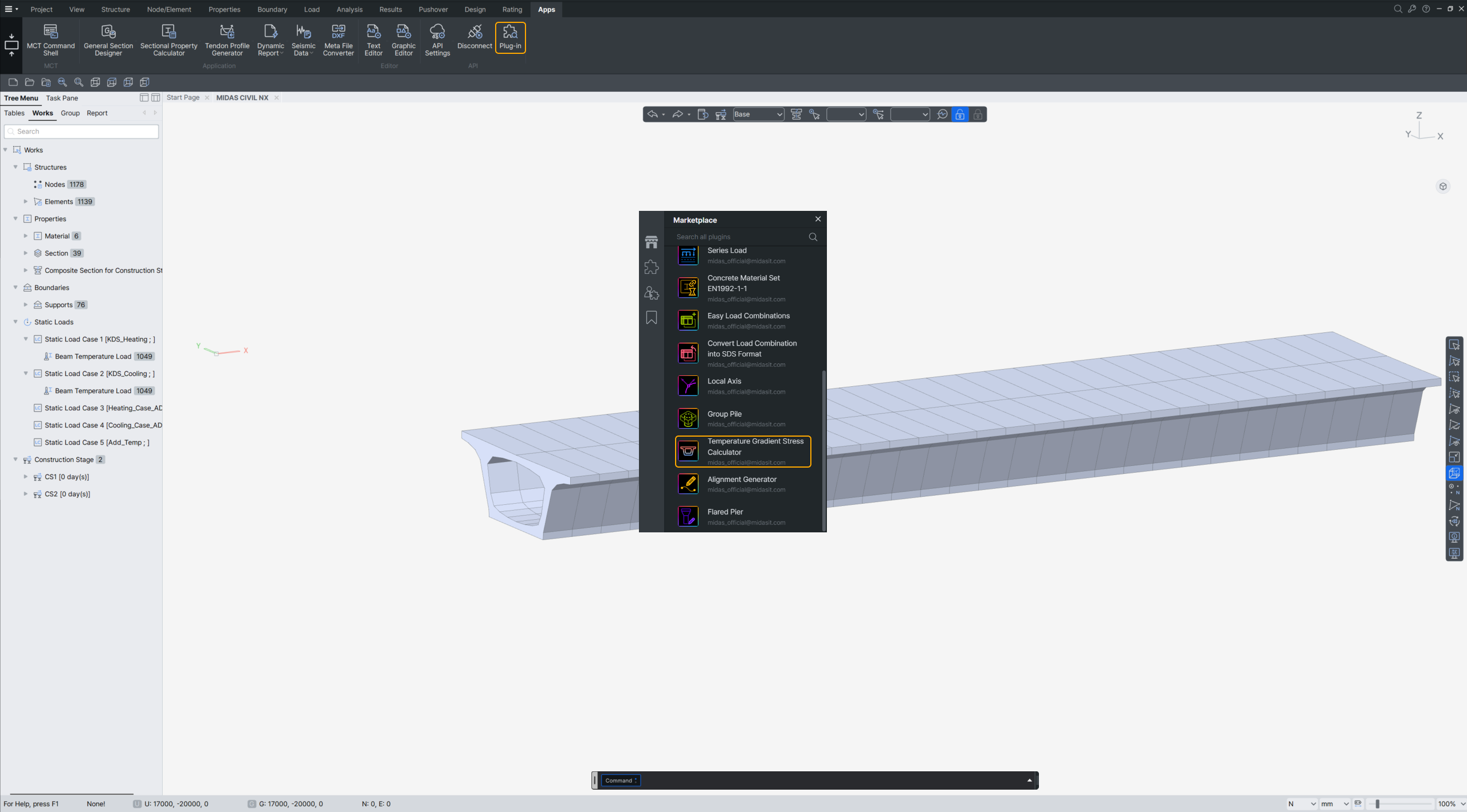
1. Open MIDAS CIVIL NX → Connect API → Open Plug-in Marketplace → Run Temperature Gradient Stress Calculator
 

Untitled 5

Figure1. Temperature Gradient Stress Calculator plugin Screenshot


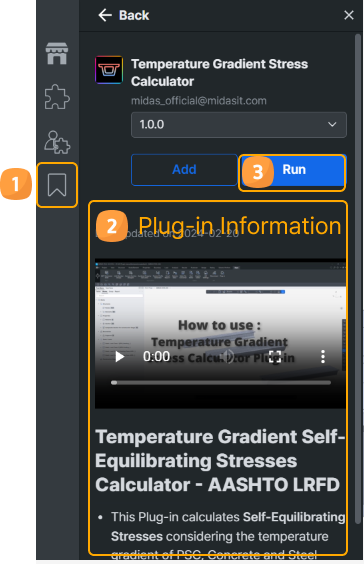
2. When users operate the Temperature Gradient Stress Calculator plug-in, they can add this plug-in to the users’ bookmark(1). The user can read plug-in information(2) and start by clicking the Run(3) button.
 

Untitled 6

Figure 2. Temperature Gradient Stress Calculator plugin


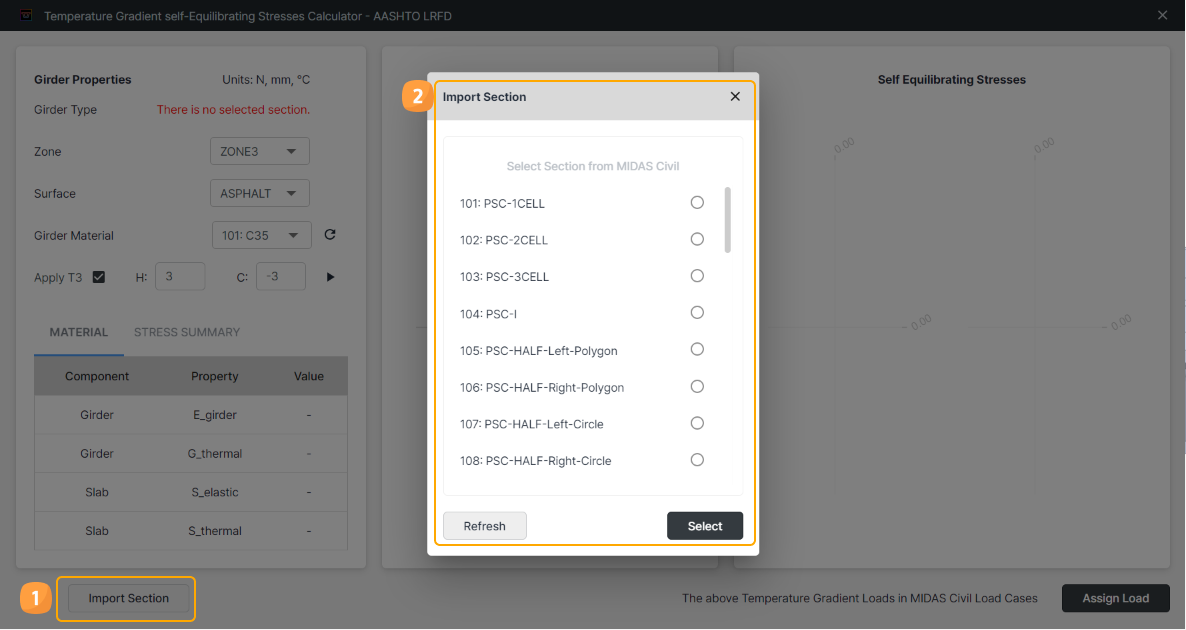
3. A new window pops up. Click Import Section(1) and select a section(2) for applying temperature gradient. The section will be imported from your CIVIL file.
 

Untitled 7


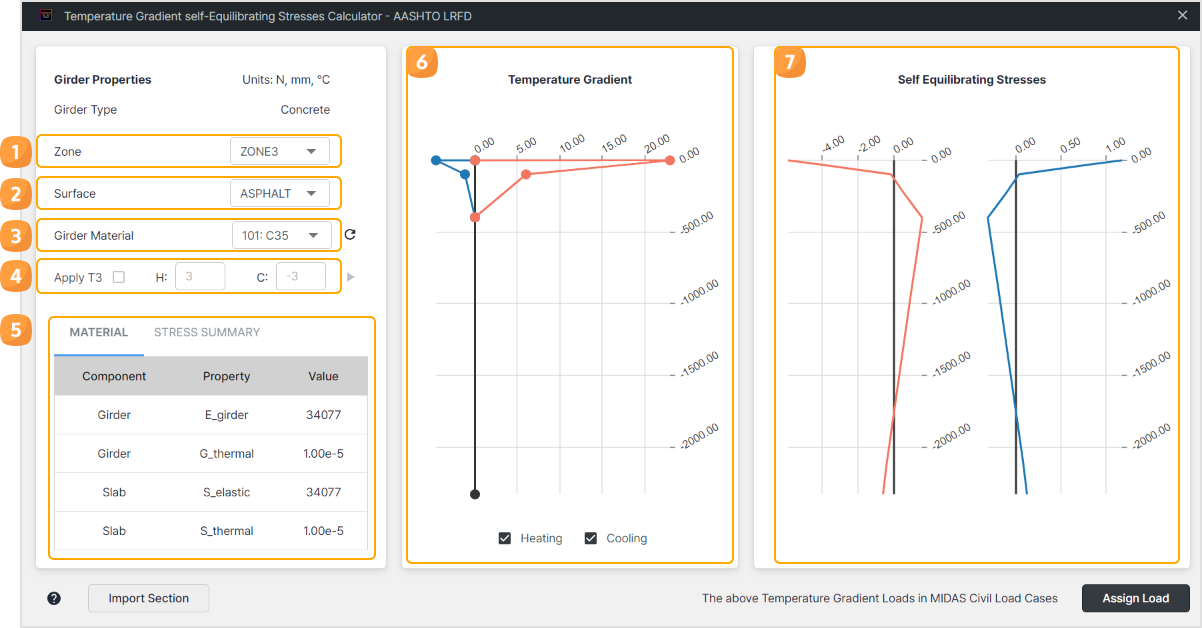
4. After selecting a section, the user can choose options: Temperature zone(1), girder surface(2), and girder materials(3) from the CIVIL file and select apply the T3 option, which is indicated at the bottom of the section. Then, the calculated value is shown in Table (5) based on selected material and options. The self-equilibrating stress is also checked here. Depending on the options, temperature gradient(6) and self-equilibrating stress(7) will be changed in real time.
 

Untitled 8


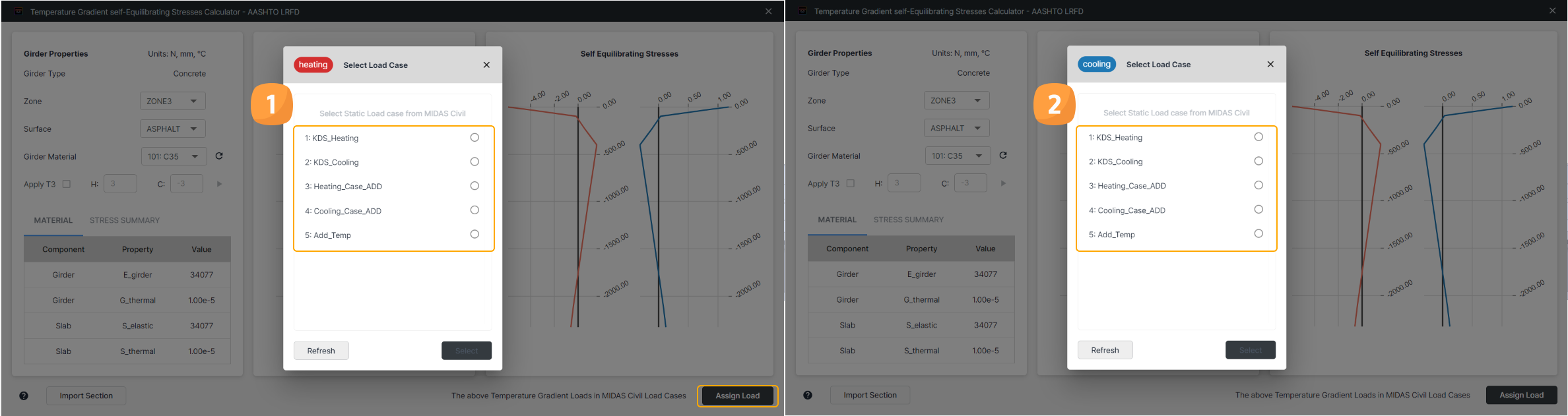
5. Now, it’s time to add a temperature load on the element. Add heating load(1) and cooling load(2). If you select one load case, you will choose just one.
 

Untitled 9


6. Select elements for application, and then you can check that temperature loads are added.
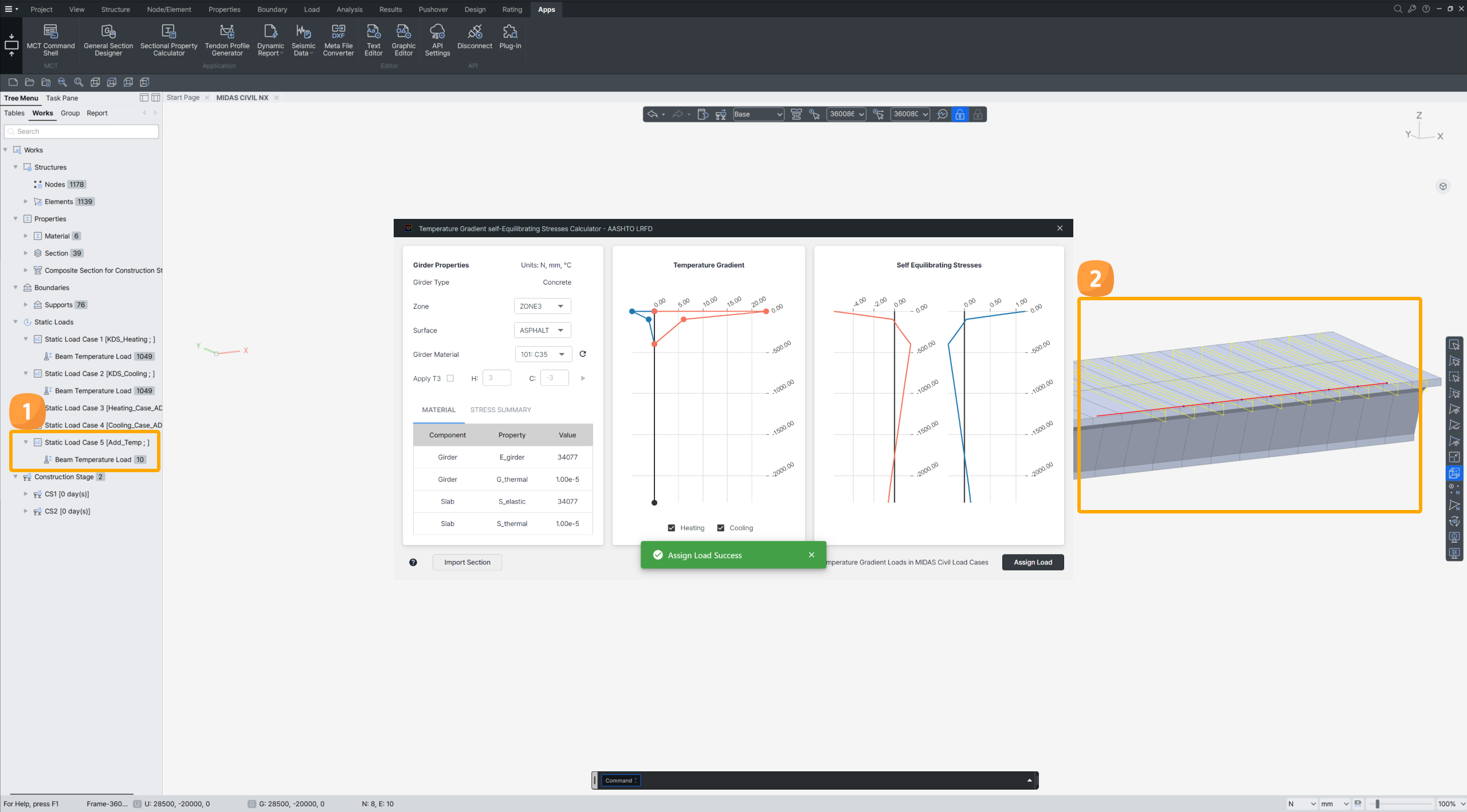
Untitled 10


3. Conclusion

The temperature load is one of the critical loads in the bridge design process. The temperature gradient self-equilibrating calculator helps add non-linear temperature gradients comfortably and shows the self-equilibrating stress values depending on options. Asymmetry and composite sections are also applicable. Please try them on your bridge project.


Susbcribe
MIDAS Newsletter

Thank you, See you soon!
Share
About the Author
Willow | Civil Engineer | MIDAS IT HQ

I'm Willow, a Civil engineer specializing in Structural engineering. I've worked as a railway project manager, and my current role is API project manager at MIDAS IT. Here, I'm dedicated to leveraging my structural engineering insights to pioneer API plug-ins, aiming to elevate customer experience through innovative solutions. I aspire to merge my technical insights with real-world experiences, offering a unique perspective on the intersection of engineering and life’s adventures.

Comments