Would you like to sign out?

Select Country

  • Afghanistan English
  • Albania English
  • Algeria English
  • American Samoa English
  • Andorra English
  • Angola English
  • Anguilla English
  • Antarctica English
  • Antigua and Barbuda English
  • Argentina Español
  • Armenia English
  • Aruba English
  • Australia English
  • Austria English
  • Azerbaijan English
  • Bahamas English
  • Bahrain English
  • Bangladesh English
  • Barbados English
  • Belarus English
  • Belgium English
  • Belize English
  • Benin English
  • Bermuda English
  • Bhutan English
  • Bolivia Español
  • Bosnia and Herzegovina English
  • Botswana English
  • Bouvet Island English
  • Brazil Español
  • British Indian Ocean Territory English
  • British Virgin Islands English
  • Brunei English
  • Bulgaria English
  • Burkina Faso English
  • Burundi English
  • Cambodia English
  • Cameroon English
  • Canada English
  • Cape Verde English
  • Caribbean Netherlands English
  • Cayman Islands English
  • Central African Republic English
  • Chad English
  • Chile Español
  • Christmas Island English
  • Cocos (Keeling) Islands English
  • Colombia Español
  • Comoros English
  • Congo English
  • Cook Islands English
  • Costa Rica Español
  • Côte d’Ivoire English
  • Croatia English
  • Cuba Español
  • Curaçao English
  • Cyprus English
  • Czech Republic English
  • Democratic Republic of the Congo English
  • Denmark English
  • Djibouti English
  • Dominica English
  • Dominican Republic Español
  • Ecuador Español
  • Egypt English
  • El Salvador Español
  • Equatorial Guinea English
  • Eritrea English
  • Estonia English
  • Ethiopia English
  • Falkland Islands English
  • Faroe Islands English
  • Fiji English
  • Finland English
  • France English
  • French Guiana Español
  • French Polynesia English
  • French Southern Territories English
  • Gabon English
  • Gambia English
  • Georgia English
  • Germany English
  • Ghana English
  • Gibraltar English
  • Greece English
  • Greenland English
  • Grenada English
  • Guadeloupe Español
  • Guam English
  • Guatemala Español
  • Guernsey English
  • Guinea English
  • Guinea-Bissau English
  • Guyana English
  • Haiti Español
  • Heard Island and McDonald Islands English
  • Honduras Español
  • Hong Kong English
  • Hungary English
  • Iceland English
  • India English
  • Indonesia English
  • Iran English
  • Iraq English
  • Ireland English
  • Isle of Man English
  • Israel English
  • Italy English
  • Jamaica English
  • Japan 日本語
  • Jersey English
  • Jordan English
  • Kazakhstan English
  • Kenya English
  • Kiribati English
  • South Korea 한국어
  • Kuwait English
  • Kyrgyzstan English
  • Laos English
  • Latvia English
  • Lebanon English
  • Lesotho English
  • Liberia English
  • Libya English
  • Liechtenstein English
  • Lithuania English
  • Luxembourg English
  • Macau English
  • Madagascar English
  • Malawi English
  • Malaysia English
  • Maldives English
  • Mali English
  • Malta English
  • Marshall Islands English
  • Martinique Español
  • Mauritania English
  • Mauritius English
  • Mayotte English
  • Mexico Español
  • Micronesia English
  • Moldova English
  • Monaco English
  • Mongolia English
  • Montenegro English
  • Montserrat English
  • Morocco English
  • Mozambique English
  • Myanmar English
  • Namibia English
  • Nauru English
  • Nepal English
  • Netherlands English
  • New Caledonia English
  • New Zealand English
  • Nicaragua Español
  • Niger English
  • Nigeria English
  • Niue English
  • Norfolk Island English
  • Northern Mariana Islands English
  • Norway English
  • Oman English
  • Pakistan English
  • Palau English
  • Palestine English
  • Panama Español
  • Papua New Guinea English
  • Paraguay Español
  • Peru Español
  • Philippines English
  • Pitcairn Islands English
  • Poland English
  • Portugal Español
  • Puerto Rico Español
  • Qatar English
  • Réunion English
  • Romania English
  • Russia English
  • Rwanda English
  • Saint Barthélemy Español
  • Saint Helena English
  • Saint Kitts and Nevis English
  • Saint Lucia English
  • Saint Martin Español
  • Saint Pierre and Miquelon English
  • Saint Vincent and the Grenadines English
  • Samoa English
  • San Marino English
  • Sao Tome and Principe English
  • Saudi Arabia English
  • Senegal English
  • Serbia English
  • Seychelles English
  • Sierra Leone English
  • Singapore English
  • Sint Maarten English
  • Slovakia English
  • Slovenia English
  • Solomon Islands English
  • Somalia English
  • South Africa English
  • South Georgia English
  • South Sudan English
  • Spain Español
  • Sri Lanka English
  • Sudan English
  • Suriname English
  • Svalbard and Jan Mayen English
  • Eswatini English
  • Sweden English
  • Switzerland English
  • Syria English
  • Taiwan English
  • Tajikistan English
  • Tanzania English
  • Thailand English
  • Togo English
  • Tokelau English
  • Tonga English
  • Trinidad and Tobago English
  • Tunisia English
  • Turkey English
  • Turkmenistan English
  • Turks and Caicos Islands English
  • Tuvalu English
  • U.S. Virgin Islands English
  • Uganda English
  • Ukraine English
  • United Arab Emirates English
  • United Kingdom English
  • United States of America English
  • U.S. Minor Outlying Islands English
  • Uruguay Español
  • Uzbekistan English
  • Vanuatu English
  • Vatican City English
  • Venezuela Español
  • Vietnam English
  • Wallis and Futuna English
  • Western Sahara English
  • Yemen English
  • Zambia English
  • Zimbabwe English
  • Åland Islands English
  • East Timor English
  • Netherlands Antilles English
  • Serbia and Montenegro English
  • North Macedonia English
  • Timor-Leste English

Structural Design Tips for Crane Girder

September 1, 2021
BLOG NEWS & TRENDS

The Objective of This Guide

The analysis and design of the crane moving load calculate the influence of the vertical and horizontal loads (Max./Min. node displacement, Max./Min. member strength, and reaction) caused by moving the crane on the crane girder, and it means a series of analyses and design processes for designing crane girder under common structures.

This material explains the use of the crane girder analysis and design features in midas nGen, and provides the relevant technology and verification data for this analysis and design.

Two types of crane girders can be supported by nGen. As shown in Fig. 1, there is a "General (type) Crane Girder" that resists vertical and horizontal forces caused by the crane itself. There is a "Composite (Type) Crane Girder" which can be combined with horizontal truss and back girder to integrate with horizontal force.

 
 
Figure 1. Concept of General Crane GirderFigure 1. Concept of General Crane Girder



Figure 2 Concept of Composite Crane Girder
           Figure 2. Concept of Composite Crane Girder
 

Generally, when the crane capacity is not large, a General Crane Girder can be used. In the case of a crane having a large capacity and a large horizontal force, as shown in Fig. 2, Composite Crane Girder Resistant with the back girder and back truss can be used.

Chapter 1 and 2 provide the concept of general crane girder and tutorial data. And Chapters 3 and 4 provide the concept of composite crane girder and tutorial data.


Introduction of General Crane Girder (Moving Load Analysis and Design Technical Background)


1.1. Element Concepts (Introduction of 1D-Beam Elements and Supportable Section)


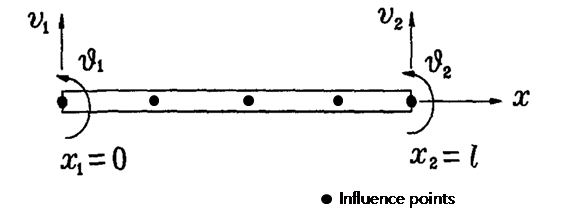
General Crane Girder is best simulated with a 1D Beam to analyze the impact of crane travel on the elements. Influence points are used to analyze the impact of moving weights (Figure 3). Here, the more Influence Points, the more accurate the moving-weight analysis results are, and the number of influence Points can be pre-specified by the user.
 
1D Beam Element and Influence points concept
Figure 3. 1D Beam Element and Influence Points Concept
 

Meanwhile, General Crane Girder in the analysis and design supports 1D Beam member with certain sections, or, as shown in the Table-1, H-shape, H-shape with Flange Plate, H-C Combined Shape are used mainly.


Type Combine Type Single-Sided Shape Design Substitution
H-Shape - Table1 h-shape


H
H-Shape with Flange Plate - Table1 h-shape with flange plate


H-Shape with Flange Plate
H-C Combined Shape Downward Table1 h-c combined shape


H


Table 1. Crane Girder Main Section Shape


1.2. Influence Points of Concept


Figure 4 shows the calculation of the influence line results that were calculated by the unit weights over each point. Each of the influence points you specify has the following impact line results, where you can enter the wheel information of the crane to determine the analysis (maximum) member force, etc. for each Influence point.
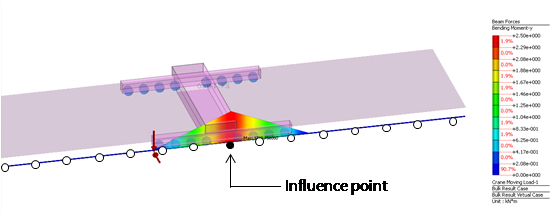
 
Figure 4 Effect line of unit weight on influence point
Figure 4. Effect Line of Unit Weight on Influence Point


1.3. Check Position Concept

Check Position is an in-member calculation point that is recognized when performing a design after analysis, and the program assigns four sections (Figure 5) as Check Position, and you can adjust the number of Check Positions according to your intentions. The selected member is determined by NG, OK or Not Checked, which of the check positions the member has the most unfavorable Rating, and provides a one-of-a-kind view of the calculation report in the output of the detailed calculation.
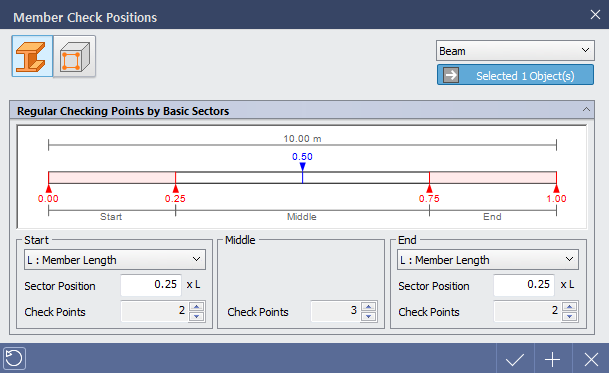
 
Figure 5 Check Positions of Absence
Figure 5. Check Positions of Absence


General Crane Girder: Introduction to Analysis and Design Procedures


This chapter uses the Crane Framing Plan in 3 spans (column 14 to column 17) of Figure 6 to follow a simple General Crane Girder model: Each column has a column spacing of 10m, and cranes with a capacity of 100Ton are located between columns D and E. Each crane girder is simply supported so that no source moment occurs.
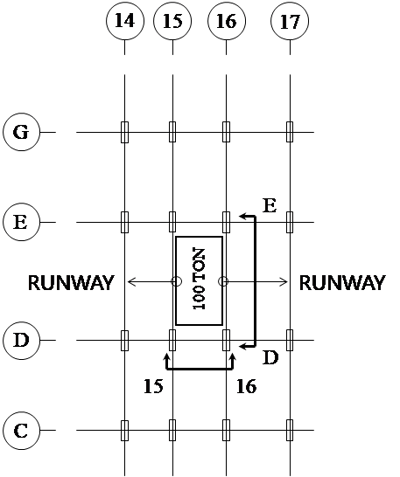
 
Figure 6 Crane Framing Plan
Figure 6. Crane Framing Plan
 

Figure 7 shows crane wheel information and crane girder information. Crane bridge has a span of 10m, hook approach has 1m. The crane has a capacity of 1,000 KN, trolley and Hoist weighs 250 KN, and has a self-weight of 250 kN. There are eight wheels at each side of the crane bridge, the wheel load acting on each wheel is assumed to be the same.


Download the full pdf file from the form below.
01_앞표지_템플릿_고정-1_crane girder


Subscribe S.O.S Newsletter

About Author
Young-il Seo | Principal Structural Engineer

Young-il has over 13+ years of experience in building design, especially high-rise buildings with column reduction analysis, plant structures, pushover analysis, health monitoring, and vibration control projects. Since 2016, he is planning and providing technical supports for midas building products such as midas Gen, nGen, and Design+.

E-BOOK Structural Design Guide
for Crane Girder

This material explains the use of the crane girder analysis and provides
the relevant technology and verification data for this analysis and design.