Would you like to sign out?

Select Country

  • Afghanistan English
  • Albania English
  • Algeria English
  • American Samoa English
  • Andorra English
  • Angola English
  • Anguilla English
  • Antarctica English
  • Antigua and Barbuda English
  • Argentina Español
  • Armenia English
  • Aruba English
  • Australia English
  • Austria English
  • Azerbaijan English
  • Bahamas English
  • Bahrain English
  • Bangladesh English
  • Barbados English
  • Belarus English
  • Belgium English
  • Belize English
  • Benin English
  • Bermuda English
  • Bhutan English
  • Bolivia Español
  • Bosnia and Herzegovina English
  • Botswana English
  • Bouvet Island English
  • Brazil Español
  • British Indian Ocean Territory English
  • British Virgin Islands English
  • Brunei English
  • Bulgaria English
  • Burkina Faso English
  • Burundi English
  • Cambodia English
  • Cameroon English
  • Canada English
  • Cape Verde English
  • Caribbean Netherlands English
  • Cayman Islands English
  • Central African Republic English
  • Chad English
  • Chile Español
  • Christmas Island English
  • Cocos (Keeling) Islands English
  • Colombia Español
  • Comoros English
  • Congo English
  • Cook Islands English
  • Costa Rica Español
  • Côte d’Ivoire English
  • Croatia English
  • Cuba Español
  • Curaçao English
  • Cyprus English
  • Czech Republic English
  • Democratic Republic of the Congo English
  • Denmark English
  • Djibouti English
  • Dominica English
  • Dominican Republic Español
  • Ecuador Español
  • Egypt English
  • El Salvador Español
  • Equatorial Guinea English
  • Eritrea English
  • Estonia English
  • Ethiopia English
  • Falkland Islands English
  • Faroe Islands English
  • Fiji English
  • Finland English
  • France English
  • French Guiana Español
  • French Polynesia English
  • French Southern Territories English
  • Gabon English
  • Gambia English
  • Georgia English
  • Germany English
  • Ghana English
  • Gibraltar English
  • Greece English
  • Greenland English
  • Grenada English
  • Guadeloupe Español
  • Guam English
  • Guatemala Español
  • Guernsey English
  • Guinea English
  • Guinea-Bissau English
  • Guyana English
  • Haiti Español
  • Heard Island and McDonald Islands English
  • Honduras Español
  • Hong Kong English
  • Hungary English
  • Iceland English
  • India English
  • Indonesia English
  • Iran English
  • Iraq English
  • Ireland English
  • Isle of Man English
  • Israel English
  • Italy English
  • Jamaica English
  • Japan 日本語
  • Jersey English
  • Jordan English
  • Kazakhstan English
  • Kenya English
  • Kiribati English
  • South Korea 한국어
  • Kuwait English
  • Kyrgyzstan English
  • Laos English
  • Latvia English
  • Lebanon English
  • Lesotho English
  • Liberia English
  • Libya English
  • Liechtenstein English
  • Lithuania English
  • Luxembourg English
  • Macau English
  • Madagascar English
  • Malawi English
  • Malaysia English
  • Maldives English
  • Mali English
  • Malta English
  • Marshall Islands English
  • Martinique Español
  • Mauritania English
  • Mauritius English
  • Mayotte English
  • Mexico Español
  • Micronesia English
  • Moldova English
  • Monaco English
  • Mongolia English
  • Montenegro English
  • Montserrat English
  • Morocco English
  • Mozambique English
  • Myanmar English
  • Namibia English
  • Nauru English
  • Nepal English
  • Netherlands English
  • New Caledonia English
  • New Zealand English
  • Nicaragua Español
  • Niger English
  • Nigeria English
  • Niue English
  • Norfolk Island English
  • Northern Mariana Islands English
  • Norway English
  • Oman English
  • Pakistan English
  • Palau English
  • Palestine English
  • Panama Español
  • Papua New Guinea English
  • Paraguay Español
  • Peru Español
  • Philippines English
  • Pitcairn Islands English
  • Poland English
  • Portugal Español
  • Puerto Rico Español
  • Qatar English
  • Réunion English
  • Romania English
  • Russia English
  • Rwanda English
  • Saint Barthélemy Español
  • Saint Helena English
  • Saint Kitts and Nevis English
  • Saint Lucia English
  • Saint Martin Español
  • Saint Pierre and Miquelon English
  • Saint Vincent and the Grenadines English
  • Samoa English
  • San Marino English
  • Sao Tome and Principe English
  • Saudi Arabia English
  • Senegal English
  • Serbia English
  • Seychelles English
  • Sierra Leone English
  • Singapore English
  • Sint Maarten English
  • Slovakia English
  • Slovenia English
  • Solomon Islands English
  • Somalia English
  • South Africa English
  • South Georgia English
  • South Sudan English
  • Spain Español
  • Sri Lanka English
  • Sudan English
  • Suriname English
  • Svalbard and Jan Mayen English
  • Eswatini English
  • Sweden English
  • Switzerland English
  • Syria English
  • Taiwan English
  • Tajikistan English
  • Tanzania English
  • Thailand English
  • Togo English
  • Tokelau English
  • Tonga English
  • Trinidad and Tobago English
  • Tunisia English
  • Turkey English
  • Turkmenistan English
  • Turks and Caicos Islands English
  • Tuvalu English
  • U.S. Virgin Islands English
  • Uganda English
  • Ukraine English
  • United Arab Emirates English
  • United Kingdom English
  • United States of America English
  • U.S. Minor Outlying Islands English
  • Uruguay Español
  • Uzbekistan English
  • Vanuatu English
  • Vatican City English
  • Venezuela Español
  • Vietnam English
  • Wallis and Futuna English
  • Western Sahara English
  • Yemen English
  • Zambia English
  • Zimbabwe English
  • Åland Islands English
  • East Timor English
  • Netherlands Antilles English
  • Serbia and Montenegro English
  • North Macedonia English
  • Timor-Leste English

What is Modal Response Spectrum Analysis?

June 29, 2021
BLOG NEWS & TRENDS

OVERVIEW

The Seismic Load Analysis Procedure has 16 processes and it is largely divided into 2 parts : Series 1 (Including Series 2 , 3 & 4) and Series 5 (Modal Response Spectrum (RS) Analysis.

The part we will look over today is Series 5 : Modal Response Spectrum (RS) Analysis.


Modal Response Spectrum(RS) Analysis
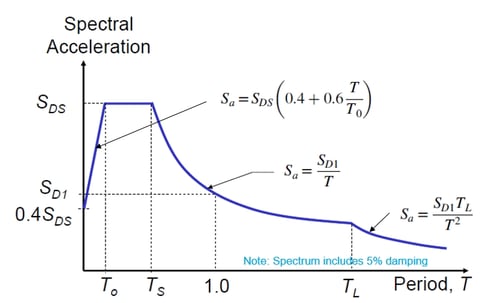


20_SERIES2_41


   Where

  ⋅ SDS = the design spectral response acceleration parameter at short periods

  ⋅ SD1 = the design spectral response acceleration parameter at a 1-sec period

  ⋅ T = the fundamental period of the structure, sec

  ⋅ T = 0.2(SD1/SDS )

  ⋅ TL  = long-period transition period(s) shown in Figs. 22-14 through 22-17


Basic Steps in RS Analysis


1. Compute modal properties for each mode

> Frequency (period), Shape, Modal participation factor, Effective modal mass


2. Determine number of modes to use in analysis

> Use a sufficient number of modes to capture at least 90% of total mass in each direction.


3. Compute spectral accelerations for each contributing mode

> Use a general spectrum.


4. Compute modified spectral accelerations

> Multiply spectral accelerations by modal participation factor and by (I/R).


5. Compute modal displacements for each mode


6. Compute element forces in each mode


7. Statistically combine modal displacements to determine system displacements

> SRSS or CQC


8. Statistically combine component forces to determine system displacements

> SRSS or CQC


9. Scale-up seismic load of RS

> If the design base shear based on modal analysis is less than 85% of the base shear(Equivalent Lateral force) computed using T=TaCu.

→ combination of modes must be scaled such that the base shear equals

0.85 times the equivalent lateral force.


10. Add accidental torsion

> As a static loading and amplify if necessary


11. Check story drift

> multiply the results of the modal analysis

(including the I/R scaling but not the 85% scaling) by Cd/I.


√ Table of Contents

1. The Setting of RS Analysis in nGen

2. Add Signs(+, -) to the Results

3. Analytical Modeling for RS Analysis

4. Calculation of Base Shear by RS Analysis


1. The Setting of RS Analysis in nGen
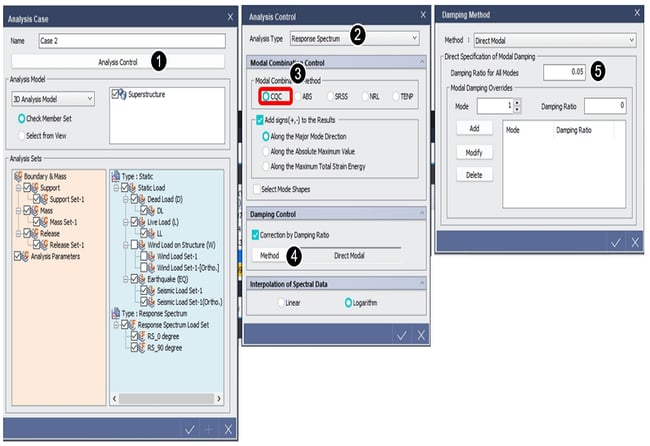
 

20_SERIES2_42-11. Click "Analysis Control" in "Analysis case" dialog box.

2. Select "Response Spectrum" in analysis type.

3. Select modal combination method. (use CQC generally).

4. Click "Method" button in damping control.

5. Modify damping ratio if necessary.


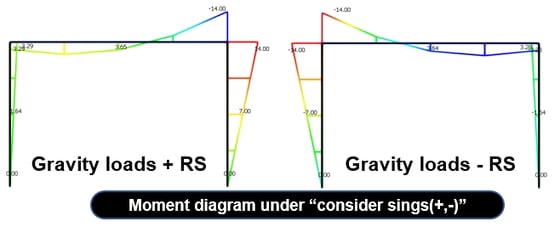
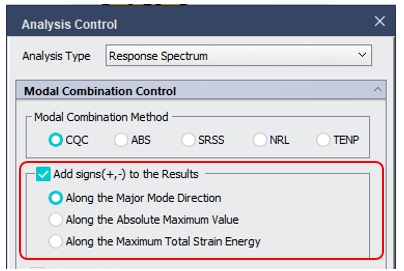
2. Add signs(+, -) to the Results


: Specify whether to restore the signs deleted during the mode combination and specify the restoration method.
 
20_SERIES2_43

Along the Major Mode Direction:  Restore the signs according to the signs(+, -) of the principal mode for every loading direction.
 
Along the Absolute Maximum Value: Restore the signs according to the signs of the absolute maximum values of the modal results.
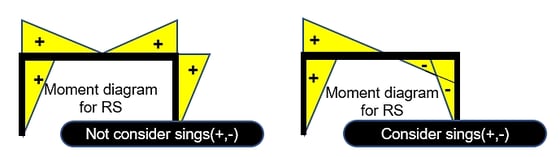
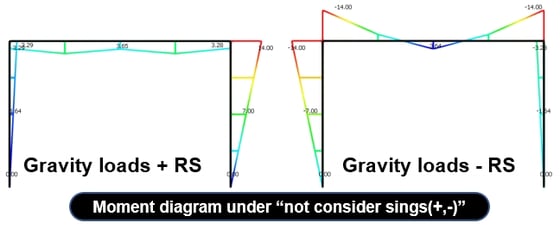


20_SERIES2_4420_SERIES2_4520_SERIES2_46In both cases, the same design results can be obtained, but the sign(+,-) must be considered in order to find the actual member force.


3. Analytical Modeling for RS Analysis


• Use 3D analysis
For concrete structures, include the effect of cracking (consider a stiffness for cracked section).
For steel structures, include panel zone deformations.
• Include flexibility of foundation if well enough defined
• Include actual flexibility of diaphragm if well enough defined
• Include P-delta effects in the analysis if the program has the capability
• Do not try to include accidental torsion by the movement of the center of mass
• Include orthogonal load effects by running the fill 100% spectrum in each direction, and then SRSSing the results.


4. Calculation of Base Shear by RS Analysis


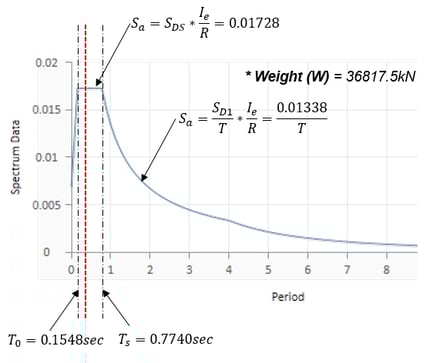
Generation of RS
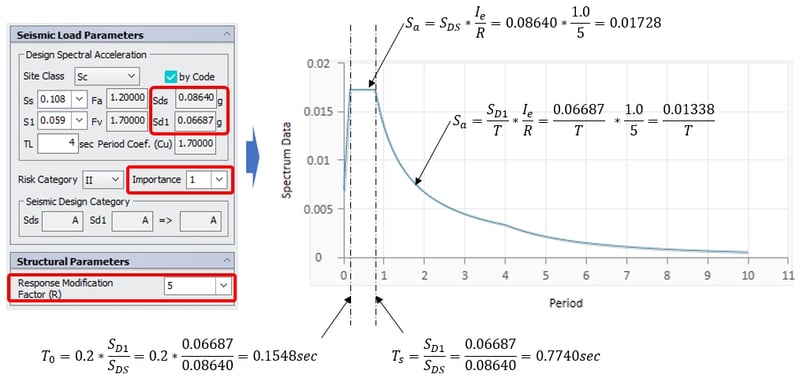
 

20_SERIES2_47


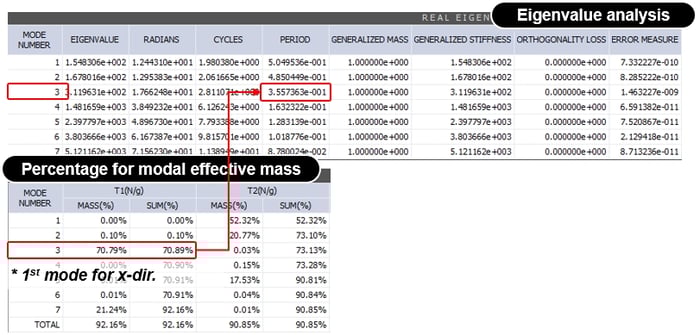
 Base shear(x-dir) for example model


20_SERIES2_4820_SERIES2_50


𝑇=0.35574sec


So, Sa = SDS*Ie/R = 0.01728

         (red dotted line)


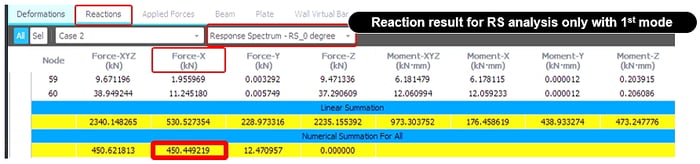
  V= W * Sa * Mass(%)

= 36817.5 * 0.01728 * 0.7089

= 451.01kN (just for 1st mode)


20_SERIES2_51


The form of downloadable white paper for the "Fundamentals of Seismic Load" is ready for you below!😉


Subscribe S.O.S Newsletter

About Author
Yeong-il Seo | Principal Structural Engineer

Young-il has over 13+ years of experience in building design, especially high-rise buildings with column reduction analysis, plant structures, pushover analysis, health monitoring, and vibration control projects. Since 2016, he is planning and providing technical supports for midas building products such as midas Gen, nGen, and Design+.

E-BOOK Fundamentals of Seismic
Load

This material explains the procedure of seismic load analysis and provides the
structural insight of modal response spectrum analysis including irregularity
evaluation and base share calculation.