OVERVIEW
The Seismic Load Analysis Procedure has 16 processes and it is largely divided into two parts: Series 1 (including Series 2,3, and 4) and Series 5 (Modal Response Spectrum (RS) Analysis.)
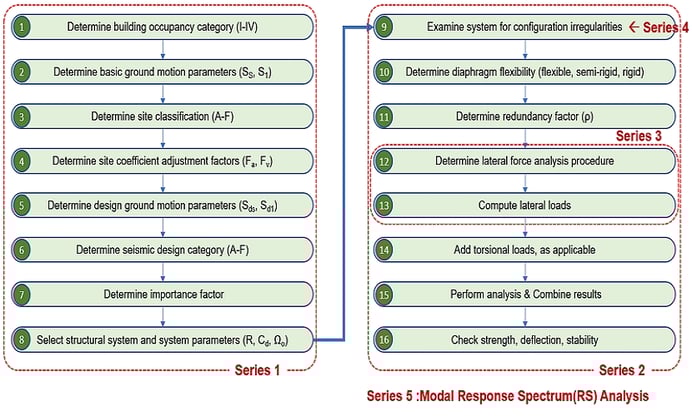
You will get to know about the Series 1 part at this time.
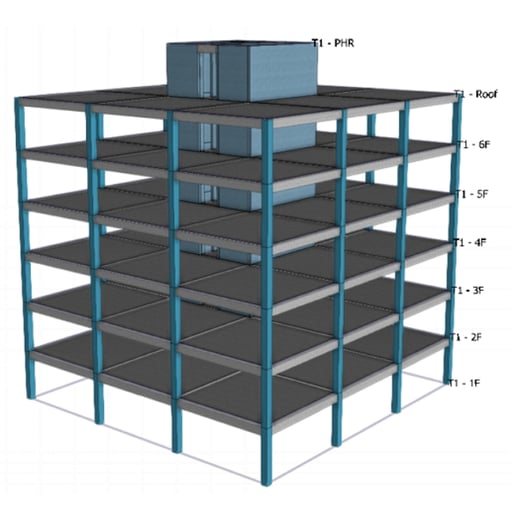
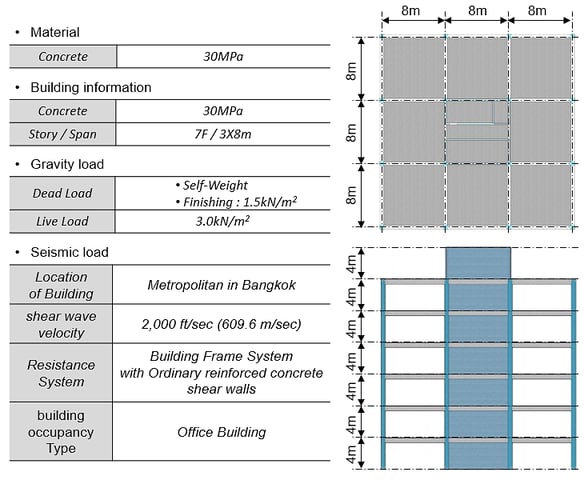
Here is an Example Model to be conducted for the calculation of Seismic Load.
Example Model
√ Summary of the Procedure
1. Determine building occupancy category (Ⅰ- Ⅳ)
2. Determine basic ground motion parameters (Ss, S1)
3. Determine site classification (A-F)
4. Determine site coefficient adjustment factors (Fa-Fy)
5. Determine design ground motion parameters (Sds, Sd1)
6. Determine seismic design category (A-F)
7. Determine importance factor
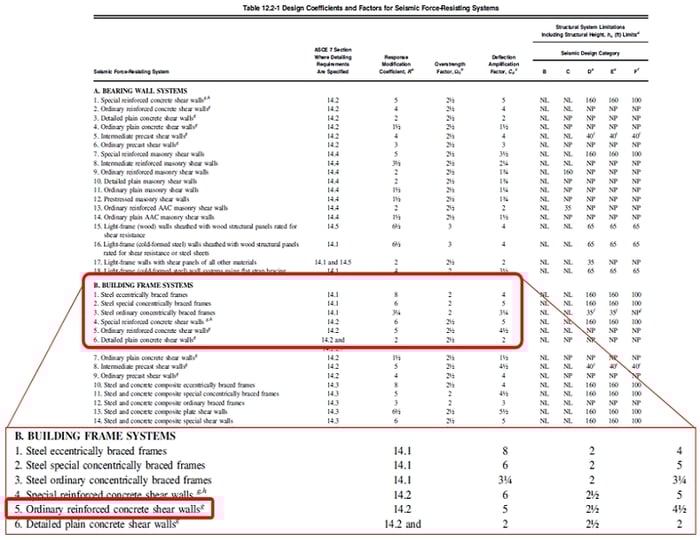
8. Select structural system and system parameters (R, Cd, Ω0)
9. Examine system for configuration irregularities
1. Determine building occupancy category (Ⅰ- Ⅳ)
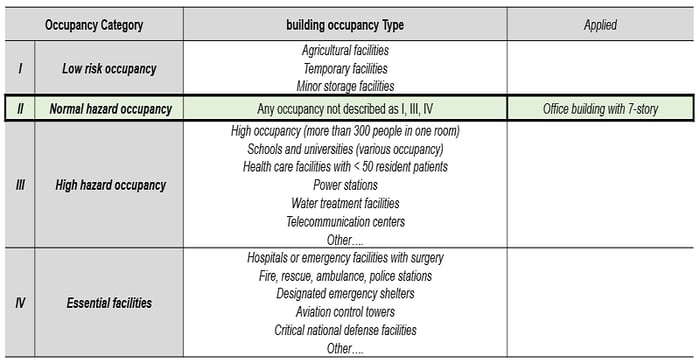
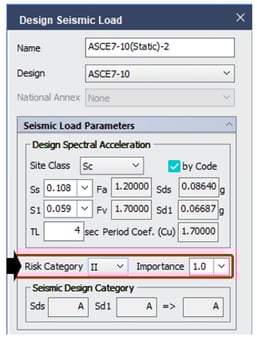
The building occupancy type of the example building is an office building. > Apply Site Class C
2. Determine basic ground motion parameters (Ss, S1)
- Provide 5% damped firm rock (Site Class B) spectral accelerations Ss and S1 or 2% in 50-year probability.
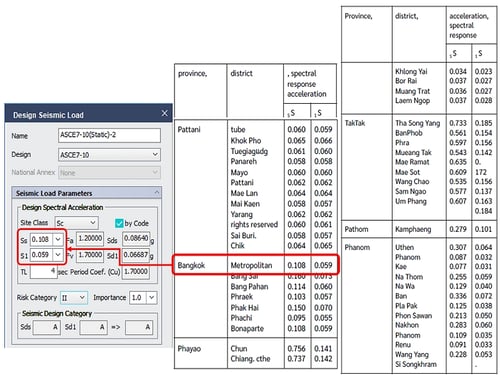
*Table) Spectral response acceleration at 0.2sec short period (SS) and 1sec (S1) period in Thailand.
3. Determine site classification (A-F)
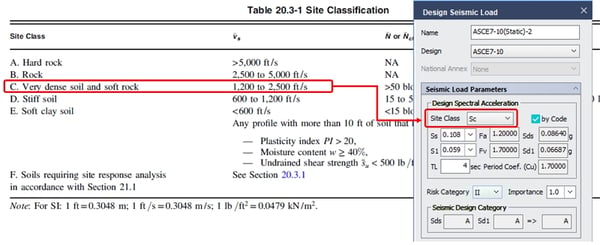
Shear wave velocity of Example building = 2,000 ft/sec > Apply Site Class C
4. Determine site coefficient adjustment factors (Fa-Fy)

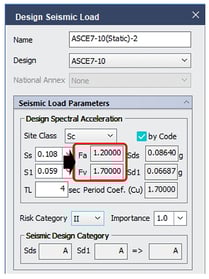
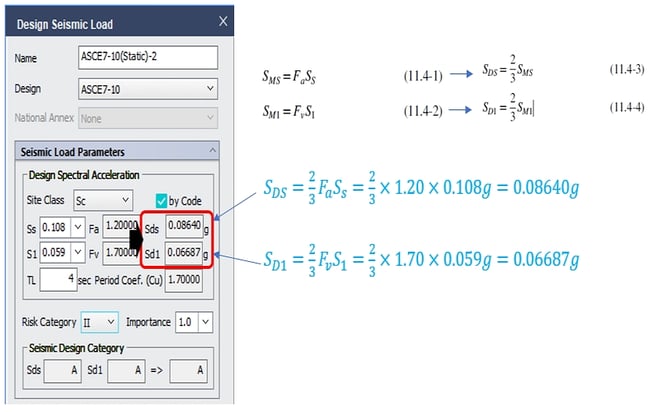
5. Determine design ground motion parameters (Sds, Sd1)
6. Determine seismic design category (A-F)
Seismic Design Category = Seismic Use Group + Design Ground Motion
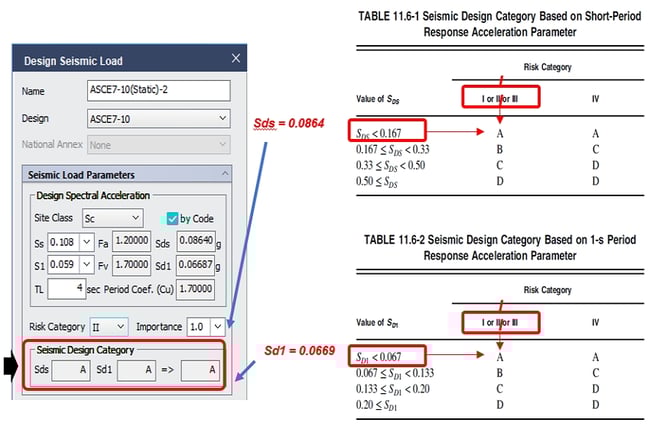
Apply the more disadvantageous of two categories.
7. Determine importance factor
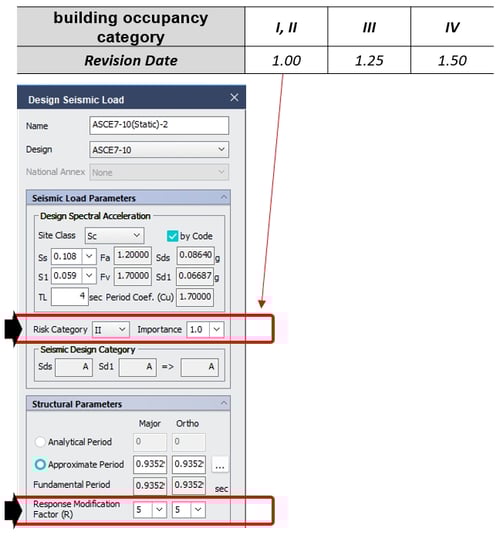
Building frame system with ordinary reinforced concrete shear walls.
> R=5, Cd=4.5 (it is used in the story drift checking)
8. Select structural system and system parameters (R, Cd, Ω0)
9. Examine system for configuration irregularities
- Irregular evaluation and related provisions: There are 2 types of structural irregularity: Horizontal and Vertical.
1) Horizontal Structural Irregularities
a. 1a and 1b Torsional Irregularity
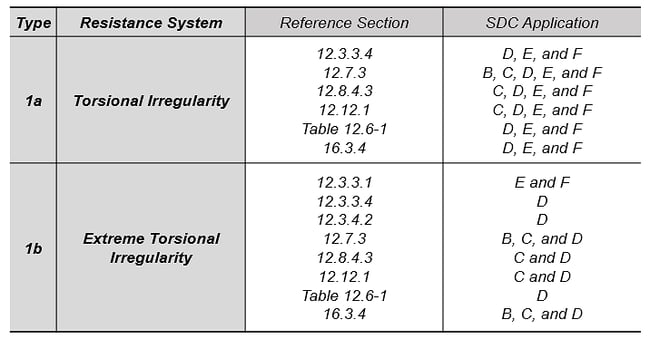
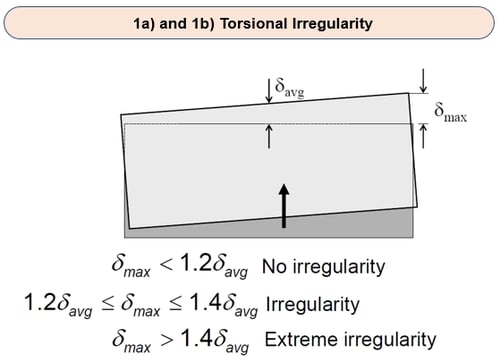 Extreme Torsion Irregularity 1b is NOT PERMITTED in SDC E or F. (SDC: Seismic Design Category)
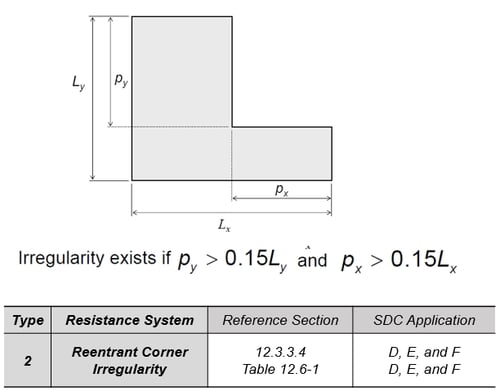
b. Re-entrant Corner Irregularity
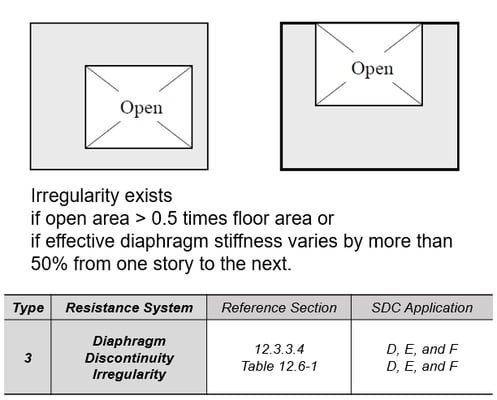
c. Diaphragm Discontinuity Irregularity
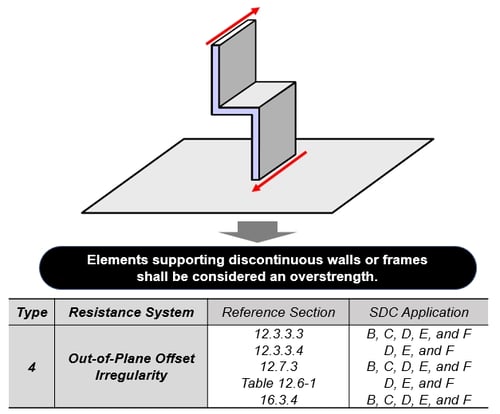
d. Out of Plane Offsets
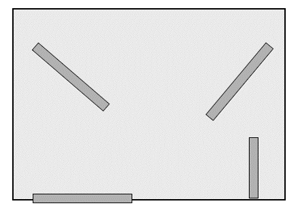
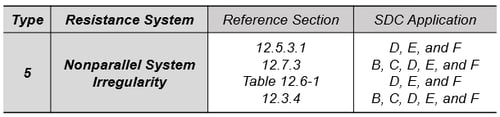
e. Nonparallel System Irregularity
Nonparallel system irregularity exists when the vertical lateral force resisting elements are not parallel to or symmetric about the major orthogonal axes of the seismic force-resisting system.
2)Vertical Structural Irregularities
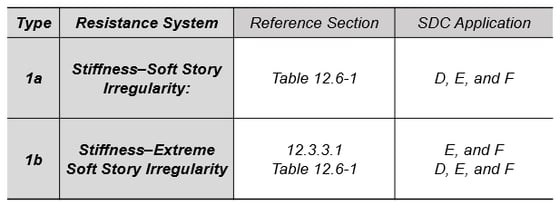
a. 1a and 1b) Stiffness (Soft Story) Irregularity
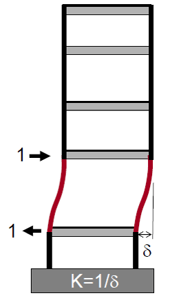 ⋅ Stiffness–Soft Story Irregularity: Irregularity (1a) exists if the stiffness of any story is less than 70% of the stiffness of the story above or less than 80% of the average stiffness of the three stories above.
⋅ Stiffness–Extreme Soft Story Irregularity: An extreme irregularity (1b) exists if the stiffness of any story is less than 60% of the stiffness of the story above or less than 70% of the average stiffness of the three stories above.
⋅ Exception: Irregularity does not exist if no story drift ratio is greater than 1.3 times drift ratio of the story above.
*K: Story Stiffness
⇓
Irregularity 1b is NOT PERMITTED in SDC E or F.
b. Weight (Mass) Irregularity
%20irregularity.png?width=148&name=weight%20(mass)%20irregularity.png)
Irregularity exists if the effective mass of any story is more than 150% of the effective mass of an adjacent story.
⋅ Exception: Irregularity does not exist if no story drift ratio is greater than 1.3 times drift ratio of the story above.

c. Vertical Geometric Irregularity
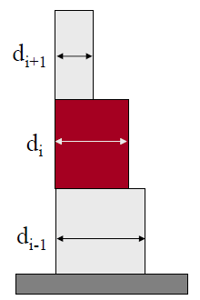
Irregularity exists if the dimension of the lateral force-resisting
system at any story is more than 130% of that
for any adjacent story.

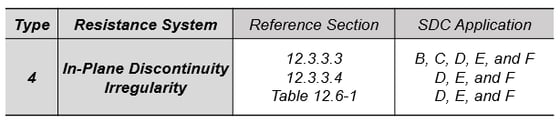
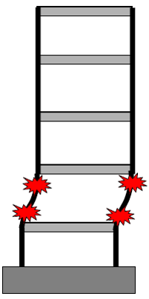
d. In-Plane Discontinuity Irregularity
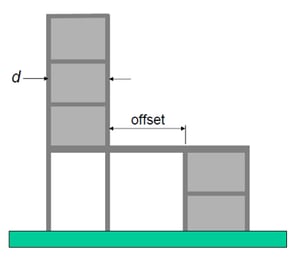
Irregularity exists if the offset is greater than the width (d)
or there exists a reduction in stiffness of the story below.
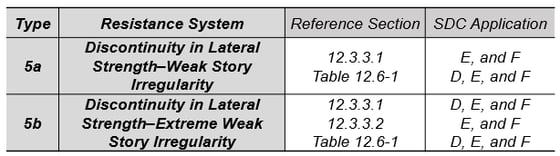
e. 5a, 5b) Strength (Weak Story) Irregularity
⋅ Irregularity (5a) exists if the lateral strength of any story is less than 80%
of the strength of the story above.
⋅ An extreme irregularity (5b) exists if the lateral strength of any story is less than 65% of the strength of the story above.
⇓
Irregularities 5a and 5b are NOT PERMITTED in SDC E or F. Irregularity 5b is not permitted in SDC D.
Please download the white paper of Fundamentals of Seismic Load below to see the full contents.