Would you like to sign out?

Select Country

  • Afghanistan English
  • Albania English
  • Algeria English
  • American Samoa English
  • Andorra English
  • Angola English
  • Anguilla English
  • Antarctica English
  • Antigua and Barbuda English
  • Argentina Español
  • Armenia English
  • Aruba English
  • Australia English
  • Austria English
  • Azerbaijan English
  • Bahamas English
  • Bahrain English
  • Bangladesh English
  • Barbados English
  • Belarus English
  • Belgium English
  • Belize English
  • Benin English
  • Bermuda English
  • Bhutan English
  • Bolivia Español
  • Bosnia and Herzegovina English
  • Botswana English
  • Bouvet Island English
  • Brazil English
  • British Indian Ocean Territory English
  • British Virgin Islands English
  • Brunei English
  • Bulgaria English
  • Burkina Faso English
  • Burundi English
  • Cambodia English
  • Cameroon English
  • Canada English
  • Cape Verde English
  • Caribbean Netherlands English
  • Cayman Islands English
  • Central African Republic English
  • Chad English
  • Chile Español
  • Christmas Island English
  • Cocos (Keeling) Islands English
  • Colombia Español
  • Comoros English
  • Congo English
  • Cook Islands English
  • Costa Rica Español
  • Côte d’Ivoire English
  • Croatia English
  • Cuba Español
  • Curaçao English
  • Cyprus English
  • Czech Republic English
  • Democratic Republic of the Congo English
  • Denmark English
  • Djibouti English
  • Dominica English
  • Dominican Republic Español
  • Ecuador Español
  • Egypt English
  • El Salvador Español
  • Equatorial Guinea English
  • Eritrea English
  • Estonia English
  • Ethiopia English
  • Falkland Islands English
  • Faroe Islands English
  • Fiji English
  • Finland English
  • France English
  • French Guiana Español
  • French Polynesia English
  • French Southern Territories English
  • Gabon English
  • Gambia English
  • Georgia English
  • Germany English
  • Ghana English
  • Gibraltar English
  • Greece English
  • Greenland English
  • Grenada English
  • Guadeloupe Español
  • Guam English
  • Guatemala Español
  • Guernsey English
  • Guinea English
  • Guinea-Bissau English
  • Guyana English
  • Haiti Español
  • Heard Island and McDonald Islands English
  • Honduras Español
  • Hong Kong English
  • Hungary English
  • Iceland English
  • India English
  • Indonesia English
  • Iran English
  • Iraq English
  • Ireland English
  • Isle of Man English
  • Israel English
  • Italy English
  • Jamaica English
  • Japan 日本語
  • Jersey English
  • Jordan English
  • Kazakhstan English
  • Kenya English
  • Kiribati English
  • South Korea 한국어
  • Kuwait English
  • Kyrgyzstan English
  • Laos English
  • Latvia English
  • Lebanon English
  • Lesotho English
  • Liberia English
  • Libya English
  • Liechtenstein English
  • Lithuania English
  • Luxembourg English
  • Macau English
  • Madagascar English
  • Malawi English
  • Malaysia English
  • Maldives English
  • Mali English
  • Malta English
  • Marshall Islands English
  • Martinique English
  • Mauritania English
  • Mauritius English
  • Mayotte English
  • Mexico Español
  • Micronesia English
  • Moldova English
  • Monaco English
  • Mongolia English
  • Montenegro English
  • Montserrat English
  • Morocco English
  • Mozambique English
  • Myanmar English
  • Namibia English
  • Nauru English
  • Nepal English
  • Netherlands English
  • New Caledonia English
  • New Zealand English
  • Nicaragua Español
  • Niger English
  • Nigeria English
  • Niue English
  • Norfolk Island English
  • Northern Mariana Islands English
  • Norway English
  • Oman English
  • Pakistan English
  • Palau English
  • Palestine English
  • Panama Español
  • Papua New Guinea English
  • Paraguay Español
  • Peru Español
  • Philippines English
  • Pitcairn Islands English
  • Poland English
  • Portugal Español
  • Puerto Rico Español
  • Qatar English
  • Réunion English
  • Romania English
  • Russia English
  • Rwanda English
  • Saint Barthélemy Español
  • Saint Helena English
  • Saint Kitts and Nevis English
  • Saint Lucia English
  • Saint Martin Español
  • Saint Pierre and Miquelon English
  • Saint Vincent and the Grenadines English
  • Samoa English
  • San Marino English
  • São Tomé and Príncipe English
  • Saudi Arabia English
  • Senegal English
  • Serbia English
  • Seychelles English
  • Sierra Leone English
  • Singapore English
  • Sint Maarten English
  • Slovakia English
  • Slovenia English
  • Solomon Islands English
  • Somalia English
  • South Africa English
  • South Georgia English
  • South Sudan English
  • Spain English
  • Sri Lanka English
  • Sudan English
  • Suriname English
  • Svalbard and Jan Mayen English
  • Eswatini English
  • Sweden English
  • Switzerland English
  • Syria English
  • Taiwan English
  • Tajikistan English
  • Tanzania English
  • Thailand English
  • Togo English
  • Tokelau English
  • Tonga English
  • Trinidad and Tobago English
  • Tunisia English
  • Turkey English
  • Turkmenistan English
  • Turks and Caicos Islands English
  • Tuvalu English
  • U.S. Virgin Islands English
  • Uganda English
  • Ukraine English
  • United Arab Emirates English
  • United Kingdom English
  • United States English
  • U.S. Minor Outlying Islands English
  • Uruguay Español
  • Uzbekistan English
  • Vanuatu English
  • Vatican City English
  • Venezuela Español
  • Vietnam English
  • Wallis and Futuna English
  • Western Sahara English
  • Yemen English
  • Zambia English
  • Zimbabwe English
  • Åland Islands English
  • East Timor English
  • Netherlands Antilles English
  • Serbia and Montenegro English
  • North Macedonia English
  • Timor-Leste English

All You Need to Know About Culverts

October 7, 2022
BLOG BRIDGE INSIGHT

The Whole New MIDAS Site Banner


Please fill out the Download Section (Click here) below the Comment Section to download the Complete Guide to Composite Sections Guide 


1. Introduction

A culvert is a buried structure, similar to a bridge, consisting of single or multi-span construction with a minimum length of 3m for each span. Two horizontal slabs are cast monolithically with two or more vertical side walls, with a maximum span of 6m. Culverts convey stormwater or non-perennial streams across roadways where the soil is weak. They are suitable for difficult site conditions, require minimum maintenance, and have a prolonged service life.


2. The different types of culverts

In this section, various culvert types are described, along with models created in Midas Civil.


👉Pipe Culvert

They are the most common type of culverts since they are economical and are easier to install. Depending on the site conditions and constraints, different shapes of pipe culverts can be seen, such as circular, elliptical, and pipe arch.

            Advantages: 

  • Any desired strength is achievable by proper mix-design, thickness, and reinforcement.
  • They are economical and easy to install. 
  • A pipe culvert can resist high tensile and compressive stresses. 

             Disadvantage:

  • Pipe culverts are susceptible to crown erosion due to organic and chemical reactions.
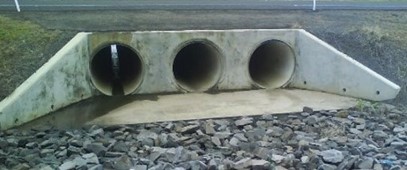
 

Figure1 Pipe Culvert

Figure 1: Pipe Culvert
 
Fig 2(a) Pipe Culvert- 3D Midas Civil ModelFig 2(b) Pipe Culvert - Boundary conditions

Figure 2: Pipe Culvert-3D Midas Civil model and the boundary conditions assigned


👉Arch Culvert

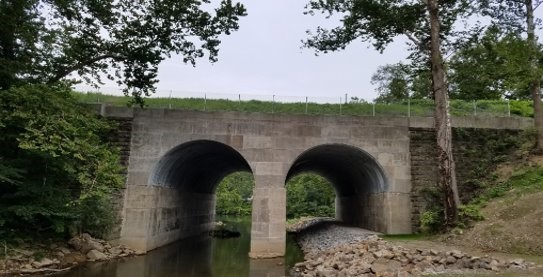
Steel, stone masonry, concrete, RCC, etc., are used to construct arch culverts. Unlike box culverts, they are erected without disrupting the water flow; construction is quick. Arch type of culvert maintains the wash bed's natural integrity and is called a low-profile culvert.


Advantages:

  • Greater spans can be achieved by arch action.
  • Greater hydraulic efficiency.
  • It can be constructed without disrupting the water flow.


Disadvantages:

  • Need stable support. The soil-bearing capacity should be high enough to withstand the support reactions.
  • Need timely maintenance.


Figure 3 Arch Culvert

Figure 3: Arch Culvert


Fig 4(a) Arch culvert 3D Midas Civil ModelFig 4(b) Displacement contour due to vertical earth pressure

Figure 4: Arch Culvert- 3D MIDAS CIVIL model and the displacement contour due to vertical earth pressure


👉Pipe-Arch Culvert

Pipe-Arch culverts are suitable for large waterway openings with a more significant hydraulic advantage. Moreover, they provide low clearance and are, much more artistic. Pipe arches are particularly useful for sites with limited headroom and a hydraulic advantage at low flows.


Advantages:

  • Suitable for waterways with large discharge.
  • An increased headroom is achieved.
  • Greater hydraulic efficiency is achieved.
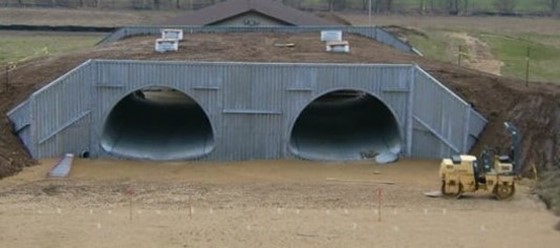
 

Figure 5 Pipe-Arch Culvert

Figure 5: Pipe-Arch Culvert


Fig 4(a) Arch culvert 3D Midas Civil Model

Figure 6: Pipe-Arch Culvert modelled in MIDAS CIVIL


👉Box Culvert

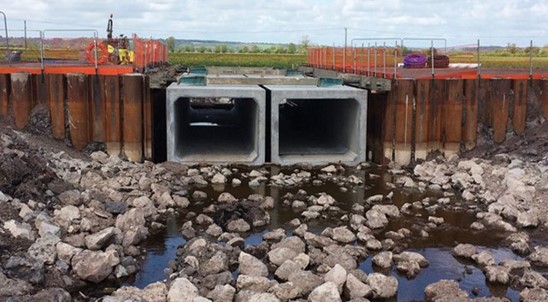
Box culvert is a monolithically cast, rigid framed structure suitable for non-perennial streams where the soil is weak. The bottom slab reduces the pressure on the ground below. Therefore, a separate foundation is not required making them economical. Even though box culverts are easy to install, a dry surface is needed for installation.


Advantages:

  • Suitable for non-perennial streams, where the soil bearing capacity is low.
  • The bottom slab reduces the soil pressure.
  • They are very economical.


Figure 7 Box Culvert

Figure 7: Box Culvert
 
 
Fig 8(a) Box Culvert-3D Midas Civil modelFig 8(b) Box Culvert- 2D Midas Civil model

Figure 8: 3D and 2D models of Box Culvert in MIDAS CIVIL


👉Bridge Culvert

Bridge culverts act as a bridge and a culvert, thus serving a dual purpose. Generally, these culverts are rectangular and built on rivers or canals. The foundation rests below ground level, and the pavement surface is on top of the culverts.
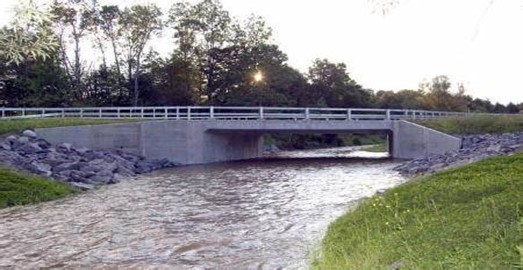
 

Figure 9 Bridge Culvert

Figure 9: Bridge Culvert


Fig 5(a) Bridge Culvert 3D Midas Civil modelFig 5(b) Bridge culvert-Bending moment contour due to moving loads

Figure 10: Bridge culvert – 3D MIDAS CIVIL model and the bending moment contour due to traffic loads


3. Loads acting on culverts

  • Dead load

Dead loads mainly constitute the self-weight of the culverts. The weight of the wearing course, the crash barrier, and other fixed loads are also considered dead loads.

  • Earth pressure loads

A linear horizontal soil pressure acts along the vertical walls, and weep holes release the pore pressure. A uniform vertical surcharge is applied on the top slab in deep culverts.

  • Traffic loads

Most of the culverts experience moving loads throughout their lifetime. Traffic loads should be applied over culverts like bridges following the various codes used worldwide. The upcoming articles will discuss the live load dispersion on culverts and the different design codes used.

  • Buoyant force

The buoyant force is the upward thrust acting on culverts due to buoyancy. In many cases, the structure gets uplifted and carried away due to strong water currents. The weight of culverts should be able to withstand this uplift.

  • Temperature loads

Stresses caused by the expansion and contraction of indeterminate structures like culverts due to temperature variation are known as temperature stresses. They can be classified into 2: uniform temperature - stresses caused due to uniform heating and cooling of the structure (climatic changes) and gradient temperature stresses – caused due to differential heating and cooling of members along the section.


Apart from the above-listed loads, dynamic loads are also considered in the case of rail tracks loading on top.


4. What's next?

In this blog, we briefly discussed various culverts and their models created in Midas Civil. The upcoming blog will discuss the live load dispersion on box culverts following different design codes. Stay tuned.    

Susbcribe
MIDAS Newsletter

Thank you, See you soon!
Share
About the Author
Rohit Joseph | Structural Engineer | MIDAS IT

Rohit is a structural engineer, currently working with Midas IT as a Technical Support Engineer. He pursued his Master's degree in Structural Engineering from NIT Surat. His main role is to work closely with bridge engineers around the world to provide them support regarding their technical queries on bridge engineering & Midas software.

Comments
DOWNLOAD Download the Ebook

Fill out the below form to
download the Complete Guide to Composite Sections

All