Would you like to sign out?

Select Country

  • Afghanistan English
  • Albania English
  • Algeria English
  • American Samoa English
  • Andorra English
  • Angola English
  • Anguilla English
  • Antarctica English
  • Antigua and Barbuda English
  • Argentina Español
  • Armenia English
  • Aruba English
  • Australia English
  • Austria English
  • Azerbaijan English
  • Bahamas English
  • Bahrain English
  • Bangladesh English
  • Barbados English
  • Belarus English
  • Belgium English
  • Belize English
  • Benin English
  • Bermuda English
  • Bhutan English
  • Bolivia Español
  • Bosnia and Herzegovina English
  • Botswana English
  • Bouvet Island English
  • Brazil English
  • British Indian Ocean Territory English
  • British Virgin Islands English
  • Brunei English
  • Bulgaria English
  • Burkina Faso English
  • Burundi English
  • Cambodia English
  • Cameroon English
  • Canada English
  • Cape Verde English
  • Caribbean Netherlands English
  • Cayman Islands English
  • Central African Republic English
  • Chad English
  • Chile Español
  • Christmas Island English
  • Cocos (Keeling) Islands English
  • Colombia Español
  • Comoros English
  • Congo English
  • Cook Islands English
  • Costa Rica Español
  • Côte d’Ivoire English
  • Croatia English
  • Cuba Español
  • Curaçao English
  • Cyprus English
  • Czech Republic English
  • Democratic Republic of the Congo English
  • Denmark English
  • Djibouti English
  • Dominica English
  • Dominican Republic Español
  • Ecuador Español
  • Egypt English
  • El Salvador Español
  • Equatorial Guinea English
  • Eritrea English
  • Estonia English
  • Ethiopia English
  • Falkland Islands English
  • Faroe Islands English
  • Fiji English
  • Finland English
  • France English
  • French Guiana Español
  • French Polynesia English
  • French Southern Territories English
  • Gabon English
  • Gambia English
  • Georgia English
  • Germany English
  • Ghana English
  • Gibraltar English
  • Greece English
  • Greenland English
  • Grenada English
  • Guadeloupe Español
  • Guam English
  • Guatemala Español
  • Guernsey English
  • Guinea English
  • Guinea-Bissau English
  • Guyana English
  • Haiti Español
  • Heard Island and McDonald Islands English
  • Honduras Español
  • Hong Kong English
  • Hungary English
  • Iceland English
  • India English
  • Indonesia English
  • Iran English
  • Iraq English
  • Ireland English
  • Isle of Man English
  • Israel English
  • Italy English
  • Jamaica English
  • Japan 日本語
  • Jersey English
  • Jordan English
  • Kazakhstan English
  • Kenya English
  • Kiribati English
  • South Korea 한국어
  • Kuwait English
  • Kyrgyzstan English
  • Laos English
  • Latvia English
  • Lebanon English
  • Lesotho English
  • Liberia English
  • Libya English
  • Liechtenstein English
  • Lithuania English
  • Luxembourg English
  • Macau English
  • Madagascar English
  • Malawi English
  • Malaysia English
  • Maldives English
  • Mali English
  • Malta English
  • Marshall Islands English
  • Martinique English
  • Mauritania English
  • Mauritius English
  • Mayotte English
  • Mexico Español
  • Micronesia English
  • Moldova English
  • Monaco English
  • Mongolia English
  • Montenegro English
  • Montserrat English
  • Morocco English
  • Mozambique English
  • Myanmar English
  • Namibia English
  • Nauru English
  • Nepal English
  • Netherlands English
  • New Caledonia English
  • New Zealand English
  • Nicaragua Español
  • Niger English
  • Nigeria English
  • Niue English
  • Norfolk Island English
  • Northern Mariana Islands English
  • Norway English
  • Oman English
  • Pakistan English
  • Palau English
  • Palestine English
  • Panama Español
  • Papua New Guinea English
  • Paraguay Español
  • Peru Español
  • Philippines English
  • Pitcairn Islands English
  • Poland English
  • Portugal Español
  • Puerto Rico Español
  • Qatar English
  • Réunion English
  • Romania English
  • Russia English
  • Rwanda English
  • Saint Barthélemy Español
  • Saint Helena English
  • Saint Kitts and Nevis English
  • Saint Lucia English
  • Saint Martin Español
  • Saint Pierre and Miquelon English
  • Saint Vincent and the Grenadines English
  • Samoa English
  • San Marino English
  • São Tomé and Príncipe English
  • Saudi Arabia English
  • Senegal English
  • Serbia English
  • Seychelles English
  • Sierra Leone English
  • Singapore English
  • Sint Maarten English
  • Slovakia English
  • Slovenia English
  • Solomon Islands English
  • Somalia English
  • South Africa English
  • South Georgia English
  • South Sudan English
  • Spain English
  • Sri Lanka English
  • Sudan English
  • Suriname English
  • Svalbard and Jan Mayen English
  • Eswatini English
  • Sweden English
  • Switzerland English
  • Syria English
  • Taiwan English
  • Tajikistan English
  • Tanzania English
  • Thailand English
  • Togo English
  • Tokelau English
  • Tonga English
  • Trinidad and Tobago English
  • Tunisia English
  • Turkey English
  • Turkmenistan English
  • Turks and Caicos Islands English
  • Tuvalu English
  • U.S. Virgin Islands English
  • Uganda English
  • Ukraine English
  • United Arab Emirates English
  • United Kingdom English
  • United States English
  • U.S. Minor Outlying Islands English
  • Uruguay Español
  • Uzbekistan English
  • Vanuatu English
  • Vatican City English
  • Venezuela Español
  • Vietnam English
  • Wallis and Futuna English
  • Western Sahara English
  • Yemen English
  • Zambia English
  • Zimbabwe English
  • Åland Islands English
  • East Timor English
  • Netherlands Antilles English
  • Serbia and Montenegro English
  • North Macedonia English
  • Timor-Leste English

Basic Concepts of Anchor Design

December 15, 2023
BLOG BRIDGE INSIGHT


Development of anchor design


Currently, the design of anchors in the United States is being led by the ACI 318 Committee, with support from the ACI 349 Committee and the ACI 355 Committee, and ACI 318 Appendix D "Anchoring to Concrete" has been reorganized into Chapter 17 of ACI 318-14.


Until the late 1990s, ACI 318 and the AISC LRFD and ASD standards had no specific provisions for anchors in concrete. Appendix B of ACI 349-85 and the PCI Design Manual, Fifth Edition, provide basic design information for cast-in-place anchors. Historically, post-installed anchors' design has relied on data supplied by specific anchor manufacturers.


The 45-degree cone method, described in ACI 349-85 Appendix B and the PCI Design Handbook, 5th Edition, was created in the middle of the 1970s. In the 1980s, extensive experiments were conducted at the University of Stuttgart, Germany, on the performance of various anchors embedded in uncracked and cracked concrete with embedment depth, edge distance parameter, and effect of anchor group as independent variables.


The kappa method, introduced in ACI 349 and ACI 355 in the late 1980s, was also based on experiments conducted at the University of Stuttgart. In the mid-1990s, ACI 349 and ACI 355 compared the CCD(Concrete Capacity Design) and the 45-degree cone method. As a result, the CCD method was adopted.


This article presents the 45-degree cone and Concrete Capacity Design (CCD) method.


1. 45 - Degree Cone method


When deciding the design strength of an anchor, the lesser of the two strengths determine the design strength: 1. The strength of the anchor steel and 2. the strength related to the anchor's embedment characteristics should be considered. The strength of the anchor steel is related to the steel's properties and the anchor's specifications. The embedment characteristics of the anchor are also relevant to the anchor's strength; embedded length, concrete strength, interaction within the adjoined anchors, edge distance, and the type of anchor head.


In the 45-Degree Cone method, assuming the failure of the concrete is conical, as shown in the figure. The concrete stress resisting tensile force act in the anchor is calculated as follows.
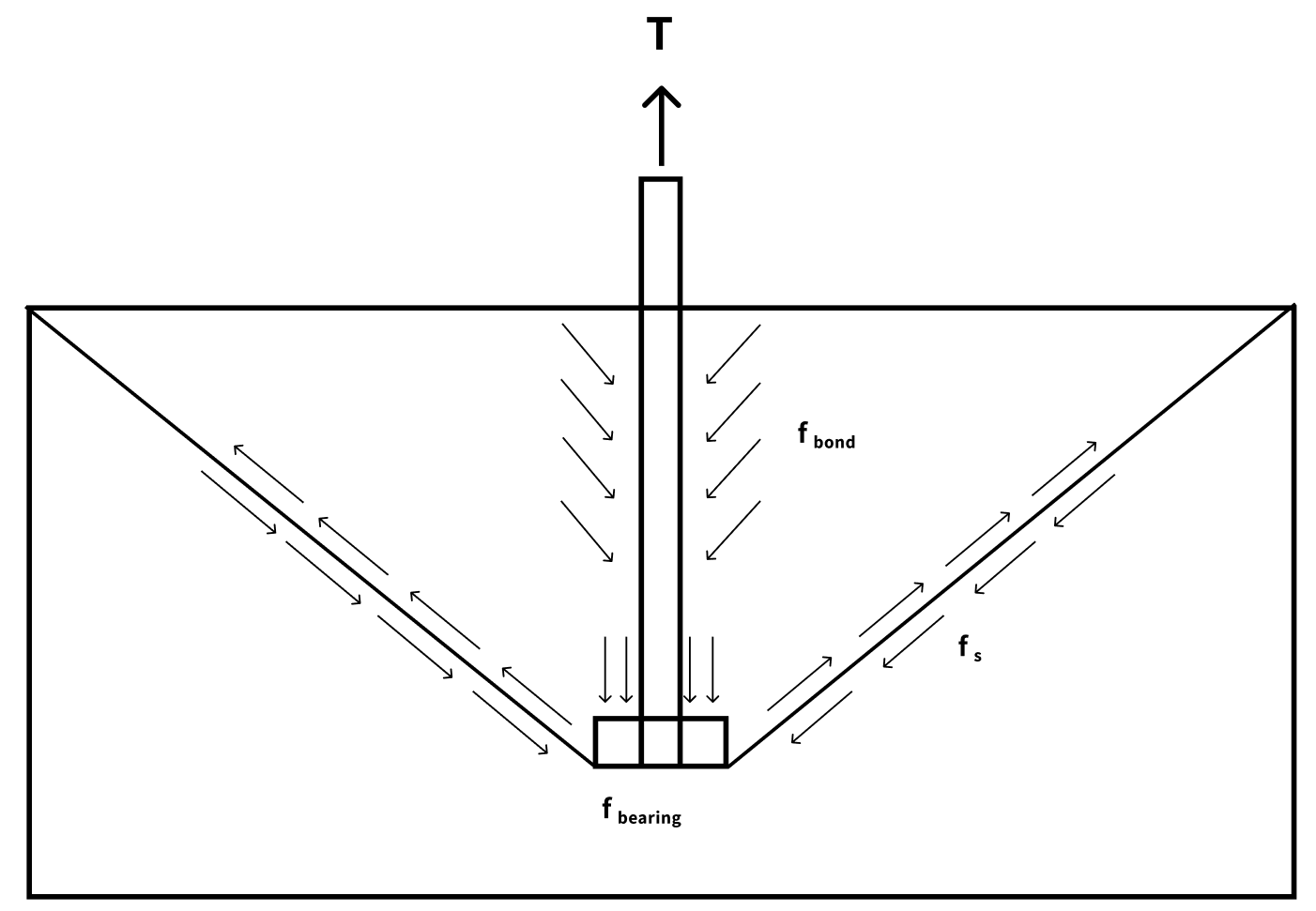
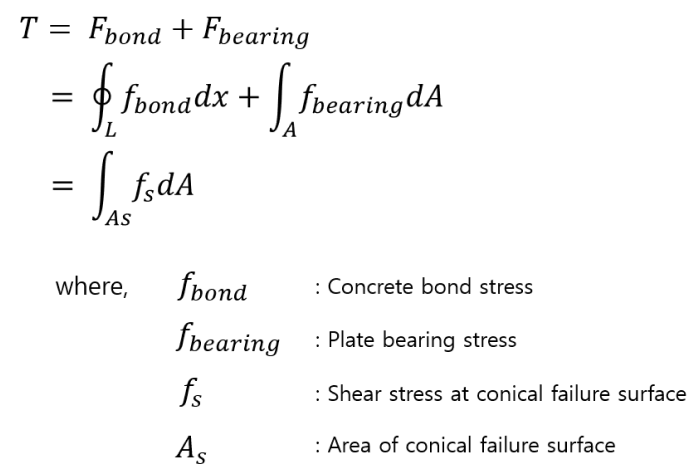
Stress at Concrete Breakoutconcrete stress resisting tensile force act in the anchor


The forces on the anchor are divided into the adhesion force on the anchor surface and the bearing force on the end plate. The shear stress along the virtual fracture plane ultimately takes control in concrete fractures.


The shear stress can be separated into horizontal and vertical forces acting on the concrete's conical virtual fracture surface. The horizontal forces are offset due to the symmetrical nature of the anchor's left and right sides. The sum of the vertical stresses acting on the virtual fracture surface will eventually equal the sum of the tensile stresses acting on the horizontal projection of the virtual fracture surface. Therefore, the concrete failure strength can be calculated as the product of the horizontal projection area and the tensile strength of the concrete.


Before ACI 349-01 Appendix B was revised, the horizontal projected area was calculated by assuming a conical fracture shape at a 45-degree angle from the anchor head, as shown below. The concrete breakout strength calculated using this method is as follows.
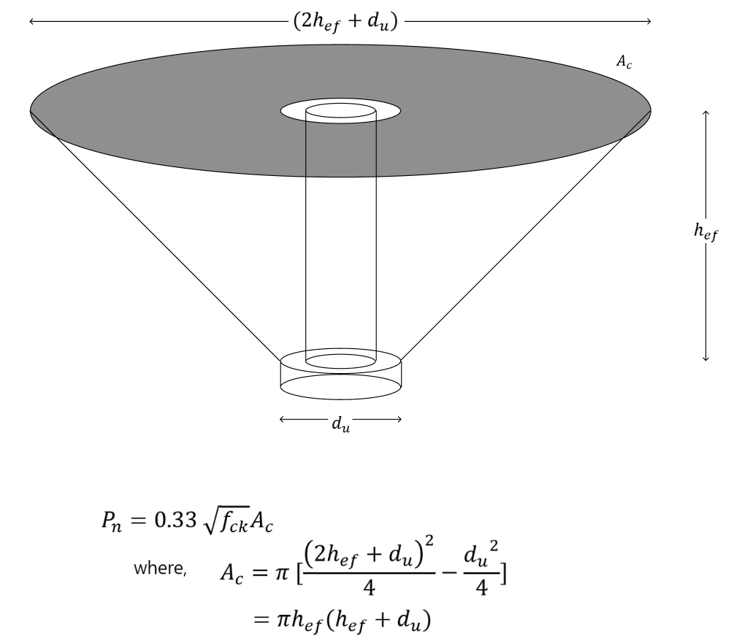
The concrete breakout strength calculated using this method


However, this method is based on a circular failure plane, complicating the strength calculation when installing multiple anchors. This method was determined unsafe through experiments in Europe and the U.S. when considerable strength is required. 1. Understimated strength at shallow embedded 2. Overestimated strength at deeply embedded.

oncrete breakout load for cast-in-situ headed studs(Werner Fuchs, 1995)

2. CCD(Concrete Capacity Design) Method


To simplify the evaluation of anchor strength, ACI 349-01 and ACI 318-2 have adopted a CCD method based on fracture mechanics. The concrete breakout strength calculation is the difference between the CCD and the 45-degree cone methods. In the case of the 45-degree cone method, the fracture surface is assumed to be a cone with a 45-degree angle, so the strength calculation appears as the square of the embedment length as described above.

 

Preview BannerComplete the form below to view the entire content.


.
.
.


CCD(Concrete Capacity Design) Method
Three failure mechanisms of group anchors consist of double-row arrangements. 

 - Case 1

 - Case 2

 - Case 3

Susbcribe
MIDAS Newsletter

Thank you, See you soon!
Share
About the Author
Jae wook Kim | MIDAS IT Technical Support Engineer

He has experience in analysis and design using FEM software, especially structural engineering. He also has a deep knowledge of various structural engineering projects.

Comments
DOWNLOAD Continuing Full Contents

Fill out the below form to
download Full Contents

All