Would you like to sign out?

Select Country

  • Afghanistan English
  • Albania English
  • Algeria English
  • American Samoa English
  • Andorra English
  • Angola English
  • Anguilla English
  • Antarctica English
  • Antigua and Barbuda English
  • Argentina Español
  • Armenia English
  • Aruba English
  • Australia English
  • Austria English
  • Azerbaijan English
  • Bahamas English
  • Bahrain English
  • Bangladesh English
  • Barbados English
  • Belarus English
  • Belgium English
  • Belize English
  • Benin English
  • Bermuda English
  • Bhutan English
  • Bolivia Español
  • Bosnia and Herzegovina English
  • Botswana English
  • Bouvet Island English
  • Brazil English
  • British Indian Ocean Territory English
  • British Virgin Islands English
  • Brunei English
  • Bulgaria English
  • Burkina Faso English
  • Burundi English
  • Cambodia English
  • Cameroon English
  • Canada English
  • Cape Verde English
  • Caribbean Netherlands English
  • Cayman Islands English
  • Central African Republic English
  • Chad English
  • Chile Español
  • Christmas Island English
  • Cocos (Keeling) Islands English
  • Colombia Español
  • Comoros English
  • Congo English
  • Cook Islands English
  • Costa Rica Español
  • Côte d’Ivoire English
  • Croatia English
  • Cuba Español
  • Curaçao English
  • Cyprus English
  • Czech Republic English
  • Democratic Republic of the Congo English
  • Denmark English
  • Djibouti English
  • Dominica English
  • Dominican Republic Español
  • Ecuador Español
  • Egypt English
  • El Salvador Español
  • Equatorial Guinea English
  • Eritrea English
  • Estonia English
  • Ethiopia English
  • Falkland Islands English
  • Faroe Islands English
  • Fiji English
  • Finland English
  • France English
  • French Guiana Español
  • French Polynesia English
  • French Southern Territories English
  • Gabon English
  • Gambia English
  • Georgia English
  • Germany English
  • Ghana English
  • Gibraltar English
  • Greece English
  • Greenland English
  • Grenada English
  • Guadeloupe Español
  • Guam English
  • Guatemala Español
  • Guernsey English
  • Guinea English
  • Guinea-Bissau English
  • Guyana English
  • Haiti Español
  • Heard Island and McDonald Islands English
  • Honduras Español
  • Hong Kong English
  • Hungary English
  • Iceland English
  • India English
  • Indonesia English
  • Iran English
  • Iraq English
  • Ireland English
  • Isle of Man English
  • Israel English
  • Italy English
  • Jamaica English
  • Japan 日本語
  • Jersey English
  • Jordan English
  • Kazakhstan English
  • Kenya English
  • Kiribati English
  • South Korea 한국어
  • Kuwait English
  • Kyrgyzstan English
  • Laos English
  • Latvia English
  • Lebanon English
  • Lesotho English
  • Liberia English
  • Libya English
  • Liechtenstein English
  • Lithuania English
  • Luxembourg English
  • Macau English
  • Madagascar English
  • Malawi English
  • Malaysia English
  • Maldives English
  • Mali English
  • Malta English
  • Marshall Islands English
  • Martinique English
  • Mauritania English
  • Mauritius English
  • Mayotte English
  • Mexico Español
  • Micronesia English
  • Moldova English
  • Monaco English
  • Mongolia English
  • Montenegro English
  • Montserrat English
  • Morocco English
  • Mozambique English
  • Myanmar English
  • Namibia English
  • Nauru English
  • Nepal English
  • Netherlands English
  • New Caledonia English
  • New Zealand English
  • Nicaragua Español
  • Niger English
  • Nigeria English
  • Niue English
  • Norfolk Island English
  • Northern Mariana Islands English
  • Norway English
  • Oman English
  • Pakistan English
  • Palau English
  • Palestine English
  • Panama Español
  • Papua New Guinea English
  • Paraguay Español
  • Peru Español
  • Philippines English
  • Pitcairn Islands English
  • Poland English
  • Portugal Español
  • Puerto Rico Español
  • Qatar English
  • Réunion English
  • Romania English
  • Russia English
  • Rwanda English
  • Saint Barthélemy Español
  • Saint Helena English
  • Saint Kitts and Nevis English
  • Saint Lucia English
  • Saint Martin Español
  • Saint Pierre and Miquelon English
  • Saint Vincent and the Grenadines English
  • Samoa English
  • San Marino English
  • São Tomé and Príncipe English
  • Saudi Arabia English
  • Senegal English
  • Serbia English
  • Seychelles English
  • Sierra Leone English
  • Singapore English
  • Sint Maarten English
  • Slovakia English
  • Slovenia English
  • Solomon Islands English
  • Somalia English
  • South Africa English
  • South Georgia English
  • South Sudan English
  • Spain English
  • Sri Lanka English
  • Sudan English
  • Suriname English
  • Svalbard and Jan Mayen English
  • Eswatini English
  • Sweden English
  • Switzerland English
  • Syria English
  • Taiwan English
  • Tajikistan English
  • Tanzania English
  • Thailand English
  • Togo English
  • Tokelau English
  • Tonga English
  • Trinidad and Tobago English
  • Tunisia English
  • Turkey English
  • Turkmenistan English
  • Turks and Caicos Islands English
  • Tuvalu English
  • U.S. Virgin Islands English
  • Uganda English
  • Ukraine English
  • United Arab Emirates English
  • United Kingdom English
  • United States English
  • U.S. Minor Outlying Islands English
  • Uruguay Español
  • Uzbekistan English
  • Vanuatu English
  • Vatican City English
  • Venezuela Español
  • Vietnam English
  • Wallis and Futuna English
  • Western Sahara English
  • Yemen English
  • Zambia English
  • Zimbabwe English
  • Åland Islands English
  • East Timor English
  • Netherlands Antilles English
  • Serbia and Montenegro English
  • North Macedonia English
  • Timor-Leste English

Comparison for Theoretical and Software Output for RSI

February 18, 2022
BLOG BRIDGE INSIGHT

Comparison for Theoretical and Software Output for RSI


Table of Contents


1. Introduction

2. Why Do We Need Rail Structure Interaction (RSI) Analysis?

3. Guidelines for RSI Analysis

4. Comparison for Theoretical and Software Output for RSI

5. Conclusion


1. Introduction


Most of the modern railways use continuous welded rail (CWR), sometimes referred to as long weld rails (LWR). These rails are welded together by flash butt welding to form one continuous rail that may be several kilometers long. There are various benefits of using CWR over jointed tracks. As there are a few joints:

  • This form of track is very strong
  • Provides a smooth ride
  • Needs less maintenance
  • Train can travel at higher speed with less friction
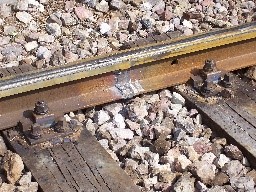
 

fig 1. Welded rail Joint

Figure 1. Welded Rail Joint


CWR is more expensive to lay as compared to jointed tracks but has much lower maintenance costs. Also, the reduction in impact force leads to an increase in the life span of CWR.


2. What is a P- Why do we need Rail Structure Interaction (RSI) analysis?


CWR over a bridge structure typically experiences a large amount of additional longitudinal axial forces due to longitudinal rail-structure interaction (track bridge interaction) due to train vertical, braking/traction load effect, and temperature change. Therefore, it is essential to ensure buckling stability by compressive stress and fracture by tensile stress due to the above-mentioned loading effects.
RSI analysis focuses on the following key design actions:

∴ RAIL
• Forces attracted by the rail and the resulting additional axial rail stresses due to combined effect of temperature, vertical and braking/traction load.
• Longitudinal relative displacement between deck and rail under these load effects to ensure the stability of the ballast in the bridge.


∴ BRIDGE
• Forces and bending moment attracted by the substructure including pier column, pile cap, and piles.


3. Guidelines for RSI Analysis


UIC- UIC, is the worldwide professional association representing the railway sector and promoting rail transport. UIC has been a standards-setting organization since its creation in 1922, and technical harmonization of the railway system remains one of its core objectives. Its members — the operators of the world’s railways — have, over the years, developed the “UIC code” comprising UIC leaflets, which define common rules to ensure safety and efficiency in the design, construction, operation, and maintenance of the railway system.

UIC 774-3 leaflet provides a sound basis for RSI analysis of bridges. It provides design graphs for various spans, support conditions, and loading. Using these curves the interaction stresses in the rail can be found. However, there are limitations to the manual method of calculation of stresses. Manual approach is fine up to 2-3 spans, it cannot be applied to bridges with large number of spans as the process becomes tedious and the stresses obtained are also not accurate. For such structures, computer-assisted interaction analysis should be performed. UIC 774-3 also provides recommendations for computer-assisted interaction analysis.
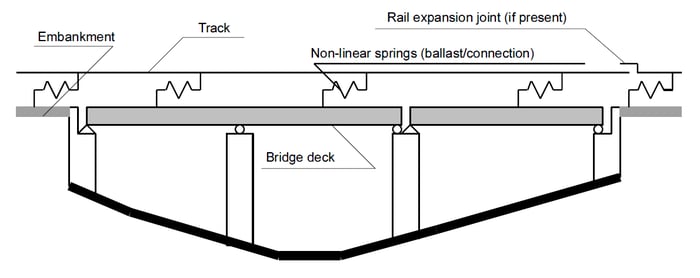
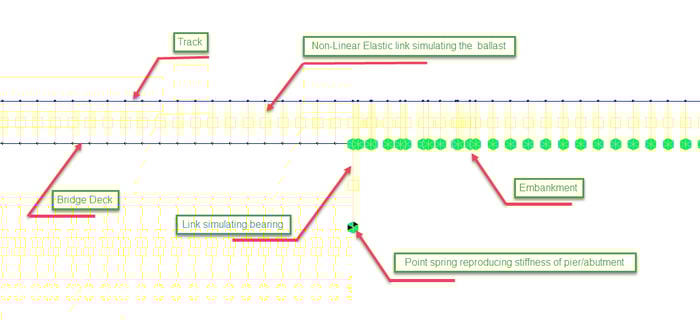
 
fig 2. Structural diagram for the evaluation of track-bridge interaction effect
Fig 2. Structural diagram for the evaluation of track-bridge interaction effect


fig 3. Simplified structural model for interaction analysisFig 3. Simplified structural model for interaction analysis


Depending on the importance and the structural scheme of the bridge. Different types of analyses can be made at different levels of accuracy. Two major categories of analyses considered are:
1. Simplified separate analysis for thermal variations, braking/acceleration, and vertical forces
2. Complete analysis of the joint effects of thermal variations, braking/acceleration, and vertical forces
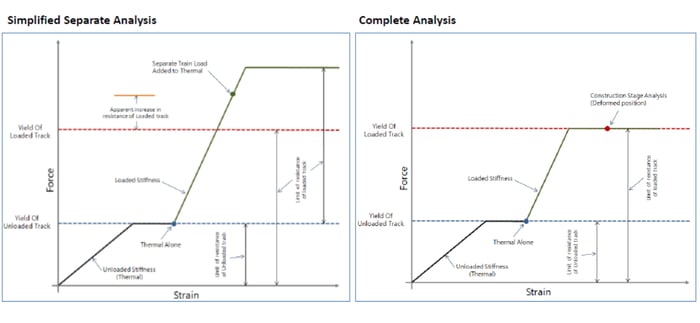
fig 4. Yield of track in case of simplified separate and complete analysis
Fig 4. Yield of track in case of simplified separate and complete analysis


4. Comparison for Theoretical and Software Output for RSI


Below shown is a comparison of stresses and support reaction for a simply supported deck with one fixed elastic support between manual stresses calculated based the theoretical method given in UIC 774-3 and stresses obtained for the same bridge modelled in midas Civil.


Bridge Data:                                                         

Deck length, L= 75 m                                             

Fixed support at one end, no friction in the movable bearing

Modulus of Elasticity: 2.10E+08 kN/㎡

I: 2.59 m4, A: 0.74 m2, H (Depth of section): 6.00 m, ω (location of centroid from top): 1.21 m,
γ = ω/H: 0.202, ΘH[LM 71] : 7.90 mm
Thermal Coefficient: 1.00E-05/℃
Temperature variations for the rails, ΔTrails : +/-50℃
Temperature variations for the deck, ΔTdeck:+/-35℃
Load due to braking and acceleration:20 kN/m


Calculation of stresses as per UIC 774-3: The stresses in rail are calculated based on the interaction diagrams due to braking and temperature variation for simply supported deck with single track given in Appendix A and Appendix B of UIC 774-3. The summary of stresses are shown below:

Temperature Stresses:

σrail (fixed) [ ΔT] = 11 N/mm2

σrail (movable) [ ΔT] = 34 N/mm2

Braking stresses:

σrail (fixed) [Braking] = 32.5 N/mm2

σrail (movable) [Braking] = 32.5 N/mm2

Vertical bending:

σrail (fixed) [ΘH] = 0

σrail (movable) [ΘH] = 13 N/mm2

Total stress at fixed end :

1.0 x σrail (fixed) [ ΔT] +1.0 x σrail (fixed) [ Braking] + 1.0 x σrail (fixed) [ΘH]

11 + 32.5 + 0 = 43.5 N/mm2

Total stress at free end :

1.0 x σrail (movable) [ ΔT]+1.0 x σrail (movable)[Braking]+1.0 x σrail (movable) [ΘH]

34 + 32.5 + 13 = 79.5 N/mm2


midas Civil Output:

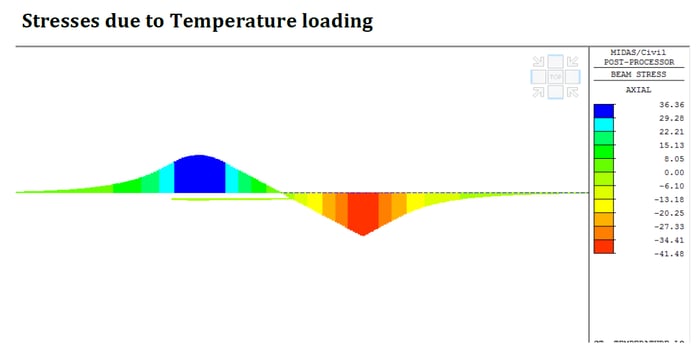
fig 5. Fig 5: Stresses in rail due to temperature loading
Fig 5. Stresses in rail due to temperature loading


Temperature stresses:

σrail (fixed) [ ΔT] = 36.36 N/mm2

σrail (movable) [ ΔT] = 41.48N/mm2
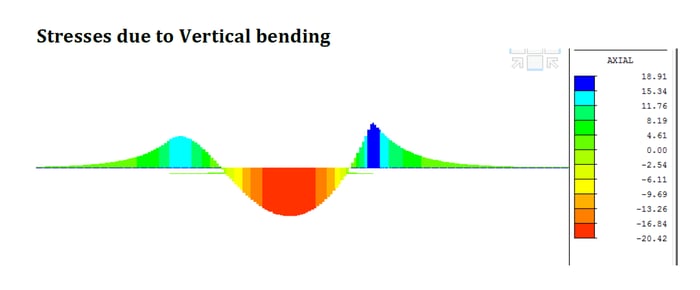
 
 
fig 6. Stresses in rail due to vertical bending
Fig 6. Stresses in rail due to vertical bending

Vertical Bending stresses:

σrail (fixed) [ ΔT] = 15.34 N/mm2
σrail (movable) [ ΔT] = 18.91 N/mm2
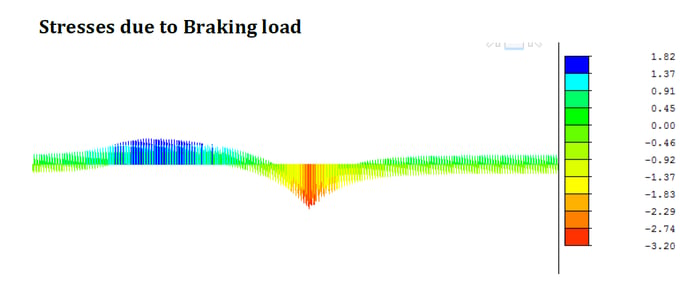
 
fig 7. Stresses in rail due to baking load
Fig 7. Stresses in rail due to baking load
 

Braking Stresses:

σrail (fixed) [ ΔT] = 1.82 N/mm2
σrail (movable) [ ΔT] = 3.2N/mm2


The comparison of stresses in rail for manual calculation and software results is shown below:

Stresses

Temp.(Mpa)

Vertical(Mpa)

Braking (Mpa)

Total(Mpa)

var. %

σrail(fixed)manual

11

0

32.5

43.5

19%

σrail(fixed)midas

36.36

15.34

1.82

53.52

σrail(free)manual

34

13

32.5

79.5

-25%

σrail(free)midas

41.48

18.91

3.2

63.59

Table 1. Comparison of stress from manual procedure and Midas Civil


5. Conclusion


It can be seen from the above comparison that the manual method mentioned in UIC 774-3 gives a conservative estimate of the stresses in rail due to interaction. The same is mentioned in UIC as well. However, the point to notice here is due to the continuity of rail which is accounted in midas Civil the stiffness distribution of the structural changes resulting in change in stress distribution. This can be evidently seen in this example. Hence for larger bridges with multiple spans software-based interaction analysis is a better option as it more accurately captures the stiffness of structure due to continuity of rail.




Susbcribe
MIDAS Newsletter

Thank you, See you soon!
Share
About the Author
Anuj Asati | Senior Structural Engineer | MIDAS IT India

Anuj is currently working with MIDAS IT as a Senior Structural/Bridge engineer. He has over 4 years of experience in the design and review of bridge/building projects. He has performed rail-structure interaction for various major railway bridges in India. He pursued his Master's Degree from IIT Madras and is experienced in handling complex technical issues related to bridge engineering projects.

Comments
DOWNLOAD Ebook Download

Please fill out the form below
to download the Ebook

All