
Would you like to sign out?

Select Country

  • Afghanistan English
  • Albania English
  • Algeria English
  • American Samoa English
  • Andorra English
  • Angola English
  • Anguilla English
  • Antarctica English
  • Antigua and Barbuda English
  • Argentina Español
  • Armenia English
  • Aruba English
  • Australia English
  • Austria English
  • Azerbaijan English
  • Bahamas English
  • Bahrain English
  • Bangladesh English
  • Barbados English
  • Belarus English
  • Belgium English
  • Belize English
  • Benin English
  • Bermuda English
  • Bhutan English
  • Bolivia Español
  • Bosnia and Herzegovina English
  • Botswana English
  • Bouvet Island English
  • Brazil English
  • British Indian Ocean Territory English
  • British Virgin Islands English
  • Brunei English
  • Bulgaria English
  • Burkina Faso English
  • Burundi English
  • Cambodia English
  • Cameroon English
  • Canada English
  • Cape Verde English
  • Caribbean Netherlands English
  • Cayman Islands English
  • Central African Republic English
  • Chad English
  • Chile Español
  • Christmas Island English
  • Cocos (Keeling) Islands English
  • Colombia Español
  • Comoros English
  • Congo English
  • Cook Islands English
  • Costa Rica Español
  • Côte d’Ivoire English
  • Croatia English
  • Cuba Español
  • Curaçao English
  • Cyprus English
  • Czech Republic English
  • Democratic Republic of the Congo English
  • Denmark English
  • Djibouti English
  • Dominica English
  • Dominican Republic Español
  • Ecuador Español
  • Egypt English
  • El Salvador Español
  • Equatorial Guinea English
  • Eritrea English
  • Estonia English
  • Ethiopia English
  • Falkland Islands English
  • Faroe Islands English
  • Fiji English
  • Finland English
  • France English
  • French Guiana Español
  • French Polynesia English
  • French Southern Territories English
  • Gabon English
  • Gambia English
  • Georgia English
  • Germany English
  • Ghana English
  • Gibraltar English
  • Greece English
  • Greenland English
  • Grenada English
  • Guadeloupe Español
  • Guam English
  • Guatemala Español
  • Guernsey English
  • Guinea English
  • Guinea-Bissau English
  • Guyana English
  • Haiti Español
  • Heard Island and McDonald Islands English
  • Honduras Español
  • Hong Kong English
  • Hungary English
  • Iceland English
  • India English
  • Indonesia English
  • Iran English
  • Iraq English
  • Ireland English
  • Isle of Man English
  • Israel English
  • Italy English
  • Jamaica English
  • Japan 日本語
  • Jersey English
  • Jordan English
  • Kazakhstan English
  • Kenya English
  • Kiribati English
  • South Korea 한국어
  • Kuwait English
  • Kyrgyzstan English
  • Laos English
  • Latvia English
  • Lebanon English
  • Lesotho English
  • Liberia English
  • Libya English
  • Liechtenstein English
  • Lithuania English
  • Luxembourg English
  • Macau English
  • Madagascar English
  • Malawi English
  • Malaysia English
  • Maldives English
  • Mali English
  • Malta English
  • Marshall Islands English
  • Martinique English
  • Mauritania English
  • Mauritius English
  • Mayotte English
  • Mexico Español
  • Micronesia English
  • Moldova English
  • Monaco English
  • Mongolia English
  • Montenegro English
  • Montserrat English
  • Morocco English
  • Mozambique English
  • Myanmar English
  • Namibia English
  • Nauru English
  • Nepal English
  • Netherlands English
  • New Caledonia English
  • New Zealand English
  • Nicaragua Español
  • Niger English
  • Nigeria English
  • Niue English
  • Norfolk Island English
  • Northern Mariana Islands English
  • Norway English
  • Oman English
  • Pakistan English
  • Palau English
  • Palestine English
  • Panama Español
  • Papua New Guinea English
  • Paraguay Español
  • Peru Español
  • Philippines English
  • Pitcairn Islands English
  • Poland English
  • Portugal Español
  • Puerto Rico Español
  • Qatar English
  • Réunion English
  • Romania English
  • Russia English
  • Rwanda English
  • Saint Barthélemy Español
  • Saint Helena English
  • Saint Kitts and Nevis English
  • Saint Lucia English
  • Saint Martin Español
  • Saint Pierre and Miquelon English
  • Saint Vincent and the Grenadines English
  • Samoa English
  • San Marino English
  • São Tomé and Príncipe English
  • Saudi Arabia English
  • Senegal English
  • Serbia English
  • Seychelles English
  • Sierra Leone English
  • Singapore English
  • Sint Maarten English
  • Slovakia English
  • Slovenia English
  • Solomon Islands English
  • Somalia English
  • South Africa English
  • South Georgia English
  • South Sudan English
  • Spain English
  • Sri Lanka English
  • Sudan English
  • Suriname English
  • Svalbard and Jan Mayen English
  • Eswatini English
  • Sweden English
  • Switzerland English
  • Syria English
  • Taiwan English
  • Tajikistan English
  • Tanzania English
  • Thailand English
  • Togo English
  • Tokelau English
  • Tonga English
  • Trinidad and Tobago English
  • Tunisia English
  • Turkey English
  • Turkmenistan English
  • Turks and Caicos Islands English
  • Tuvalu English
  • U.S. Virgin Islands English
  • Uganda English
  • Ukraine English
  • United Arab Emirates English
  • United Kingdom English
  • United States English
  • U.S. Minor Outlying Islands English
  • Uruguay Español
  • Uzbekistan English
  • Vanuatu English
  • Vatican City English
  • Venezuela Español
  • Vietnam English
  • Wallis and Futuna English
  • Western Sahara English
  • Yemen English
  • Zambia English
  • Zimbabwe English
  • Åland Islands English
  • East Timor English
  • Netherlands Antilles English
  • Serbia and Montenegro English
  • North Macedonia English
  • Timor-Leste English

Bridge Span According to AASHTO LRFD

May 13, 2022
BLOG BRIDGE INSIGHT

The Whole New MIDAS Site Banner


🗂️ Download Now

Please fill out the Download Section (Click here) below the Comment Section to download the Complete Guide to Composite Sections



1. Purpose of Bridge Rating


               AASHTO LRFD Bridge Design Specifications are used for bridge assessment, design, and rehabilitation. LRFD or Load and Resistance Factor Design pertain relatively to the superstructure and substructure’s↗ level of safety. The level of safety varies depending on the member type, span length, and arrangement. There is such variability since the design loads and their utilization was not ciphered to result in a force effect with a similar level of safety to all the span and member types.


2. What is a Bridge Span


               The center-to-center distance of adjacent towers, pylons, piers, or supports is called a bridge span. Bridge length however pertains to the total length of the total span of the bridge.
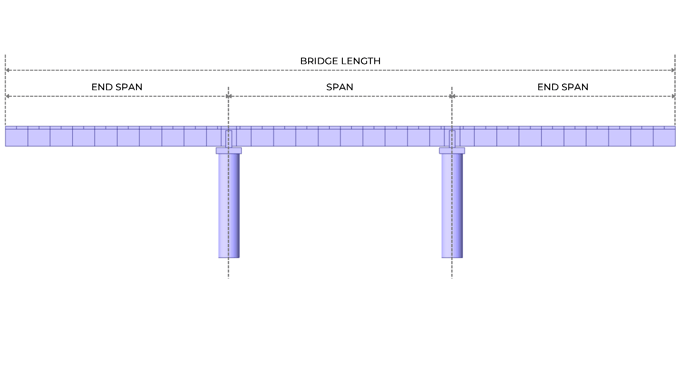


Figure 1
Figure.1 Bridge span and length


3. Bridge Span According to AASHTO LRFD


               The safety factor in designing a bridge is simply when the requirement on the section and materials is less than that of what is supplied. Hence, when a load or load combination reaches the resistance of the section or material, failure is likely to happen.

                Deterioration of wearing surfaces caused by service load deformations weakens the bridge’s durability and serviceability. According to AASHTO LRFD, in the absence of other criteria, various deflection limits may be considered for concrete, steel, and/or aluminum bridges. These deflection limits are in accordance with AASHTO LRFD 2.5.2.6.2 Criteria for Deflection. It is stated that the deflection limit is larger for the vehicular and/or pedestrian loads for cantilever arms compared to the general or usual.
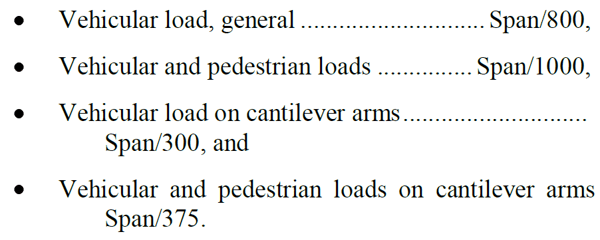


Figure 2
Figure.2 AASHTO LRFD 2.5.2.6.2 Criteria for Deflection


                As for the deflection limits for wood construction in the absence of other criteria, vehicular and pedestrian loads are Span/425. On the other hand, the deflection limit of vehicular load on wood planks and panels for extreme relative deflection between adjacent edges is 0.10 inches.

               Provisions for orthotropic plate decks shall also be applied for vehicular load in deck plate, with a deflection limit of Span/300. The deflection limit for the vehicular load on ribs of orthotropic metal decks is Span/1000, or with an extreme relative deflection between adjacent ribs of 0.10 inch.

                Optional Criteria for Span-to-Depth Ratios are given in AASHTO 2.5.2.6.3. The limits in Table 2.5.2.6.3-1 may be considered in the absence of other criteria and shall be taken to apply to overall depth unless noted.

                For curved steel girders, a larger ideal minimum depth of girder is defined to consider the disproportionate share of loading experienced in the outermost curved girder. As for the curved skewed bridge, increasing the girder’s stiffness by increasing the depth leads to smaller relative deflection differences and cross-frame forces.
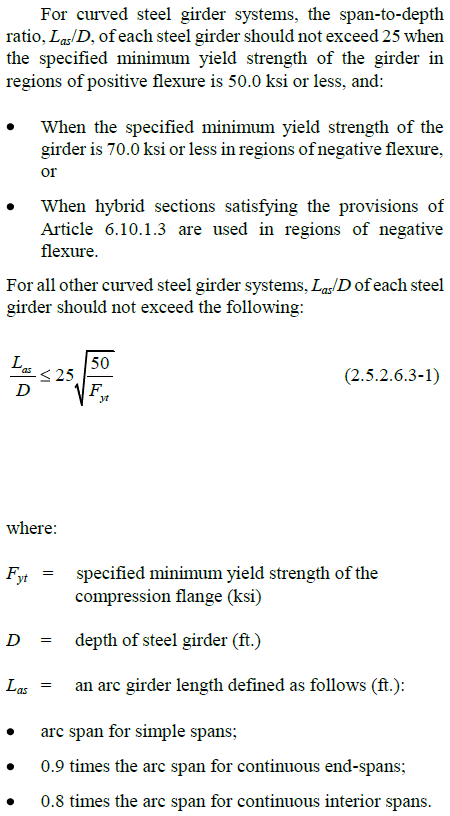


Figure 3
Figure 3: AASHTO LRFD 2.5.2.6.3 optional criteria for span-to-depth ratios


               The minimum depth for constant depth of superstructures as shown in Table 2.5.2.6.3-1 for continuous spans is lesser than the simple spans. The T-Beams for reinforced concrete have a minimum depth larger than the box beams and the pedestrian structure beams being the smallest. CIP box beams and precast I-beams have the same and largest minimum depth with respect to the span length for prestressed concrete, followed by the pedestrian structure beams and adjacent box beams respectfully. For the steel, the truss type has the largest minimum depth, followed by the overall depth of composite I-beam, and the depth of the I-beam portion of composite I-beam.
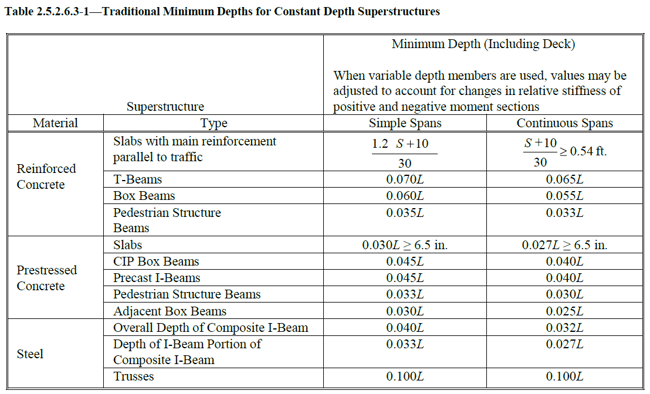


Figure 4
Figure 4: Table 2.5.2.6.3-1 Traditional minimum depths for constant depth superstructures


               The beam size particularly its height, controls the span of the beam. By increasing the beam height, the beam has more material to subdue the tension. As the distance increases, the size of the supports also increases until the weight of the bridge can no longer support itself. Hence, despite some added supports to create tall beams, the bridge is still limited in the distance it can span.


Susbcribe
MIDAS Newsletter

Thank you, See you soon!
Share
About the Author
Marie Hannalei Aguila | Technical Engineer | MIDAS IT PH

Marie Hannalei T. Aguila specializes in designing civil structures through the vertical and horizontal structure software of Midas. She earned her bachelor’s degree in Civil Engineering at Saint Mary’s University. She has actively participated in various structural design trainings and has over 3 years experience in the field of design. She is currently a Technical Engineer at Midas IT Philippines and has conducted various trainings locally and internationally.

Comments

Download the E-BOOK

Fill out the below form to download the Complete Guide to Composite Sections