Would you like to sign out?

Select Country

  • Afghanistan English
  • Albania English
  • Algeria English
  • American Samoa English
  • Andorra English
  • Angola English
  • Anguilla English
  • Antarctica English
  • Antigua and Barbuda English
  • Argentina Español
  • Armenia English
  • Aruba English
  • Australia English
  • Austria English
  • Azerbaijan English
  • Bahamas English
  • Bahrain English
  • Bangladesh English
  • Barbados English
  • Belarus English
  • Belgium English
  • Belize English
  • Benin English
  • Bermuda English
  • Bhutan English
  • Bolivia Español
  • Bosnia and Herzegovina English
  • Botswana English
  • Bouvet Island English
  • Brazil English
  • British Indian Ocean Territory English
  • British Virgin Islands English
  • Brunei English
  • Bulgaria English
  • Burkina Faso English
  • Burundi English
  • Cambodia English
  • Cameroon English
  • Canada English
  • Cape Verde English
  • Caribbean Netherlands English
  • Cayman Islands English
  • Central African Republic English
  • Chad English
  • Chile Español
  • Christmas Island English
  • Cocos (Keeling) Islands English
  • Colombia Español
  • Comoros English
  • Congo English
  • Cook Islands English
  • Costa Rica Español
  • Côte d’Ivoire English
  • Croatia English
  • Cuba Español
  • Curaçao English
  • Cyprus English
  • Czech Republic English
  • Democratic Republic of the Congo English
  • Denmark English
  • Djibouti English
  • Dominica English
  • Dominican Republic Español
  • Ecuador Español
  • Egypt English
  • El Salvador Español
  • Equatorial Guinea English
  • Eritrea English
  • Estonia English
  • Ethiopia English
  • Falkland Islands English
  • Faroe Islands English
  • Fiji English
  • Finland English
  • France English
  • French Guiana Español
  • French Polynesia English
  • French Southern Territories English
  • Gabon English
  • Gambia English
  • Georgia English
  • Germany English
  • Ghana English
  • Gibraltar English
  • Greece English
  • Greenland English
  • Grenada English
  • Guadeloupe Español
  • Guam English
  • Guatemala Español
  • Guernsey English
  • Guinea English
  • Guinea-Bissau English
  • Guyana English
  • Haiti Español
  • Heard Island and McDonald Islands English
  • Honduras Español
  • Hong Kong English
  • Hungary English
  • Iceland English
  • India English
  • Indonesia English
  • Iran English
  • Iraq English
  • Ireland English
  • Isle of Man English
  • Israel English
  • Italy English
  • Jamaica English
  • Japan 日本語
  • Jersey English
  • Jordan English
  • Kazakhstan English
  • Kenya English
  • Kiribati English
  • South Korea 한국어
  • Kuwait English
  • Kyrgyzstan English
  • Laos English
  • Latvia English
  • Lebanon English
  • Lesotho English
  • Liberia English
  • Libya English
  • Liechtenstein English
  • Lithuania English
  • Luxembourg English
  • Macau English
  • Madagascar English
  • Malawi English
  • Malaysia English
  • Maldives English
  • Mali English
  • Malta English
  • Marshall Islands English
  • Martinique English
  • Mauritania English
  • Mauritius English
  • Mayotte English
  • Mexico Español
  • Micronesia English
  • Moldova English
  • Monaco English
  • Mongolia English
  • Montenegro English
  • Montserrat English
  • Morocco English
  • Mozambique English
  • Myanmar English
  • Namibia English
  • Nauru English
  • Nepal English
  • Netherlands English
  • New Caledonia English
  • New Zealand English
  • Nicaragua Español
  • Niger English
  • Nigeria English
  • Niue English
  • Norfolk Island English
  • Northern Mariana Islands English
  • Norway English
  • Oman English
  • Pakistan English
  • Palau English
  • Palestine English
  • Panama Español
  • Papua New Guinea English
  • Paraguay Español
  • Peru Español
  • Philippines English
  • Pitcairn Islands English
  • Poland English
  • Portugal Español
  • Puerto Rico Español
  • Qatar English
  • Réunion English
  • Romania English
  • Russia English
  • Rwanda English
  • Saint Barthélemy Español
  • Saint Helena English
  • Saint Kitts and Nevis English
  • Saint Lucia English
  • Saint Martin Español
  • Saint Pierre and Miquelon English
  • Saint Vincent and the Grenadines English
  • Samoa English
  • San Marino English
  • São Tomé and Príncipe English
  • Saudi Arabia English
  • Senegal English
  • Serbia English
  • Seychelles English
  • Sierra Leone English
  • Singapore English
  • Sint Maarten English
  • Slovakia English
  • Slovenia English
  • Solomon Islands English
  • Somalia English
  • South Africa English
  • South Georgia English
  • South Sudan English
  • Spain English
  • Sri Lanka English
  • Sudan English
  • Suriname English
  • Svalbard and Jan Mayen English
  • Eswatini English
  • Sweden English
  • Switzerland English
  • Syria English
  • Taiwan English
  • Tajikistan English
  • Tanzania English
  • Thailand English
  • Togo English
  • Tokelau English
  • Tonga English
  • Trinidad and Tobago English
  • Tunisia English
  • Turkey English
  • Turkmenistan English
  • Turks and Caicos Islands English
  • Tuvalu English
  • U.S. Virgin Islands English
  • Uganda English
  • Ukraine English
  • United Arab Emirates English
  • United Kingdom English
  • United States English
  • U.S. Minor Outlying Islands English
  • Uruguay Español
  • Uzbekistan English
  • Vanuatu English
  • Vatican City English
  • Venezuela Español
  • Vietnam English
  • Wallis and Futuna English
  • Western Sahara English
  • Yemen English
  • Zambia English
  • Zimbabwe English
  • Åland Islands English
  • East Timor English
  • Netherlands Antilles English
  • Serbia and Montenegro English
  • North Macedonia English
  • Timor-Leste English

Helicoidal Bridge

June 16, 2021
BLOG CASE STUDY

Helicoidal Bridge


Project Application


Project Name: Helicoidal Bridge

Location: Risaralda, Colombia

Company: Gregorio Renteria Ingenieros SA (GRISA)

Engineer: Gregorioa Renteria Antorveza

Types of analysis used: Construction stage analysis, moving load analysis, post-tensioned analysis, dynamic nonlinear analysis, seismic isolators

Program used: midas Civil

Length: 395m

Diameter: 180m

Year of inauguration: 2010


Project Description


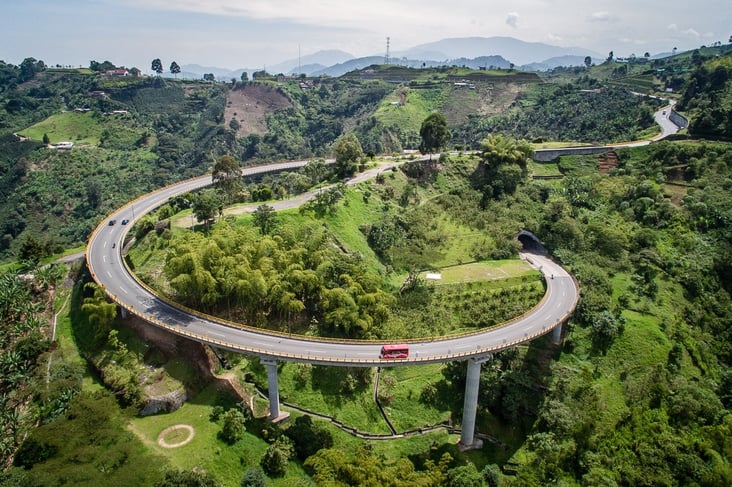
The Helicoidal Bridge is part of a road that has a total of 3.5 kilometers, of which 125 meters are tunnel and 395 meters of the bridge. The bridge is 395.30 m long with a diameter of 180 m. All mounted-on friction pendulum seismic isolators allow the displacement of the superstructure in the event of an earthquake or due to changes in temperature.


As a solution to the instability of the slopes and the difference in height, an alignment was designed including a geometric helical figure, like the spiral of a spring.


The bridge has 7 spans at 50m and 2 terminal overhangs at 28m. It has 2 abutments and 8 hollow circular piers with two have a section of 3.20 m in external diameter and for the tallest pier on each slope and 2.30 m in diameter for the remaining piers. The height of the piers varies between 4.82 m and 25.59 m.


The post-tensioned concrete box girder has a 10 m wide deck and a constant section height of 2.20m. It has a 7% gradient and 8% superelevation. The elevation of 38 meters makes it possible to take to the ridge of the mountain to travel practically to the back of the hill.
 

The portal of a curved tunnel leading to the helical bridgeFigure 1. The portal of a curved tunnel leading to the Helical Bridge


Determining Factors


  • Unstable soil, composed of volcanic ash and residual materials.

  • Impossibility of expanding the existing road.

  • Minimum intervention of the terrain, to guarantee the stability of the road alignment.

  • This structure was selected from several alternatives due to the safety it represents since it did not require a major intervention on the ground, which does not present great stability due to geographical conditions.

  • In addition, the work does not register high environmental impacts and represents greater long-term stability.


Construction Process


The construction methodology chosen for this project is that of balanced cantilever segmental construction, which is carried out through form travelers, installed on the surface of the slab of the support beams.


To execute it, a form traveler formwork system is mounted with a crane that allows the first segment to be poured, which after setting is tensioned. To install the second traveler, the first must move on to the already poured segment. The construction of the voussoirs is made symmetrically on the column; the length of the cantilever depends on the design specifications. In this project, four travelers were used to speed up the splicing of the cantilevers.
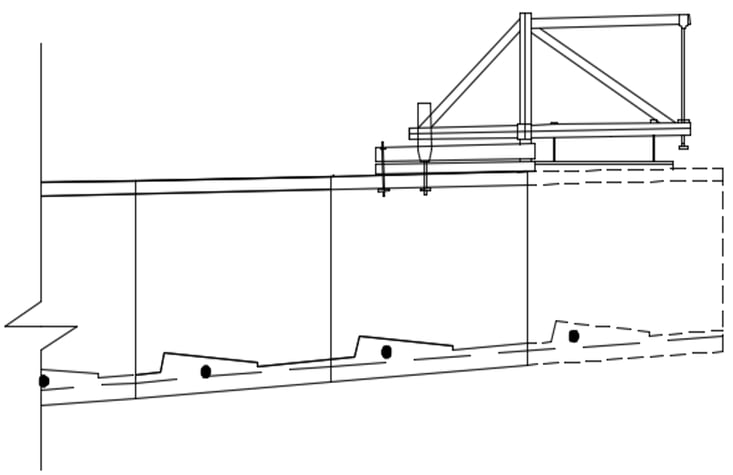
 

Formwork travelerFigure 2. Formwork traveler


This project was of high risk, which was assumed by the builders and designers since to achieve that the cantilevers of this bridge built in successive segments with such high gradient, superelevation, and radius of curvature they had room for error of less than 3 cm of added displacements X, Y, and Z. It was possible thanks to compliance with strict construction and quality control protocols.


Before putting the bridge into operation, the road had traffic records of up to 7 thousand vehicles per day, mostly heavy vehicles, with average operating speeds of less than 20 kilometers per hour. Therefore, any problem on the road generates significant traffic jams.


The proposal that has been built makes it possible to improve the level of service and increase road capacity, with a dual carriageway with two lanes in each direction, as opposed to what was thought of two two-way carriageways each.


Additionally, 'inverted pendulum' type seismic isolators were used, a state-of-the-art technology that creates a structural discontinuity, between segments and support, using a mechanism in which two concave surfaces meet. This allows the bridge to 'float' on the seismic isolators in the event of a seismic movement. In other words, the energy of an earthquake is not transmitted to the superstructure and it is freed from this requirement.


 

Susbcribe
MIDAS Newsletter

Thank you, See you soon!
Share
About the Author
Edgar De Los Santos | Senior Engineer | MIDASoft Inc.

Edgar is a Senior Engineer at MIDASoft Inc. experienced in numerical modeling and bridge design and has over 8+ years of experience. Edgar has participated in designs of Prestressed Girder Bridges and Segmental Bridges. Edgar pursued his Civil Engineering Degree from the New Jersey Institute of Technology (NJIT) and is currently pursuing a Master's Degree in Civil Engineering at the Universidad del Norte in Barranquilla, Colombia.


Comments
Project Application Download the
Project Application

Please fill out the below form to
download 80 Masterworks of Civil Engineering

All