Would you like to sign out?

Select Country

  • Afghanistan English
  • Albania English
  • Algeria English
  • American Samoa English
  • Andorra English
  • Angola English
  • Anguilla English
  • Antarctica English
  • Antigua and Barbuda English
  • Argentina Español
  • Armenia English
  • Aruba English
  • Australia English
  • Austria English
  • Azerbaijan English
  • Bahamas English
  • Bahrain English
  • Bangladesh English
  • Barbados English
  • Belarus English
  • Belgium English
  • Belize English
  • Benin English
  • Bermuda English
  • Bhutan English
  • Bolivia Español
  • Bosnia and Herzegovina English
  • Botswana English
  • Bouvet Island English
  • Brazil English
  • British Indian Ocean Territory English
  • British Virgin Islands English
  • Brunei English
  • Bulgaria English
  • Burkina Faso English
  • Burundi English
  • Cambodia English
  • Cameroon English
  • Canada English
  • Cape Verde English
  • Caribbean Netherlands English
  • Cayman Islands English
  • Central African Republic English
  • Chad English
  • Chile Español
  • Christmas Island English
  • Cocos (Keeling) Islands English
  • Colombia Español
  • Comoros English
  • Congo English
  • Cook Islands English
  • Costa Rica Español
  • Côte d’Ivoire English
  • Croatia English
  • Cuba Español
  • Curaçao English
  • Cyprus English
  • Czech Republic English
  • Democratic Republic of the Congo English
  • Denmark English
  • Djibouti English
  • Dominica English
  • Dominican Republic Español
  • Ecuador Español
  • Egypt English
  • El Salvador Español
  • Equatorial Guinea English
  • Eritrea English
  • Estonia English
  • Ethiopia English
  • Falkland Islands English
  • Faroe Islands English
  • Fiji English
  • Finland English
  • France English
  • French Guiana Español
  • French Polynesia English
  • French Southern Territories English
  • Gabon English
  • Gambia English
  • Georgia English
  • Germany English
  • Ghana English
  • Gibraltar English
  • Greece English
  • Greenland English
  • Grenada English
  • Guadeloupe Español
  • Guam English
  • Guatemala Español
  • Guernsey English
  • Guinea English
  • Guinea-Bissau English
  • Guyana English
  • Haiti Español
  • Heard Island and McDonald Islands English
  • Honduras Español
  • Hong Kong English
  • Hungary English
  • Iceland English
  • India English
  • Indonesia English
  • Iran English
  • Iraq English
  • Ireland English
  • Isle of Man English
  • Israel English
  • Italy English
  • Jamaica English
  • Japan 日本語
  • Jersey English
  • Jordan English
  • Kazakhstan English
  • Kenya English
  • Kiribati English
  • South Korea 한국어
  • Kuwait English
  • Kyrgyzstan English
  • Laos English
  • Latvia English
  • Lebanon English
  • Lesotho English
  • Liberia English
  • Libya English
  • Liechtenstein English
  • Lithuania English
  • Luxembourg English
  • Macau English
  • Madagascar English
  • Malawi English
  • Malaysia English
  • Maldives English
  • Mali English
  • Malta English
  • Marshall Islands English
  • Martinique English
  • Mauritania English
  • Mauritius English
  • Mayotte English
  • Mexico Español
  • Micronesia English
  • Moldova English
  • Monaco English
  • Mongolia English
  • Montenegro English
  • Montserrat English
  • Morocco English
  • Mozambique English
  • Myanmar English
  • Namibia English
  • Nauru English
  • Nepal English
  • Netherlands English
  • New Caledonia English
  • New Zealand English
  • Nicaragua Español
  • Niger English
  • Nigeria English
  • Niue English
  • Norfolk Island English
  • Northern Mariana Islands English
  • Norway English
  • Oman English
  • Pakistan English
  • Palau English
  • Palestine English
  • Panama Español
  • Papua New Guinea English
  • Paraguay Español
  • Peru Español
  • Philippines English
  • Pitcairn Islands English
  • Poland English
  • Portugal Español
  • Puerto Rico Español
  • Qatar English
  • Réunion English
  • Romania English
  • Russia English
  • Rwanda English
  • Saint Barthélemy Español
  • Saint Helena English
  • Saint Kitts and Nevis English
  • Saint Lucia English
  • Saint Martin Español
  • Saint Pierre and Miquelon English
  • Saint Vincent and the Grenadines English
  • Samoa English
  • San Marino English
  • São Tomé and Príncipe English
  • Saudi Arabia English
  • Senegal English
  • Serbia English
  • Seychelles English
  • Sierra Leone English
  • Singapore English
  • Sint Maarten English
  • Slovakia English
  • Slovenia English
  • Solomon Islands English
  • Somalia English
  • South Africa English
  • South Georgia English
  • South Sudan English
  • Spain English
  • Sri Lanka English
  • Sudan English
  • Suriname English
  • Svalbard and Jan Mayen English
  • Eswatini English
  • Sweden English
  • Switzerland English
  • Syria English
  • Taiwan English
  • Tajikistan English
  • Tanzania English
  • Thailand English
  • Togo English
  • Tokelau English
  • Tonga English
  • Trinidad and Tobago English
  • Tunisia English
  • Turkey English
  • Turkmenistan English
  • Turks and Caicos Islands English
  • Tuvalu English
  • U.S. Virgin Islands English
  • Uganda English
  • Ukraine English
  • United Arab Emirates English
  • United Kingdom English
  • United States English
  • U.S. Minor Outlying Islands English
  • Uruguay Español
  • Uzbekistan English
  • Vanuatu English
  • Vatican City English
  • Venezuela Español
  • Vietnam English
  • Wallis and Futuna English
  • Western Sahara English
  • Yemen English
  • Zambia English
  • Zimbabwe English
  • Åland Islands English
  • East Timor English
  • Netherlands Antilles English
  • Serbia and Montenegro English
  • North Macedonia English
  • Timor-Leste English

Evaluating Tendons Through Simulation in Civil Engineering

September 19, 2023
BLOG CASE STUDY

Evaluating Tendons Through Simulation in Civil Engineering


As defined in General, Tendons refer to "steel wires, steel strands, or steel bars used for applying prestress to concrete structures." They play a pivotal role in introducing prestress to concrete members, compensating for concrete's material properties, which excel in compression but are weaker in tension.


Applying prestress to concrete structures involves either introducing compressive stresses by tensioning steel wires, tendons, or steel bars within the concrete or pre-bending steel reinforcement and releasing it under stress before concrete casting. The former method results in prestressed concrete (PSC) girders, while the latter yields Preflex girders.


In this content, we delve into simulating the installation of tendons in concrete beams using various dimensional elements (ie. 1D Frame, 2D Plate, 3D Solid included Tendon) and analyze how tendon stresses vary depending on the element type.


1. Overview


The evaluation of tendons typically entails utilizing finite element models for precise assessments of the impact of tendon placement and shape on concrete beam deformation and stress patterns. While various modeling methods are employed to represent tendons within concrete when creating finite element models, it is commonplace to model tendons within 1D beam elements.


However, for more accurate consideration of the structural behavior induced by tendon installation and to account for tendon placement and shape with greater precision, simulations can be conducted by embedding tendons within 2D plate elements or 3D solid elements.


In this content, we will compare the distribution of stress in tendons applied to midas Civil's 1D Frame elements with that in tendons applied to FEA NX's 2D Plate elements and 3D Solid elements, taking into account the dimensions of each applied element.


2. Modeling


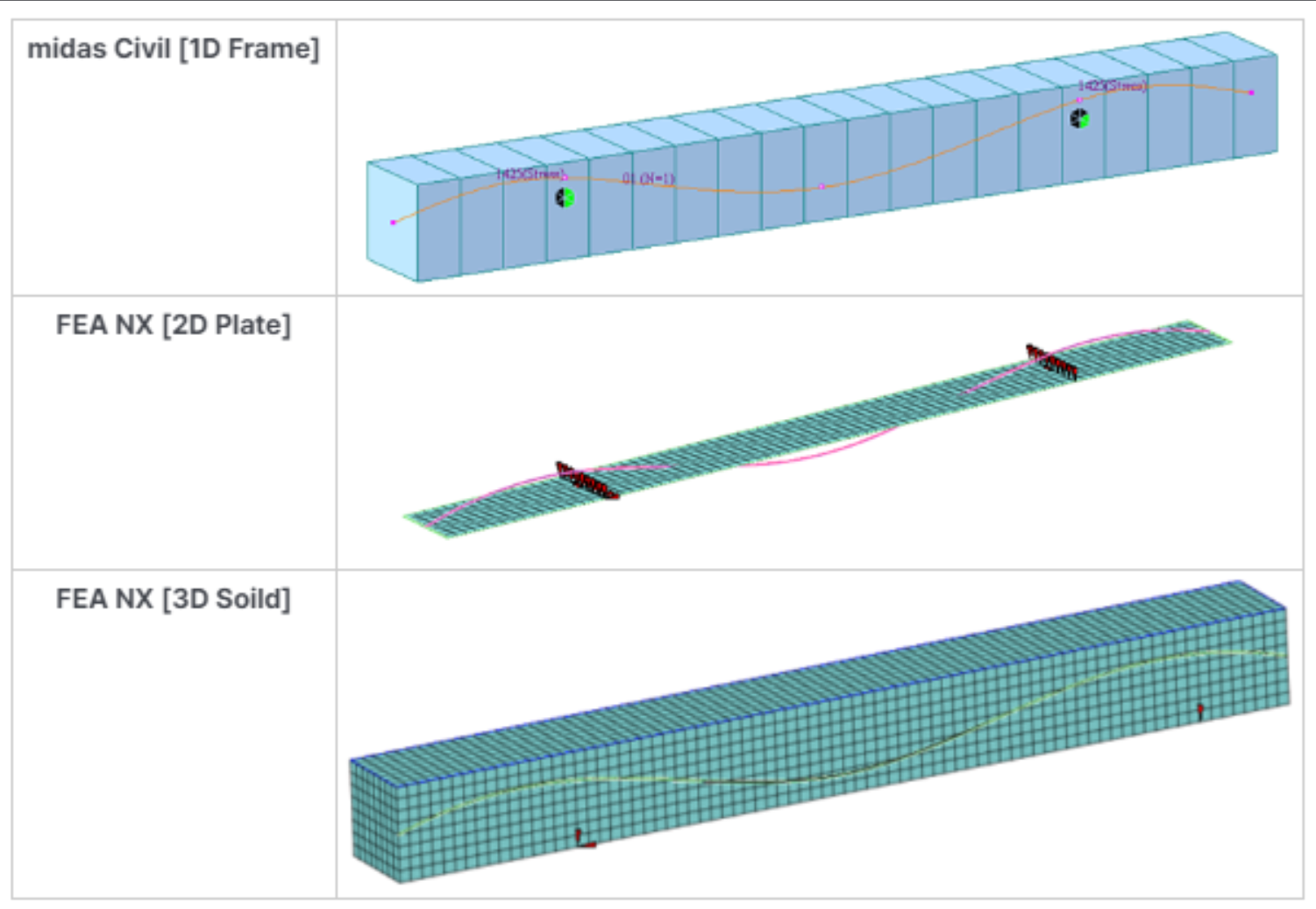
The structural modeling, considering tendons, was categorized as follows and executed using midas Civil and FEA NX:


  1. 1D Frame Element with Tendon: midas Civil
  2. 2D Plate Element with Tendon: FEA NX
  3. 3D Solid Element with Tendon: FEA NX


The material and cross-sectional properties employed for this modeling are as follows:


  • Concrete: C40
  • Concrete Area: 0.5 x 0.5 m
  • Tendon: SWPC7B
  • Tendon Area: 2,635.3 mm²
  • Duct Diameter: 100 mm
  • Relaxation Coefficient: CEP-FIP 5%
  • Tendon Ultimate Strength: 1,863.26 MPa
  • Tendon Yield Strength: 1,569.06 MPa
  • Curvature Friction Factor: 0.3
  • Wobble Friction Factor: 6.6E-06 1/mm
  • Anchorage Slip: Begin & End 0.6 mm


The characteristics of the tendons applied to midas Civil and FEA NX are as follows (Figures 1 & 2). These characteristics were considered when assuming the curvature of tendons:
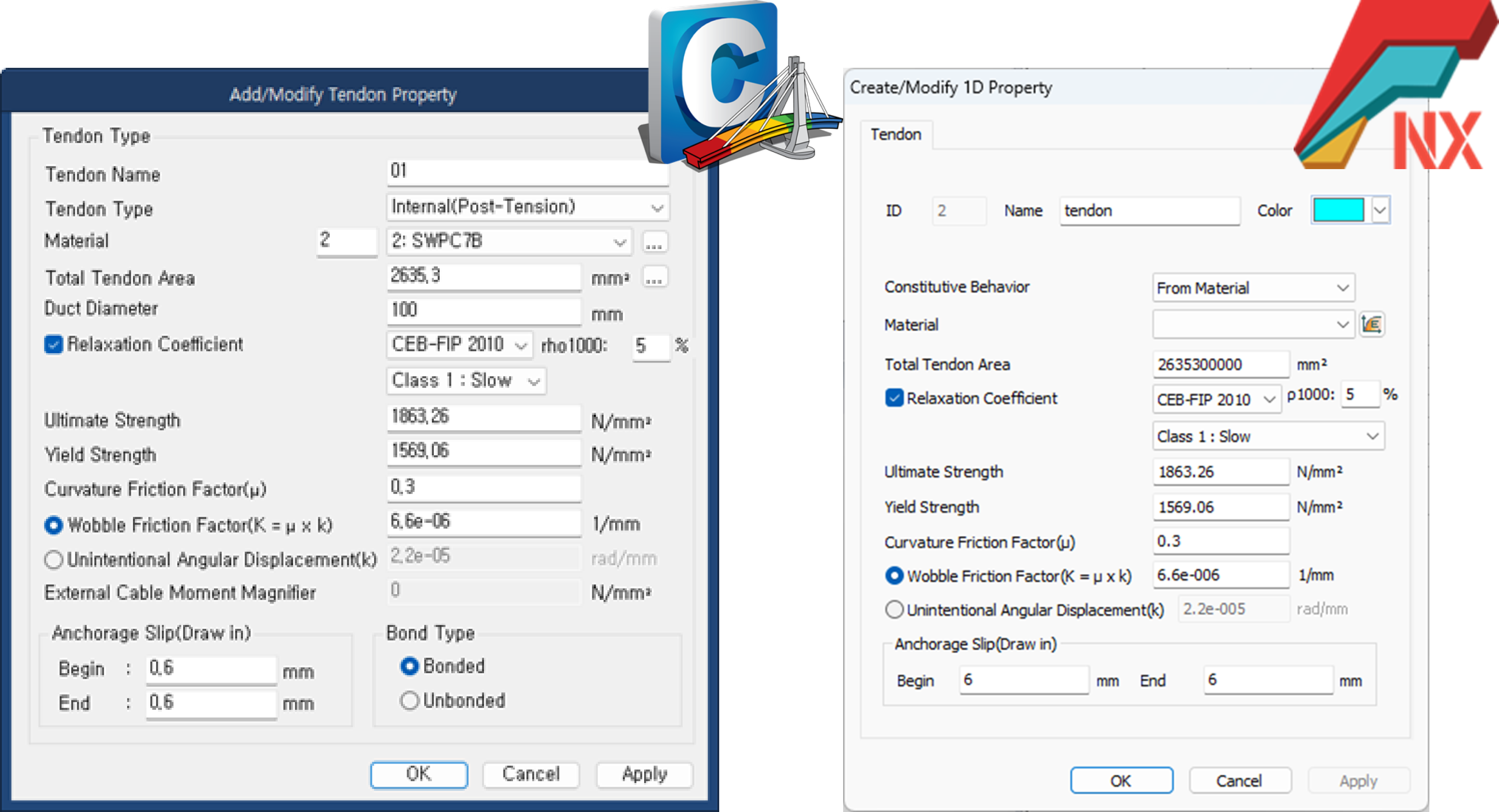
 

Figure 1. Tendon Characteristics

<Figure 1. Tendon Property>


Figure 2. Tendon Analysis Modeling<Figure 2. Tendon Analysis Modeling>


Using the models configured as shown in Figure 2, we applied tension to the tendon ends and compared the stress patterns in the tendon and the structure for each applied element.


3. Simulation Results


The stress in tendons for each element type was calculated as shown in Figure 3, and it was observed that there was minimal difference in tendon stress depending on the element's dimension. However, assuming a curvature configuration, modeling tendon shapes more accurately showed a trend of producing slightly higher stresses in 1D Frame elements.


Figure 3. Comparison of Tendon Stresses by Element Type<Figure 3. Comparison of Tendon Stresses by Element Type>


When comparing 2D Plate elements to 1D Frame elements based on different element dimensions, the stress in tendons showed a maximum difference of 1.90%, and in the case of Solid elements, a maximum difference of 1.86% was noted. The detailed result for tendon stress is shown below in Table 1.


Category

Stress(MPa)

Compared to Frame(%)

Remarks

Frame

Max

1,336.17

-


Min

1,113.82

-


Plate

Max

1,312.00

1.84


Min

1,093.00

1.90


Solid

Max

1,312.45

1.81


Min

1,093.47

1.86


<Table 1. Comparison of Tendon Stresses by Element Type>


The structural stresses induced by tendon forces were calculated as shown in the figure below. The stresses in the structure exhibited a similar trend across all element dimensions.
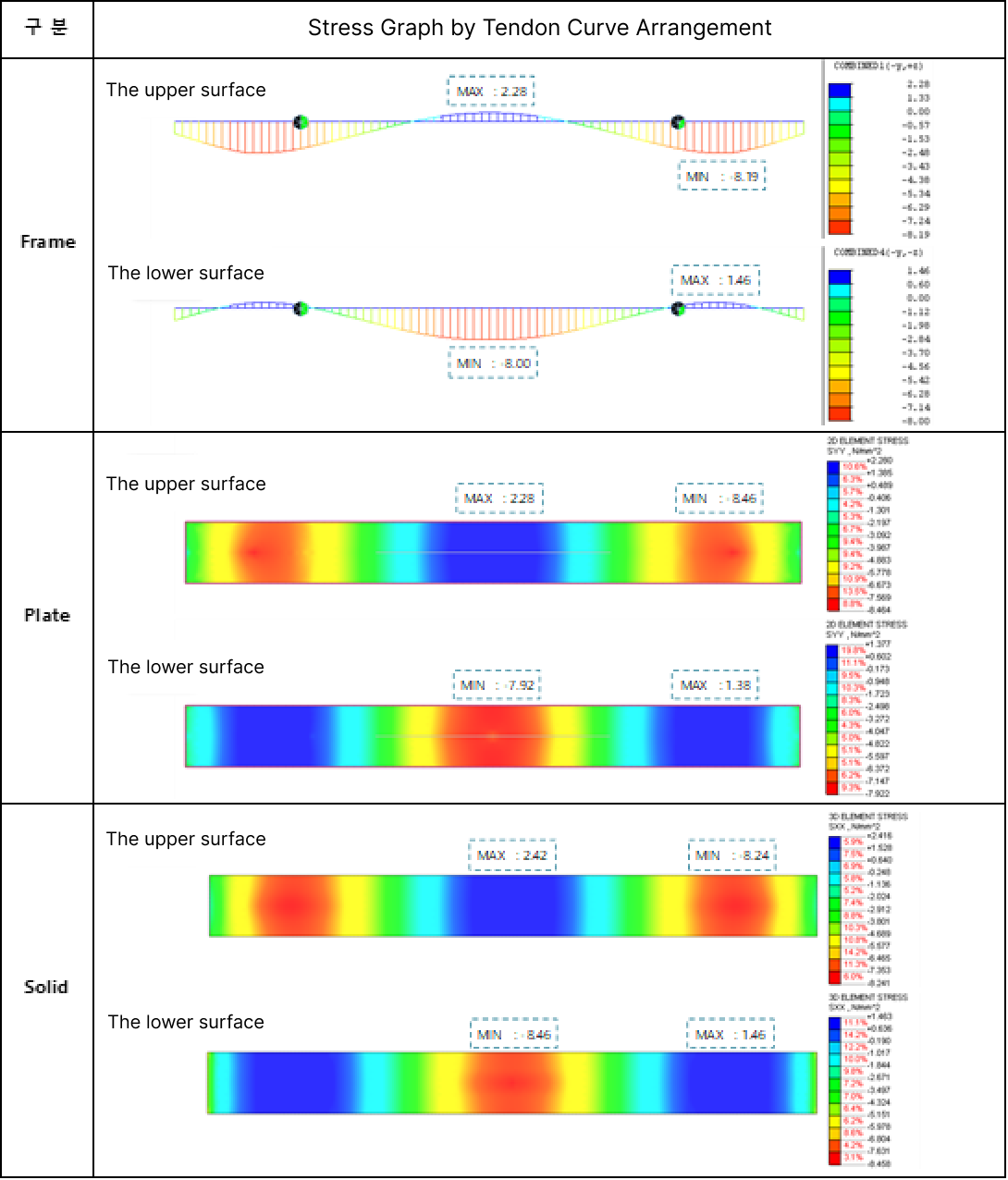
 

Figure 4. Comparison of Structural Stresses by Element Type<Figure 4. Comparison of Structural Stresses by Element Type>


Depending on the dimension of each element, when comparing the results of applying 2D Plate elements to 1D Frame elements, the structural stresses in the structure showed a maximum difference of 5.80%. In the case of 3D Solid elements, the maximum difference reached 6.38%. The detailed result for structural stress is shown below in Table 2.


Category

Stress(MPa)

Compared to Frame(%)

Remarks

Frame

Top

Max

2.28

-


Min

-8.19

-


Bottom

Max

1.46

-


Min

-8.00

-


Plate

Top

Max

2.28

0.00


Min

-8.46

3.19


Bottom

Max

1.38

5.80


Min

-7.92

1.01


Solid

Top

Max

2.42

5.79


Min

-8.24

0.61


Bottom

Max

1.46

0.00


Min

-8.46

6.38


<Table 2. Comparison of Structural Stresses by Element Type>


4. Conclusion


The simulation of tendons can be conducted using various element types, and the choice of element dimension should align with the engineer's needs and judgment.


In this content, we demonstrated how the choice of element dimension can affect tendon application, showing that the difference remains within approximately 10%. However, it's important to note that this difference can be more significant or less significant depending on how precisely the curvature configuration of tendons is modeled.


Today's content aimed to shed light on the differences in tendon application based on element dimensions. The simulations indicate that these differences remain minimal, staying within approximately 10%. Tendon simulation can now offer engineers more diverse options, allowing for a broader range of simulations using midas Civil and FEA NX, depending on their needs.


Susbcribe
MIDAS Newsletter

Thank you, See you soon!
Share
About the Author
Harold Ha | Structural Engineer | MIDAS IT

He endeavors to assist engineers by presenting a clear understanding of the latest industry trends and structural insights, drawing from diverse practical experience in civil engineering and BIM.

Comments
DOWNLOAD CIM Catalog Download

Fill out the below form to
download the CIM Catalog

All