Would you like to sign out?

Select Country

  • Afghanistan English
  • Albania English
  • Algeria English
  • American Samoa English
  • Andorra English
  • Angola English
  • Anguilla English
  • Antarctica English
  • Antigua and Barbuda English
  • Argentina Español
  • Armenia English
  • Aruba English
  • Australia English
  • Austria English
  • Azerbaijan English
  • Bahamas English
  • Bahrain English
  • Bangladesh English
  • Barbados English
  • Belarus English
  • Belgium English
  • Belize English
  • Benin English
  • Bermuda English
  • Bhutan English
  • Bolivia Español
  • Bosnia and Herzegovina English
  • Botswana English
  • Bouvet Island English
  • Brazil English
  • British Indian Ocean Territory English
  • British Virgin Islands English
  • Brunei English
  • Bulgaria English
  • Burkina Faso English
  • Burundi English
  • Cambodia English
  • Cameroon English
  • Canada English
  • Cape Verde English
  • Caribbean Netherlands English
  • Cayman Islands English
  • Central African Republic English
  • Chad English
  • Chile Español
  • Christmas Island English
  • Cocos (Keeling) Islands English
  • Colombia Español
  • Comoros English
  • Congo English
  • Cook Islands English
  • Costa Rica Español
  • Côte d’Ivoire English
  • Croatia English
  • Cuba Español
  • Curaçao English
  • Cyprus English
  • Czech Republic English
  • Democratic Republic of the Congo English
  • Denmark English
  • Djibouti English
  • Dominica English
  • Dominican Republic Español
  • Ecuador Español
  • Egypt English
  • El Salvador Español
  • Equatorial Guinea English
  • Eritrea English
  • Estonia English
  • Ethiopia English
  • Falkland Islands English
  • Faroe Islands English
  • Fiji English
  • Finland English
  • France English
  • French Guiana Español
  • French Polynesia English
  • French Southern Territories English
  • Gabon English
  • Gambia English
  • Georgia English
  • Germany English
  • Ghana English
  • Gibraltar English
  • Greece English
  • Greenland English
  • Grenada English
  • Guadeloupe Español
  • Guam English
  • Guatemala Español
  • Guernsey English
  • Guinea English
  • Guinea-Bissau English
  • Guyana English
  • Haiti Español
  • Heard Island and McDonald Islands English
  • Honduras Español
  • Hong Kong English
  • Hungary English
  • Iceland English
  • India English
  • Indonesia English
  • Iran English
  • Iraq English
  • Ireland English
  • Isle of Man English
  • Israel English
  • Italy English
  • Jamaica English
  • Japan 日本語
  • Jersey English
  • Jordan English
  • Kazakhstan English
  • Kenya English
  • Kiribati English
  • South Korea 한국어
  • Kuwait English
  • Kyrgyzstan English
  • Laos English
  • Latvia English
  • Lebanon English
  • Lesotho English
  • Liberia English
  • Libya English
  • Liechtenstein English
  • Lithuania English
  • Luxembourg English
  • Macau English
  • Madagascar English
  • Malawi English
  • Malaysia English
  • Maldives English
  • Mali English
  • Malta English
  • Marshall Islands English
  • Martinique English
  • Mauritania English
  • Mauritius English
  • Mayotte English
  • Mexico Español
  • Micronesia English
  • Moldova English
  • Monaco English
  • Mongolia English
  • Montenegro English
  • Montserrat English
  • Morocco English
  • Mozambique English
  • Myanmar English
  • Namibia English
  • Nauru English
  • Nepal English
  • Netherlands English
  • New Caledonia English
  • New Zealand English
  • Nicaragua Español
  • Niger English
  • Nigeria English
  • Niue English
  • Norfolk Island English
  • Northern Mariana Islands English
  • Norway English
  • Oman English
  • Pakistan English
  • Palau English
  • Palestine English
  • Panama Español
  • Papua New Guinea English
  • Paraguay Español
  • Peru Español
  • Philippines English
  • Pitcairn Islands English
  • Poland English
  • Portugal Español
  • Puerto Rico Español
  • Qatar English
  • Réunion English
  • Romania English
  • Russia English
  • Rwanda English
  • Saint Barthélemy Español
  • Saint Helena English
  • Saint Kitts and Nevis English
  • Saint Lucia English
  • Saint Martin Español
  • Saint Pierre and Miquelon English
  • Saint Vincent and the Grenadines English
  • Samoa English
  • San Marino English
  • São Tomé and Príncipe English
  • Saudi Arabia English
  • Senegal English
  • Serbia English
  • Seychelles English
  • Sierra Leone English
  • Singapore English
  • Sint Maarten English
  • Slovakia English
  • Slovenia English
  • Solomon Islands English
  • Somalia English
  • South Africa English
  • South Georgia English
  • South Sudan English
  • Spain English
  • Sri Lanka English
  • Sudan English
  • Suriname English
  • Svalbard and Jan Mayen English
  • Eswatini English
  • Sweden English
  • Switzerland English
  • Syria English
  • Taiwan English
  • Tajikistan English
  • Tanzania English
  • Thailand English
  • Togo English
  • Tokelau English
  • Tonga English
  • Trinidad and Tobago English
  • Tunisia English
  • Turkey English
  • Turkmenistan English
  • Turks and Caicos Islands English
  • Tuvalu English
  • U.S. Virgin Islands English
  • Uganda English
  • Ukraine English
  • United Arab Emirates English
  • United Kingdom English
  • United States English
  • U.S. Minor Outlying Islands English
  • Uruguay Español
  • Uzbekistan English
  • Vanuatu English
  • Vatican City English
  • Venezuela Español
  • Vietnam English
  • Wallis and Futuna English
  • Western Sahara English
  • Yemen English
  • Zambia English
  • Zimbabwe English
  • Åland Islands English
  • East Timor English
  • Netherlands Antilles English
  • Serbia and Montenegro English
  • North Macedonia English
  • Timor-Leste English

Introduction to AASHTO Bridge Design Specification

February 20, 2024
BLOG BRIDGE INSIGHT

1. Why do we need design codes?

   Numerous impressive structures were created before the formulation of standardized design codes, but challenges existed. The shift to modern design codes introduced a systematic and scientific approach to bridge engineering, enhancing safety, consistency, and reliability in design and construction. Design codes also play an important role in protecting bridge engineers by providing a framework for legal compliance, standardization, risk mitigation, and professional accountability.


2. Introduction to AASHTO

   AASHTO, the American Association of State Highway and Transportation Officials, develops and publishes specifications, guidelines, and documents for the design, construction, and maintenance of U.S. transportation infrastructure. Each state's Department of Transportation, like Caltrans, TxDOT etc. conducts finite element research and establishes region-specific design checks for bridge engineers, in addition to AASHTO standards

 

Figure 2


3. What are the contents of AASHTO Standards for Bridge Engineer?

   Now, let us come to the main objective of this blog. As you can see, this is a very introductory blog, and my primary aim is to list out the significant codes required for bridge design in the US for engineers. The AASHTO Classification is as follows.

   Read on…


  • AASHTO LRFD Bridge Design Specifications (LRFD): Specifications for the design, evaluation, and rehabilitation of highway bridges using the Load and Resistance Factor Design approach.
  • AASHTO Standard Specifications for Highway Bridges (LFD): Standard specifications for the design and construction of highway bridges using the Load Factor Design approach.
  • AASHTO Guide Specifications for LRFD Seismic Bridge Design (Seismic): Seismic design and evaluation of highway bridges using the LRFD approach.
  • AASHTO LRFD Bridge Construction Specifications (Construction): Specifications for the construction and erection of highway bridges, including materials and methods.
  • AASHTO Guide for Design of Pavement Structures (Pavement): Guidelines for the design of several types of pavement structures, including those related to bridges.
  • AASHTO LRFD Movable Highway Bridge Design Specifications (Movable): Specific guidelines for the design of movable highway bridges using the LRFD approach.
  • AASHTO Manual for Bridge Evaluation (MBE): Evaluation and rating of existing highway bridges, including load rating procedures.
  • AASHTO Guide Specifications for Horizontally Curved Steel Girder Highway Bridges (Curved Girder): Design considerations for horizontally curved steel girder bridges.


The codes mentioned above are revised regularly. As for our users, I would like to point out that MIDAS CIVIL has incorporated the latest versions of AASHTO LRFD 20 for design and AASHTO LRFR 19 for the load rating of bridges. 😊


4. Follow the code or face the consequences.

   Nowadays, due to the influence of social media, we hear a lot about bridge collapses around the globe, out of which a good share of the failures is due to the omission of specific code clauses. One such incident is the collapse of the Sweetwater University City bridge, taking the lives of 6. “Errors in bridge design, inadequate peer review and poor engineering judgment led to the collapse of this bridge,” said NTSB chairman Robert Sumwalt.
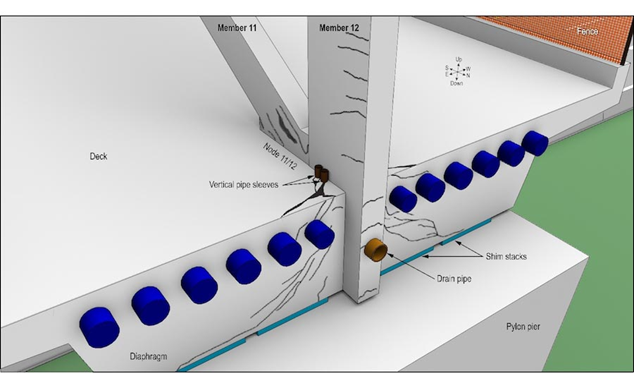
 

Figure 3


5. Conclusion

   The AASHTO LRFD Bridge Design Specifications have become an integral part of bridge engineering, not only in the United States but also in various parts of the world. Being a part of MIDAS has enabled me to explore many codes around the world, and I personally feel that AASHTO codes are the most descriptive and regularly revised.

   But that doesn’t mean that the code provisions are always right. Certainly not. Consider the Millennium Bridge in London, closed on its first day due to synchronized lateral excitation. Prior to this incident, global design codes only assessed vertical vibrations for comfort criteria, neglecting lateral ones. Subsequently, the comfort criteria for lateral vibrations in pedestrian bridges were adjusted to 2.5 Hz.

   While we can attribute collapse to the code, I would like to remind ourselves that as structural engineers, we must take responsibility for our designs. Given the uniqueness of each project, codes may not cover all scenarios, necessitating reliance on engineering judgment.


Further testing should be conducted if discrepancies arise. Advanced finite element software, like MIDAS, enables more detailed analysis and simulation of the structure's actual behavior.

 

Figure 4


6. What’s next?

   This article is just a starting point, explaining the different codes essential for bridge engineers, specifically focusing on AASHTO standards. The upcoming articles will delve more into various code provisions.


   Stay tuned! 😊

Susbcribe
MIDAS Newsletter

Thank you, See you soon!
Share
About the Author
Rohit Joseph | Structural Engineer | MIDAS IT

Rohit is a structural engineer, currently working with MIDAS IT as a Technical Support Engineer. He pursued his Master's degree in Structural Engineering from NIT Surat. His main role is to work closely with bridge engineers around the world to provide them support regarding their technical queries on bridge engineering & MIDAS software.

Comments