Would you like to sign out?

Select Country

  • Afghanistan English
  • Albania English
  • Algeria English
  • American Samoa English
  • Andorra English
  • Angola English
  • Anguilla English
  • Antarctica English
  • Antigua and Barbuda English
  • Argentina Español
  • Armenia English
  • Aruba English
  • Australia English
  • Austria English
  • Azerbaijan English
  • Bahamas English
  • Bahrain English
  • Bangladesh English
  • Barbados English
  • Belarus English
  • Belgium English
  • Belize English
  • Benin English
  • Bermuda English
  • Bhutan English
  • Bolivia Español
  • Bosnia and Herzegovina English
  • Botswana English
  • Bouvet Island English
  • Brazil English
  • British Indian Ocean Territory English
  • British Virgin Islands English
  • Brunei English
  • Bulgaria English
  • Burkina Faso English
  • Burundi English
  • Cambodia English
  • Cameroon English
  • Canada English
  • Cape Verde English
  • Caribbean Netherlands English
  • Cayman Islands English
  • Central African Republic English
  • Chad English
  • Chile Español
  • Christmas Island English
  • Cocos (Keeling) Islands English
  • Colombia Español
  • Comoros English
  • Congo English
  • Cook Islands English
  • Costa Rica Español
  • Côte d’Ivoire English
  • Croatia English
  • Cuba Español
  • Curaçao English
  • Cyprus English
  • Czech Republic English
  • Democratic Republic of the Congo English
  • Denmark English
  • Djibouti English
  • Dominica English
  • Dominican Republic Español
  • Ecuador Español
  • Egypt English
  • El Salvador Español
  • Equatorial Guinea English
  • Eritrea English
  • Estonia English
  • Ethiopia English
  • Falkland Islands English
  • Faroe Islands English
  • Fiji English
  • Finland English
  • France English
  • French Guiana Español
  • French Polynesia English
  • French Southern Territories English
  • Gabon English
  • Gambia English
  • Georgia English
  • Germany English
  • Ghana English
  • Gibraltar English
  • Greece English
  • Greenland English
  • Grenada English
  • Guadeloupe Español
  • Guam English
  • Guatemala Español
  • Guernsey English
  • Guinea English
  • Guinea-Bissau English
  • Guyana English
  • Haiti Español
  • Heard Island and McDonald Islands English
  • Honduras Español
  • Hong Kong English
  • Hungary English
  • Iceland English
  • India English
  • Indonesia English
  • Iran English
  • Iraq English
  • Ireland English
  • Isle of Man English
  • Israel English
  • Italy English
  • Jamaica English
  • Japan 日本語
  • Jersey English
  • Jordan English
  • Kazakhstan English
  • Kenya English
  • Kiribati English
  • South Korea 한국어
  • Kuwait English
  • Kyrgyzstan English
  • Laos English
  • Latvia English
  • Lebanon English
  • Lesotho English
  • Liberia English
  • Libya English
  • Liechtenstein English
  • Lithuania English
  • Luxembourg English
  • Macau English
  • Madagascar English
  • Malawi English
  • Malaysia English
  • Maldives English
  • Mali English
  • Malta English
  • Marshall Islands English
  • Martinique English
  • Mauritania English
  • Mauritius English
  • Mayotte English
  • Mexico Español
  • Micronesia English
  • Moldova English
  • Monaco English
  • Mongolia English
  • Montenegro English
  • Montserrat English
  • Morocco English
  • Mozambique English
  • Myanmar English
  • Namibia English
  • Nauru English
  • Nepal English
  • Netherlands English
  • New Caledonia English
  • New Zealand English
  • Nicaragua Español
  • Niger English
  • Nigeria English
  • Niue English
  • Norfolk Island English
  • Northern Mariana Islands English
  • Norway English
  • Oman English
  • Pakistan English
  • Palau English
  • Palestine English
  • Panama Español
  • Papua New Guinea English
  • Paraguay Español
  • Peru Español
  • Philippines English
  • Pitcairn Islands English
  • Poland English
  • Portugal Español
  • Puerto Rico Español
  • Qatar English
  • Réunion English
  • Romania English
  • Russia English
  • Rwanda English
  • Saint Barthélemy Español
  • Saint Helena English
  • Saint Kitts and Nevis English
  • Saint Lucia English
  • Saint Martin Español
  • Saint Pierre and Miquelon English
  • Saint Vincent and the Grenadines English
  • Samoa English
  • San Marino English
  • São Tomé and Príncipe English
  • Saudi Arabia English
  • Senegal English
  • Serbia English
  • Seychelles English
  • Sierra Leone English
  • Singapore English
  • Sint Maarten English
  • Slovakia English
  • Slovenia English
  • Solomon Islands English
  • Somalia English
  • South Africa English
  • South Georgia English
  • South Sudan English
  • Spain English
  • Sri Lanka English
  • Sudan English
  • Suriname English
  • Svalbard and Jan Mayen English
  • Eswatini English
  • Sweden English
  • Switzerland English
  • Syria English
  • Taiwan English
  • Tajikistan English
  • Tanzania English
  • Thailand English
  • Togo English
  • Tokelau English
  • Tonga English
  • Trinidad and Tobago English
  • Tunisia English
  • Turkey English
  • Turkmenistan English
  • Turks and Caicos Islands English
  • Tuvalu English
  • U.S. Virgin Islands English
  • Uganda English
  • Ukraine English
  • United Arab Emirates English
  • United Kingdom English
  • United States English
  • U.S. Minor Outlying Islands English
  • Uruguay Español
  • Uzbekistan English
  • Vanuatu English
  • Vatican City English
  • Venezuela Español
  • Vietnam English
  • Wallis and Futuna English
  • Western Sahara English
  • Yemen English
  • Zambia English
  • Zimbabwe English
  • Åland Islands English
  • East Timor English
  • Netherlands Antilles English
  • Serbia and Montenegro English
  • North Macedonia English
  • Timor-Leste English

Introduction to IS Codes

March 20, 2024
BLOG BRIDGE INSIGHT

1. Introduction

In India, the IS codes, or Indian Standards codes, play a crucial role in ensuring the quality, safety, and reliability of structures in India. It serves as an essential benchmarks to guide the design, construction, modification, and upkeep of structures. These codes are formulated by the Bureau of Indian Standards (BIS), a national body that develops and publishes standards to promote quality and consistency across various industries. These codes are reviewed from time to time and updated to reflect the latest developments in industries.

 

Figure 1


The most common example of IS code for civil engineers is “IS 456:2000 Plain and Reinforced Concrete – Code of Practice.”


  • IS Code: The prefix "IS" stands for "Indian Standard."
  • 456: The numerical designation "456" in IS 456:2000 is a unique identifier for this standard.
  • 2000: The year "2000" indicates the year of publication or the last major amendment/Revision of the code.
  • Title - "Code of Practice for Plain and Reinforced Concrete": The title describes the scope of the standard. IS 456:2000 specifically deals with the design and construction practices related to both plain and reinforced concrete structures.


2. Classification of IS Code

A Civil engineer, from experienced engineers to students use these codes in their day-to-day lives. Based on the field of expertise these codes are divided into different categories. Here are a few classifications and examples of IS codes for civil engineers.


a. IS Codes (Indian Standard Codes)

The term "IS Code" refers to the Indian Standard Code, a set of standards and specifications established by the Bureau of Indian Standards (BIS).

 

Figure 2

IS Codes (Indian Standard Codes)


b. SP (Special Publication)

Organizations that issue special publications provide additional guidance, research findings, or specific information related to a particular field or industry.


Figure 3. IS Codes (Indian Standard Codes)

SP (Special Publication)


c. IRC Codes (Indian Roads Congress)

The Indian Roads Congress (IRC) issues various codes and guidelines related to road design, construction, and maintenance.


Figure 4. SP (Special Publication)

IRC Codes (Indian Roads Congress)


d. IRS Codes (Indian Rail Standards)


Figure 5. IRC Codes (Indian Roads Congress)

IRS Codes (Indian Rail Standards)


Interesting Facts

  • Initially, as we talked about the purpose of these standards is to maintain quality and consistency across various industries. In the construction industry the most common material we use is concrete, and for designing the structure the common material properties we consider is “Modulus of Elasticity”.
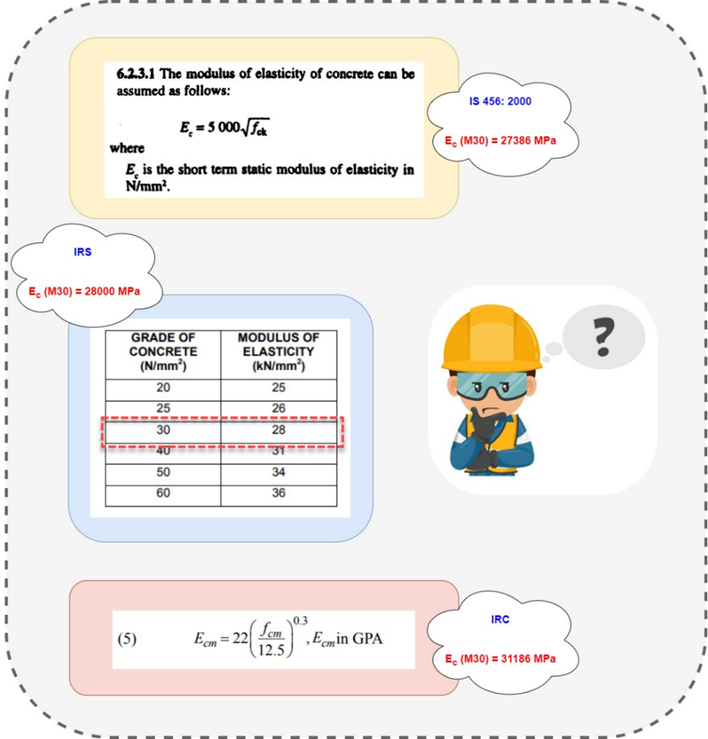
 

Figure 7


However, if we refer to different IS codes they provide different values for the modulus of elasticity, as an engineer common question that arises is since the material is the same, its material properties should be same.


  • Are Codes being revised from time to time, but the revision process might not always keep pace with rapidly evolving technologies, materials, and construction practices across the world? This can lead to codes becoming outdated and not reflecting the latest advancements.
  • In highly specialized or emerging areas of engineering, there may be a lack of specific IS Codes. Engineers might need to rely on international standards or best practices until relevant Indian standards are developed.
  • Some information or data in IS Codes can be complex and challenging to interpret for those who are not familiar with the specific field. The complexity can sometimes lead to misinterpretations or difficulties in application.
  • India has diverse geographical and climatic conditions. Standards developed for one region may not be directly applicable to another region with different environmental challenges. Local variations might not always be adequately addressed in the codes.


3. Conclusion

Civil engineers, architects, contractors, and other professionals in the construction and manufacturing industries refer to IS Codes during the planning, design, and execution phases of projects. Engineers need to refer to the specific standards and codes applicable to their projects and regions to ensure compliance for maintaining quality, safety, and uniformity in engineering practices across India.

These IS codes are developed for the general structure, for unique and iconic structures sometimes this code may be limited in such cases one has to rely on other resources. Each code has some limitations and it's important for engineers and professionals to be aware of these limitations and to exercise judgment, and experience, and sometimes use supplementary guidelines, research, or international standards where necessary. Staying informed about updates, participating in standard-setting processes, and incorporating best practices beyond codes are essential to overcoming these limitations and ensuring the highest standards of engineering practice.


Susbcribe
MIDAS Newsletter

Thank you, See you soon!
Share
About the Author
Sagar Gohil | Structural Technician | MIDAS IT India

Sagar has years of design experience in different types of structures including PSC Integral bridges, Box culverts, and Residential and commercial buildings. He pursued his master's degree from IIT Roorkee and is experienced in handling complex technical issues related to bridges.

Comments