Would you like to sign out?

Select Country

  • Afghanistan English
  • Albania English
  • Algeria English
  • American Samoa English
  • Andorra English
  • Angola English
  • Anguilla English
  • Antarctica English
  • Antigua and Barbuda English
  • Argentina Español
  • Armenia English
  • Aruba English
  • Australia English
  • Austria English
  • Azerbaijan English
  • Bahamas English
  • Bahrain English
  • Bangladesh English
  • Barbados English
  • Belarus English
  • Belgium English
  • Belize English
  • Benin English
  • Bermuda English
  • Bhutan English
  • Bolivia Español
  • Bosnia and Herzegovina English
  • Botswana English
  • Bouvet Island English
  • Brazil English
  • British Indian Ocean Territory English
  • British Virgin Islands English
  • Brunei English
  • Bulgaria English
  • Burkina Faso English
  • Burundi English
  • Cambodia English
  • Cameroon English
  • Canada English
  • Cape Verde English
  • Caribbean Netherlands English
  • Cayman Islands English
  • Central African Republic English
  • Chad English
  • Chile Español
  • Christmas Island English
  • Cocos (Keeling) Islands English
  • Colombia Español
  • Comoros English
  • Congo English
  • Cook Islands English
  • Costa Rica Español
  • Côte d’Ivoire English
  • Croatia English
  • Cuba Español
  • Curaçao English
  • Cyprus English
  • Czech Republic English
  • Democratic Republic of the Congo English
  • Denmark English
  • Djibouti English
  • Dominica English
  • Dominican Republic Español
  • Ecuador Español
  • Egypt English
  • El Salvador Español
  • Equatorial Guinea English
  • Eritrea English
  • Estonia English
  • Ethiopia English
  • Falkland Islands English
  • Faroe Islands English
  • Fiji English
  • Finland English
  • France English
  • French Guiana Español
  • French Polynesia English
  • French Southern Territories English
  • Gabon English
  • Gambia English
  • Georgia English
  • Germany English
  • Ghana English
  • Gibraltar English
  • Greece English
  • Greenland English
  • Grenada English
  • Guadeloupe Español
  • Guam English
  • Guatemala Español
  • Guernsey English
  • Guinea English
  • Guinea-Bissau English
  • Guyana English
  • Haiti Español
  • Heard Island and McDonald Islands English
  • Honduras Español
  • Hong Kong English
  • Hungary English
  • Iceland English
  • India English
  • Indonesia English
  • Iran English
  • Iraq English
  • Ireland English
  • Isle of Man English
  • Israel English
  • Italy English
  • Jamaica English
  • Japan 日本語
  • Jersey English
  • Jordan English
  • Kazakhstan English
  • Kenya English
  • Kiribati English
  • South Korea 한국어
  • Kuwait English
  • Kyrgyzstan English
  • Laos English
  • Latvia English
  • Lebanon English
  • Lesotho English
  • Liberia English
  • Libya English
  • Liechtenstein English
  • Lithuania English
  • Luxembourg English
  • Macau English
  • Madagascar English
  • Malawi English
  • Malaysia English
  • Maldives English
  • Mali English
  • Malta English
  • Marshall Islands English
  • Martinique English
  • Mauritania English
  • Mauritius English
  • Mayotte English
  • Mexico Español
  • Micronesia English
  • Moldova English
  • Monaco English
  • Mongolia English
  • Montenegro English
  • Montserrat English
  • Morocco English
  • Mozambique English
  • Myanmar English
  • Namibia English
  • Nauru English
  • Nepal English
  • Netherlands English
  • New Caledonia English
  • New Zealand English
  • Nicaragua Español
  • Niger English
  • Nigeria English
  • Niue English
  • Norfolk Island English
  • Northern Mariana Islands English
  • Norway English
  • Oman English
  • Pakistan English
  • Palau English
  • Palestine English
  • Panama Español
  • Papua New Guinea English
  • Paraguay Español
  • Peru Español
  • Philippines English
  • Pitcairn Islands English
  • Poland English
  • Portugal Español
  • Puerto Rico Español
  • Qatar English
  • Réunion English
  • Romania English
  • Russia English
  • Rwanda English
  • Saint Barthélemy Español
  • Saint Helena English
  • Saint Kitts and Nevis English
  • Saint Lucia English
  • Saint Martin Español
  • Saint Pierre and Miquelon English
  • Saint Vincent and the Grenadines English
  • Samoa English
  • San Marino English
  • São Tomé and Príncipe English
  • Saudi Arabia English
  • Senegal English
  • Serbia English
  • Seychelles English
  • Sierra Leone English
  • Singapore English
  • Sint Maarten English
  • Slovakia English
  • Slovenia English
  • Solomon Islands English
  • Somalia English
  • South Africa English
  • South Georgia English
  • South Sudan English
  • Spain English
  • Sri Lanka English
  • Sudan English
  • Suriname English
  • Svalbard and Jan Mayen English
  • Eswatini English
  • Sweden English
  • Switzerland English
  • Syria English
  • Taiwan English
  • Tajikistan English
  • Tanzania English
  • Thailand English
  • Togo English
  • Tokelau English
  • Tonga English
  • Trinidad and Tobago English
  • Tunisia English
  • Turkey English
  • Turkmenistan English
  • Turks and Caicos Islands English
  • Tuvalu English
  • U.S. Virgin Islands English
  • Uganda English
  • Ukraine English
  • United Arab Emirates English
  • United Kingdom English
  • United States English
  • U.S. Minor Outlying Islands English
  • Uruguay Español
  • Uzbekistan English
  • Vanuatu English
  • Vatican City English
  • Venezuela Español
  • Vietnam English
  • Wallis and Futuna English
  • Western Sahara English
  • Yemen English
  • Zambia English
  • Zimbabwe English
  • Åland Islands English
  • East Timor English
  • Netherlands Antilles English
  • Serbia and Montenegro English
  • North Macedonia English
  • Timor-Leste English

The Manyovu Bridge

December 30, 2021
BLOG NEWS & TRENDS

Table of Contents


1. Project Description

2. Determining Factors

3. Construction Process

4. Project Application in midas Civil


1. Project Description


Project Name: Manyovu Bridge

Type of Bridge: Continuous Slab Bridge

Location: Tanzania-Burundi Boarder

Company: Kaburu Okelo Consulting Engineers     Website: https://kaburuokelo.com/

Engineer: Alituha Brian

Types of analysis used: Moving load analysis, Static analysis

Programs used: midas Civil

Length: 30m

Keywords: Skewed, Curved, Slab Bridge, varying thickness.


The Manyovi bridge is an overpass that connects Burundi and Tanzania. There was a need to separate their routes at the border post since both countries, Burundi and Tanzania, drive on different hands. Tanzanians keep left while Burindians keep right. The Manyovu Bridge is therefore a one-way road that helps to overcome such a contrariety. 


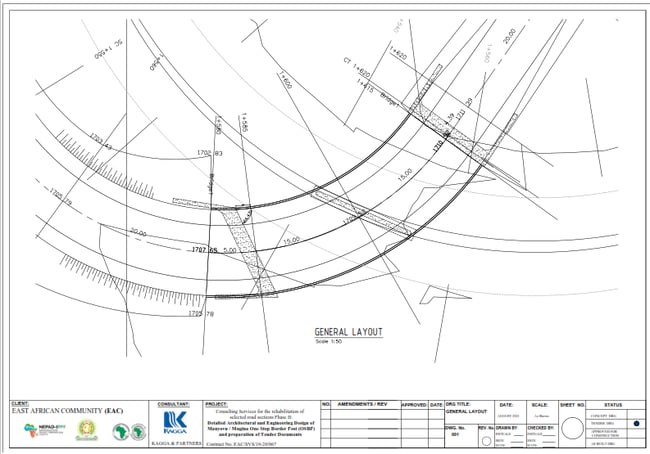
The bridge has two spans of 15 m each and a curvature radius of 600 m. The 600 mm thick center pier has a skew angle of 66.34° and a length of 6.7 m. The height of the pier is 6m. To house the 5 bearings above the pier, there is a 1 m wide and 1.2 m deep pier cap tapering, on both cantilevered ends, for 1.82m. Different skew angles of 7° and 55.14° were applied to each supporting abutment.


3
 Figure 1. General Layout


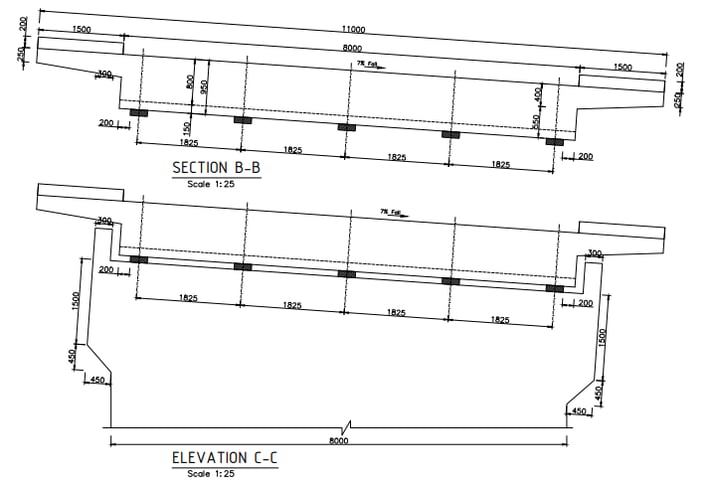
The Reinforced Concrete Slab Bridge has a varying thickness of 800.00 mm at the mid-span and 950.00 mm at the support with tapering of 1.50 m on each side of the center pier. The width is 11.00 m to accommodate two roadways (2x4.0m), two sidewalks (2x1.5m), and concrete barriers on an upstand (2x0.4m). It has a 9% vertical gradient and 8% superelevation. The superelevation helps to counteract the centrifugal force due to moving loads at the sharp curvature throughout the length of the bridge.
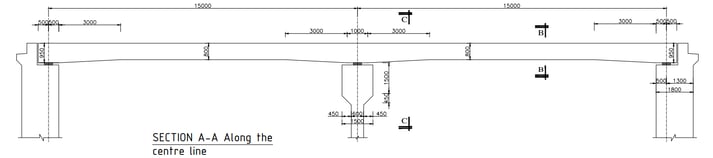


4Figure 2. Longitudinal section
 
 
5Figure 3. Cross-section


The design working life was chosen in accordance with the Eurocode EN 1990:2002 Cl 2.3(1).


2. Determining Factors


The bridge exhibits a huge curve and a generous skew angle which makes it impractical to use girders for the bridge deck. There are two types of slab bridges, viz. the Solid Slab Bridge and the Voided Slab bridge. Due to the high skew and curvature, the Solid Slab Bridge was meticulously chosen.


The alignment of the bridge was set considering the rugged terrain and sharp slopes all around the bridge. The collision loads and centrifugal forces had been among the major factors for bridge design.


Other advantages of using a slab bridge are:

  1. Conventional concrete and formwork are less costly.
  2. A smaller thickness of the deck reduces the height of fill and consequently the cost of the approaches.
  • Improved aesthetics due to a flat soffit.
  1. A simple arrangement of reinforcement to avoid rebar clashes as they are evenly distributed throughout the full width of the deck.
  2. Placing concrete is much easier. The chances of honeycombing in concrete are less likely.
  3. Quicker construction at times.


Disadvantages of using slab bridges:

  1. The greater cost of materials
  2. Larger dead loads
     

3. Construction Process


Due to the curvature and skew it was decided that conventional concrete will be cast-in-situ. The formwork setting has to be versatile and shall fit the shape of the tapering slab. Connectors and push-pull props are used to join the walers to give the required shape to the formwork. The slab concreting work procedure involves construction joints, concrete production, pouring of concrete, finishing the surface, and curing of concrete.


With all the formwork settings, the contractor must take care of the bracing and safety items.


4. Project Application in midas Civil


Due to the different skew angles on either side of the bridge and the high curvature, modeling of the bridge was quite demanding. CAD importing and modeling features were used to achieve the final outcome.
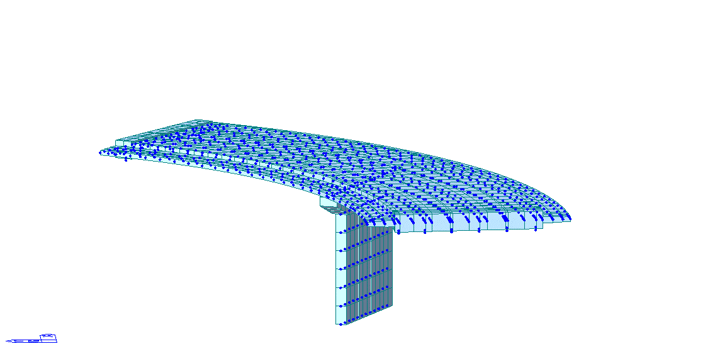
 

6Figure 4. Nodes/elements used for bridge modeling
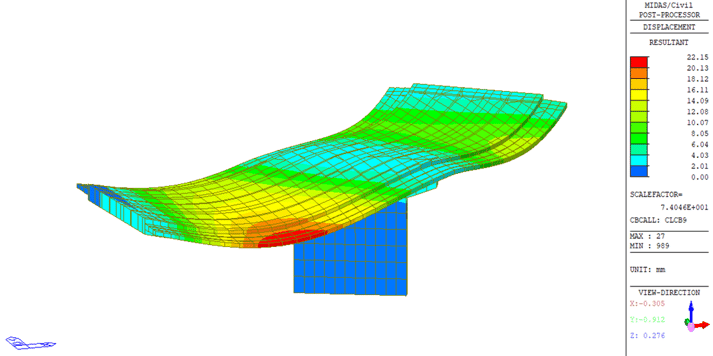
 
 
7Figure 5. Bridge deformation under critical load combination


The structural analysis has been carried out based on the global analysis model established by using the structural analysis software of midas Civil.


Different load combinations were carried out using the above-mentioned bridge loads and reactions of these actions were directly produced by the software.
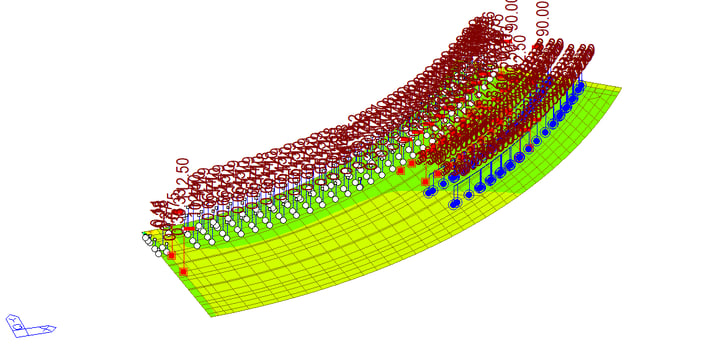
 
8Figure 6. Moving load tracer


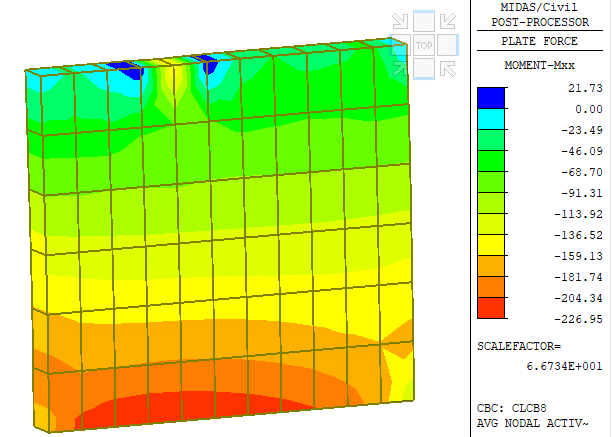
9Figure 7. Plate forces for skewed pier


The plate forces for the skewed pier, as shown in Figure. 7, clarify the high moments about the vertical axis of the pier, which are majorly at the inner curvature. The critical load combination included the effect of self-weight, crash barrier, walkway, wearing surface as gravity loads and Wind load, Deck collision load as well as Collision Force on the Pier as lateral loads out of which the deck collision load caused significant negative moments at the pier bottom.


 

Susbcribe
MIDAS Newsletter

Thank you, See you soon!
Share
About the Author
Nivedita Kumar | Senior Engineer | Midas India Pvt. Ltd.

Nivedita is a Senior Technical Support Engineer at MIDAS India Pvt. Ltd. experienced in numerical modeling, building, and bridge design and has over 6+ years of experience. Nivedita pursued her Civil Engineering Degree from the Savitribai Phule University, formerly known as Pune University, and has worked as a building design consultant for two years.


Comments
DOWNLOAD Ebook Download

Please fill out the below form to
download the Ebook

All